


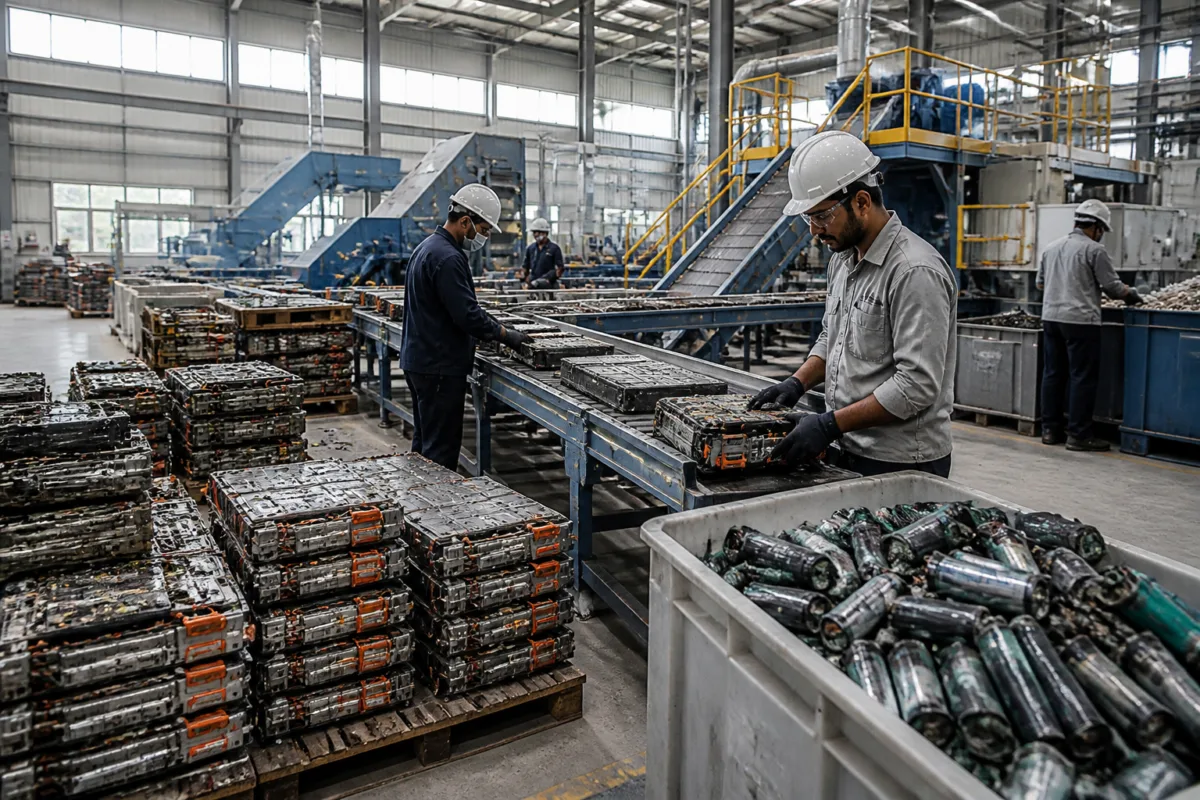
Battery recycling company LICO Materials is targeting revenue of ₹450-500 crore in the financial year 2026-27 as higher processing volumes, improved capacity utilisation and rising availability of end-of-life lithium-ion batteries support its growth, chief executive and founder Gaurav Dolwani said.
The company reported revenue of approximately ₹350 crore in 2025-26, Dolwani told PTI in an interview, as reported by Business Standard. He said LICO’s material-processing capacity had expanded significantly since the company last discussed its operations around March 2025.
LICO currently has battery-processing capacity of around 4 GWh and plans to increase it to approximately 10 GWh over the next three years. The company expects the expansion of domestic cell manufacturing during the same period to strengthen the wider battery ecosystem and increase the availability of material for recycling and reuse.
The company’s growth plans come as electric two-wheelers and three-wheelers increase the volume of lithium-ion batteries entering the market. Dolwani said LICO had also been able to import batteries from other parts of the world, despite the challenges involved, allowing it to access material more successfully than some of its peers.
The Bengaluru-based company operates in battery recycling and repurposing. It processes end-of-life lithium-ion batteries, recovers materials used in battery manufacturing and gives usable cells a second life through LiGRID, its battery energy storage system. Founded in 2021, LICO works to recover, reprocess and reintegrate battery materials into the battery value chain.
Dolwani said LICO is working with job-work partners in Uttar Pradesh and Haryana and wants to strengthen its presence in the region. The company is also evaluating opportunities in western India, including Gujarat. Over time, it may establish its own facility or acquire an existing business with relevant capabilities, he said.
The company’s expansion plans are also linked to the pace of domestic battery-cell manufacturing. Dolwani said cell manufacturing had taken longer than initially anticipated and involved significant technological challenges. Some companies have established pilot lines, invested in research and development and learned from earlier difficulties, he said.
“Developing cells is extremely difficult, and we should recognise the complexity of the task and give the industry time to develop. The policy intent is right, but execution remains the key challenge,” Dolwani said.
The proposed increase from 4 GWh to 10 GWh would expand LICO’s ability to process used batteries and recover materials, although the company’s stated revenue target will depend on processing volumes, capacity utilisation and the availability of batteries. LICO’s next steps include strengthening its partner network in northern India, assessing a presence in Gujarat and deciding whether future expansion will come through a new facility or an acquisition.

