


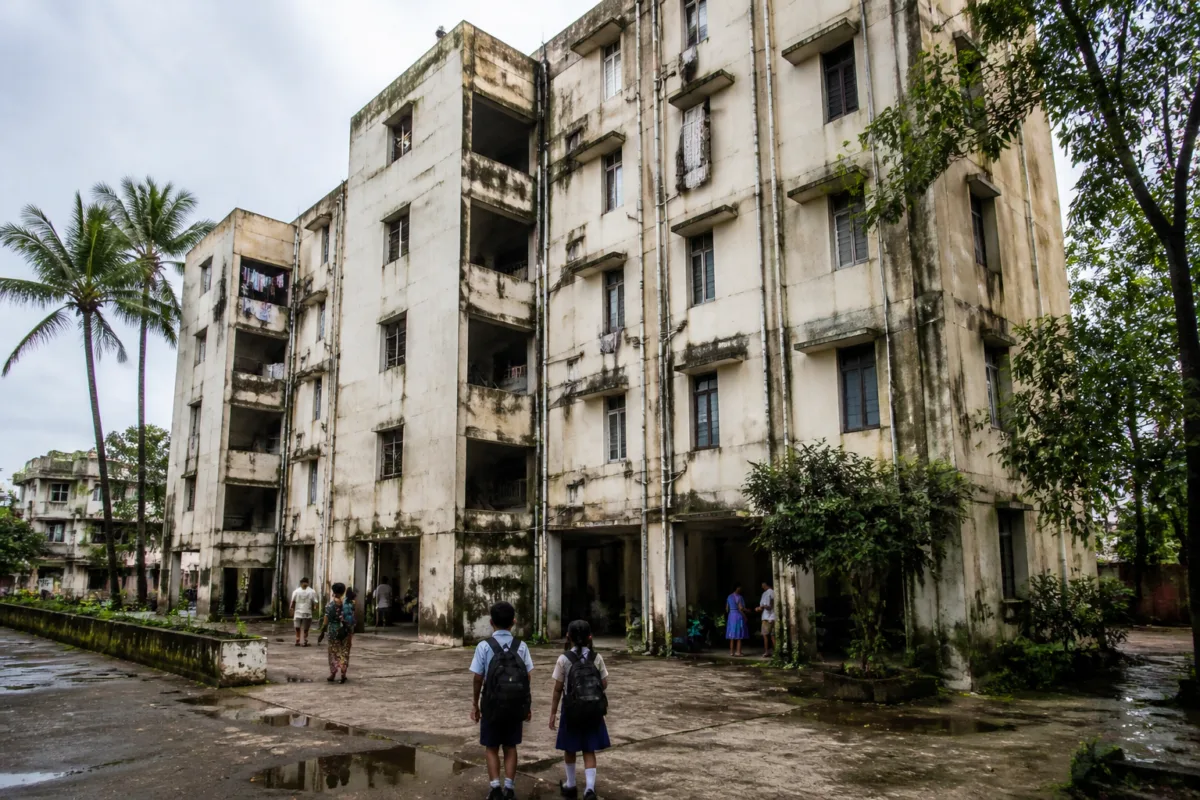
Nearly 65 children living in Kochi’s P&T Apartment complex are still waiting for education support approved by the city corporation, exposing how unresolved defects in a rehabilitation project have extended into schooling, household finances and the basic functioning of a resettled community. The immediate dispute concerns an online tuition centre and assistance for higher education, but the larger issue is whether a housing project can be considered complete when the families moved into it continue to face unsafe or inadequate living conditions and essential support remains undecided.
The apartments at Mundamveli were built to rehabilitate 77 families from the flood-prone P&T Colony. The Rs 14.62 crore project was implemented by the Greater Cochin Development Authority, or GCDA, and families were rehoused in January 2024. According to the report, problems began soon after occupation. Ceilings started leaking, walls became damp, plaster fell off and wastewater entered living rooms and kitchens. The project has also faced allegations of corruption, compromised structural safety and procedural lapses.
The education issue is therefore not separate from the housing problem. Residents sought uninterrupted schooling and support for higher education for children from economically and socially disadvantaged families. Their petition, submitted with supporting documents, has remained pending for nearly 10 months. The previous corporation council cleared the project, and the newly elected council approved it again at its third meeting after the local body elections. Despite those decisions, the initiative has not moved from approval to operation.
That gap between an approved intervention and a functioning service is central to the case. Public institutions can formally recognise a need, allocate or approve a project and still fail to deliver it if the administrative steps that follow are not completed. Here, residents say an online tuition centre could earlier have been established for about Rs 3.5 lakh, with an institution prepared to provide free online classes. The residents’ association has claimed that delays increased the estimated cost to Rs 30 lakh. The report does not provide an independent cost assessment, but the contrast illustrates how delay has become part of the project’s financial problem.
Kochi Mayor V K Minimol gave a different account of the delay. She said the corporation had invited tenders twice to establish the facility but received no response. The corporation is now in talks with several agencies, she said, and a final decision would be taken when the families are rehabilitated to another location. The mayor added that installing equipment at the current apartments could require it to be shifted later, and that the district collector had been briefed.
The mayor’s explanation places the education facility within a larger unresolved decision about the apartments themselves. If the families are expected to move again, the corporation is reluctant to install equipment at the existing site. If relocation is not immediate, however, children continue to wait for the support that the local body has already approved. The result is a circular administrative problem: uncertainty over housing delays education assistance, while the absence of assistance continues to affect residents in the existing housing complex.
The sequence also shows why rehabilitation cannot be measured only by the number of families moved from a vulnerable location into a new building. The P&T project was intended to address the risks faced by families in a flood-prone colony. But the reported leakage, dampness, falling plaster and wastewater intrusion indicate that the quality and usability of the replacement housing have become significant questions. The report does not establish the technical causes of these defects or record a final finding by an investigating authority. It does establish that the problems appeared soon after occupation and that the project has faced allegations involving construction quality and procedure.
For residents, these defects are not limited to maintenance inconvenience. Water entering kitchens and living rooms affects the daily use of the home. Damp walls and falling plaster raise concerns about habitability and safety, even though the supplied report does not provide a structural assessment. In such circumstances, the apartment complex becomes more than a completed construction project. It becomes an unsettled site in which families cannot be certain whether they are living in a permanent home, awaiting repairs or preparing for another relocation.
That uncertainty has direct consequences for public-service planning. A tuition centre requires space, equipment, an operating institution and a decision on who will manage it. It also requires confidence that the building will remain available for long enough to justify the expenditure. The corporation’s tender attempts suggest that the implementation model has not yet secured a provider. The absence of bidders, as described by the mayor, may indicate that the project’s terms, location or expected operating arrangements have not attracted agencies, although the report does not identify the tender conditions or explain why the bids failed to materialise.
The governance chain is similarly divided. GCDA implemented the apartment project. The Kochi corporation approved the education initiative and invited tenders. Residents submitted the petition and supporting documents. The district collector issued a directive and has been briefed on the corporation’s position. The mayor has said that the final decision will be linked to the families’ rehabilitation. Each institution therefore appears in a different part of the story, but the report does not identify a single agency responsible for resolving the combined housing, repair, relocation and education questions.
This division matters because the families’ needs do not follow departmental boundaries. A construction defect may require a technical or project-level response. A relocation decision may involve the authority that implemented or controls the housing project. Education assistance sits with the local body and its proposed institutional partner. Residents, however, experience these as one continuous problem: the place intended to provide secure rehabilitation has not delivered stable living conditions, and the education support linked to that situation remains unimplemented.
The numbers in the report underline the scale without suggesting that the problem is large only because of the number of children. Seventy-seven families were rehabilitated through a Rs 14.62 crore project. Nearly 65 children are awaiting education support. The proposed tuition centre was initially estimated by the residents’ association at Rs 3.5 lakh and is now claimed to require Rs 30 lakh. These figures describe three different layers of the same failure: the size of the housing intervention, the number of children affected and the reported escalation in the cost of a relatively small support facility.
The timing is also significant. Families entered the apartments in January 2024, and the reported defects appeared soon after. The education petition has remained unresolved for nearly 10 months despite approval by successive councils. The report does not state when the tenders were issued, whether any repair work has been completed, whether a formal relocation plan has been approved or whether the Rs 30 lakh estimate has been independently accepted by the corporation. Those missing details are important because they would show whether the current impasse is temporary, contractual or part of a wider failure of project oversight.
The case raises a basic question for urban rehabilitation: what obligations continue after residents receive possession of a replacement home? The answer cannot be determined from this report alone, but the facts point to obligations that extend beyond construction. A rehabilitation project must remain usable, defects must be addressed through an identifiable process and associated support promised by the local government must reach residents within a meaningful period. Otherwise, the project can meet a physical relocation target while failing its social purpose.
The P&T apartments also demonstrate how decisions made during project planning can shape later costs. Residents say the tuition centre could have been created at a much lower cost when a free online education partner was available. The mayor says that a facility established now may have to be shifted if rehabilitation occurs elsewhere. Neither account resolves the dispute, but together they show that delays have consequences beyond waiting time. They can increase estimated expenditure, reduce the usefulness of equipment and make agencies less willing to participate.
What remains unresolved is therefore not only whether the education centre will be built. The corporation must determine whether families will remain at the current apartments, whether the reported defects will be repaired, whether another relocation is planned and which institution will provide education assistance in the interim. The district collector has been informed, according to the mayor, but the supplied report does not record a fresh directive, a deadline or a publicly announced implementation schedule.
The evidence confirms that the P&T rehabilitation project has produced a chain of unfinished obligations: housing defects reported after occupation, allegations concerning project execution, an approved education intervention that has not started and uncertainty over possible relocation. It does not establish the technical responsibility for the defects or independently verify the competing cost estimates. The next meaningful developments will be the corporation’s final decision on the education facility, any formal repair or rehabilitation plan and evidence that the 65 children receive support without waiting for the housing dispute to be settled.

