


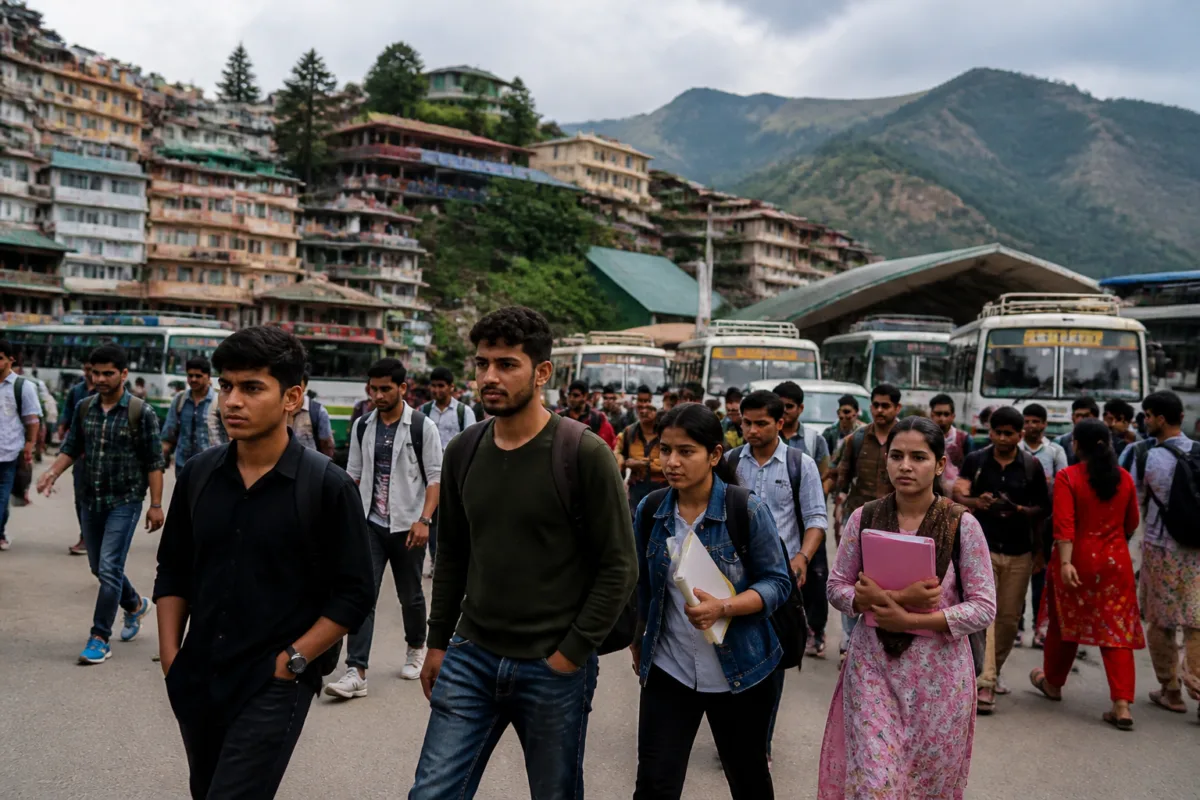
Himachal youth unemployment has risen to 26.4%, the second-highest rate in the country among people aged 15 to 29, according to the Periodic Labour Force Survey for July to September 2026. The figure is more than a labour-market statistic: it shows how limited economic diversification, uneven urban opportunity and gender barriers are shaping the prospects of young people in the hill state.
The latest quarterly data places Himachal Pradesh behind Kerala, where youth unemployment stood at 28.9%. Himachal’s rate increased by 2.3 percentage points from 24.1% in April to June 2026. The increase came even as the all-India youth unemployment rate declined from 15.9% to 15.3% over the same period.
The neighbouring states present a mixed regional picture. Punjab’s youth unemployment rate fell from 22.3% to 20.5%, while Haryana recorded a marginal increase from 11.8% to 12.3%. These variations matter because the three states share overlapping labour markets, education patterns and migration links, but offer very different mixes of urban employment, industry, agriculture, government work and services.
The Himachal figure is particularly significant because the state’s problem is not simply a shortage of work across all locations. The survey shows that urban youth unemployment was 30.7%, above the state’s overall rate and considerably higher than the rural rate of 25.8%. This reverses the pattern seen in Punjab and Haryana, where rural youth unemployment was higher than urban unemployment.
## Himachal youth unemployment is unusually severe in cities
In Punjab, rural youth unemployment stood at 23.9%, compared with 16.7% in urban areas. Haryana recorded a rural rate of 14.7% and an urban rate of 9.7%. Himachal Pradesh, by contrast, recorded its higher rate in urban areas. The data indicates that towns and cities in the hill state are not absorbing young job-seekers at the same rate as urban centres in the neighbouring states.
The survey figures do not identify the precise causes of the urban-rural difference, but they provide an important clue about the nature of the state’s employment challenge. Urban areas may offer greater access to education, government offices and formal services, yet that does not automatically translate into enough jobs for a growing or better-qualified young population. Where the number of available positions is limited, urban concentration can make competition more visible rather than reducing unemployment.
Professor Aswini Kumar Nanda, a demographer quoted in the report, said Himachal’s employment challenge needed to be understood in the context of the state’s limited opportunities outside the formal sector. He said the state did not have a sufficiently developed informal sector to absorb people who could not find work in organised or government employment.
That observation points to an institutional gap. A labour market with a large informal sector may offer low-paid or insecure work, but it can still absorb some workers who are waiting for formal employment. Himachal’s reported weakness in both formal opportunities and alternative employment channels leaves young people with fewer options between education and stable work.
Tourism adds another layer of vulnerability. According to Nanda, a significant share of informal employment in the state is linked to tourism. Those livelihoods can be affected by tourist arrivals, adverse weather, developments in neighbouring states, transport disruptions and regulatory restrictions. The result is an employment structure exposed to factors that workers and local businesses may not control.
## The gender gap is wider than the headline rate
The overall youth unemployment rate conceals an even deeper divide between young men and women. In Himachal Pradesh, youth unemployment among women was 33.8%, compared with 22.7% among men. The gap of 11.1 percentage points was the second widest among the three states in the survey, after Haryana’s 11.4 percentage-point gap.
The gender difference also persists across settlement types. In rural Himachal Pradesh, female youth unemployment was 33.3%, compared with 24.7% among males. In urban areas, female youth unemployment climbed to 38.7%, compared with 26.4% among males. These figures show that urban residence does not, by itself, remove the barriers faced by young women seeking work.
Labour force participation provides a second measure of this exclusion. In Himachal Pradesh, 32.3% of young women were working or seeking work, compared with 59.1% of young men. The gap was smaller than in Punjab and Haryana, but it still meant that a majority of young women were outside the labour force as defined by the survey.
The Worker Population Ratio presents a similar pattern. The proportion of young women who were employed stood at 21.4%, against 45.7% among young men. At the national level, the corresponding figures were 17.6% and 52.2%. Himachal therefore had a higher female youth participation and employment ratio than the national average, but its gender divide remained substantial.
These measures need to be read together. A high unemployment rate among women describes those who are participating in the labour force but cannot find work. A low participation rate also indicates that many others are not working or seeking work. Taken together, the Himachal figures suggest that the problem is both access to employment and the conditions under which young women enter or remain in the labour market.
## Punjab and Haryana show different regional pressures
Punjab’s youth unemployment rate fell to 20.5%, but the state continued to record a marked gender gap. Female youth unemployment was 27.9%, compared with 18.3% among males. Women’s labour force participation was only 23.6%, against 68.9% for men, while the female Worker Population Ratio was 17%, compared with 56.3% among men.
Punjab’s rural pattern is also important. Female youth unemployment reached 32.6% in rural areas, compared with 23.5% in urban areas. Among males, the corresponding rates were 21.6% and 14.4%. The state’s lower overall rate in the latest quarter therefore does not mean that the employment challenge has been evenly resolved. The improvement coexists with severe exclusion among rural and female youth.
Haryana recorded the lowest youth unemployment rate among the three states at 12.3%, although it increased from 11.8%. Its gender gap was the widest in the regional comparison: 22% for young women against 10.6% for young men. Female labour force participation was 11.8%, compared with 57% among males, and the female Worker Population Ratio was just 9.2%, against 51% for men.
The Haryana data demonstrates why the headline unemployment rate alone is insufficient for judging labour-market health. A relatively low overall rate can exist alongside very low participation and employment among young women. In Punjab and Haryana, the rural-urban pattern differs from Himachal’s, but the gender pattern is consistent: young women face a much weaker connection to paid work.
## The wider labour-market picture is less dramatic but still uneven
For people aged 15 years and above, the unemployment rates were lower than the youth rates in all three states. Punjab recorded 7.8%, Himachal Pradesh 5.9% and Haryana 5.2%, compared with the all-India rate of 5.1%.
The difference between the youth and all-age figures is central to understanding the data. Young people are entering the labour market, moving from education into work or seeking their first stable job. Their unemployment rate can therefore expose weaknesses in the transition between schooling, training and employment that are less visible in the overall working-age population.
In Himachal Pradesh, the gap is especially pronounced: youth unemployment at 26.4% is more than four times the all-age rate of 5.9%. The comparison does not establish that younger workers are competing directly with older workers, but it does show that the employment experience of the state’s youth is substantially worse than the average for people aged 15 and above.
The national figures also show that Himachal’s challenge is not part of a uniform countrywide increase. India’s youth unemployment rate declined during the quarter, while Himachal’s rose. Punjab’s rate also declined, whereas Haryana’s increase was modest. The state-level divergence suggests that local economic structures and employment channels influence outcomes alongside broader national trends.
## Tourism cannot carry the entire employment burden
The explanation offered in the report places tourism at the centre of Himachal’s informal employment system. Tourism can create work in accommodation, transport, food services and related activities, but the sector is sensitive to disruptions. Weather, transport access, developments in neighbouring states and regulatory decisions can all affect visitor flows and, in turn, livelihoods.
This dependence creates a structural problem for young workers. If employment opportunities are concentrated in a sector with fluctuating demand, workers may experience periods of work without a reliable path to stable incomes. The supplied evidence does not quantify the share of tourism-linked employment or compare it with other sectors, but it establishes the vulnerability identified by the quoted demographer.
The urban unemployment figure makes the issue more complicated. If urban youth unemployment is higher than rural unemployment, the state’s towns are not simply benefiting from tourism-related services or public-sector concentration. They are also places where young people gather in search of education, government work and formal employment. The resulting mismatch can turn urban centres into waiting rooms for jobs that are too few or too narrowly distributed.
The data therefore raises a question about the relationship between urbanisation and opportunity in hill states. Building towns and improving connectivity may expand access to services, but the employment effect depends on whether local economies generate a sufficiently broad range of work. The PLFS figures show that this connection cannot be assumed.
Himachal Pradesh’s latest youth unemployment numbers confirm a deep and uneven labour-market problem. The pressure is highest among young people, sharper for women and particularly severe in urban areas. Punjab’s improvement and Haryana’s lower overall rate do not erase comparable gender barriers in those states. The next figures to monitor are whether Himachal’s urban rate falls, whether female participation converts into employment, and whether the state develops employment channels less exposed to tourism volatility.

