


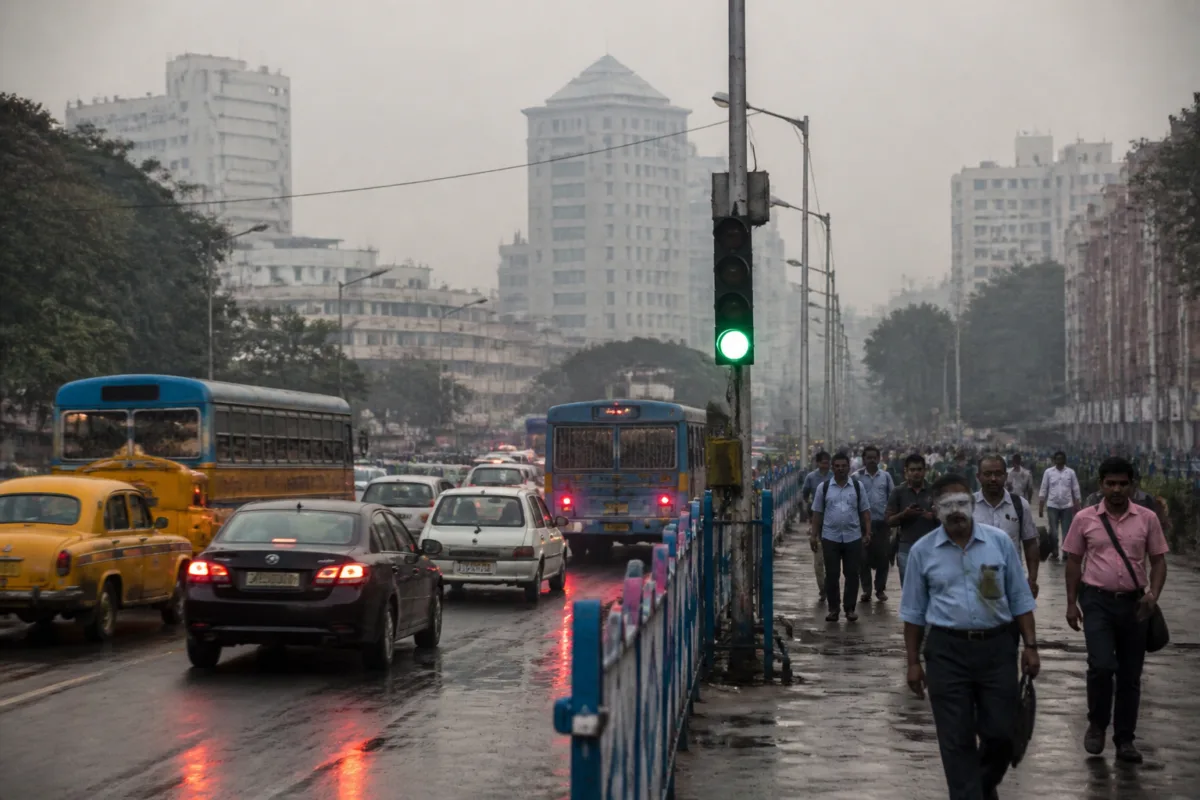
Kolkata’s air quality has moved back into the moderate category after a short improvement brought by rain, exposing the limits of weather-led relief in a city entering its more pollution-prone autumn and winter period. The citywide Air Quality Index, calculated from readings at all seven monitoring stations, stood at 130 at 3 pm on Saturday, compared with 83 on Friday, 60 on Thursday and 88 on Wednesday.
The shift matters because the improvement was not linked to a lasting reduction in emissions. A sharp spell of rain on Tuesday evening washed accumulated pollutants from the air, producing an immediate improvement in readings. In the days that followed, pollutants built up again. Environment scientists cited in the report said sporadic rain may improve the pollution meter for a day or two, but such relief is unlikely to endure without changes in emissions or atmospheric conditions.
The pattern illustrates an important feature of urban air-quality management: the AQI is not only a measure of what cities emit, but also of how weather determines whether those emissions disperse or remain concentrated. Rain can remove pollutants temporarily, while lower temperatures and weaker winds can allow them to stay suspended for longer. That makes the same volume of emissions more consequential during autumn and winter than during periods when stronger winds or frequent rain help clear the air.
## The limits of rain-led improvement
According to the Central Pollution Control Board, an AQI between 50 and 100 is classified as satisfactory. The category is associated with minor breathing discomfort for sensitive people. An AQI between 101 and 200 is moderate and can cause breathing discomfort for people with lung disease, asthma and heart disease. Kolkata’s reading of 130 therefore represented a deterioration from the satisfactory readings recorded between Wednesday and Friday.
The citywide number also concealed no clear local pocket of substantially better air on Saturday. All seven Kolkata monitoring stations reported moderate air quality for most of the day, according to the report. That consistency suggests that the deterioration was not confined to one neighbourhood or a single localised source, although the supplied information does not identify the individual pollutants or station-level readings responsible for the change.
An environment scientist explained that rain helps wash pollutants from the air and is one reason air quality generally remains better during the monsoon, when frequent rainfall repeatedly clears accumulated pollution. Once that cleansing mechanism becomes less frequent, the underlying emission burden can reappear in the readings.
Anumita Roy Chowdhury, executive director of the Centre for Science and Environment, added that short-term deterioration or improvement can result from a sudden peak or fall in the dominant pollutant over the previous 24 hours. Emission levels and changing atmospheric conditions can both influence that movement. The observation is significant for interpreting daily AQI changes: a better reading after rain does not necessarily demonstrate that the city has solved the sources of pollution, just as a one-day decline does not by itself establish a long-term trend.
## Why winter makes the problem harder
The seasonal mechanism described in the report is straightforward. As temperatures fall, pollutants can remain in the air for longer. Wind speeds also decline, reducing the rate at which pollutants disperse. Together, these conditions create a less forgiving atmosphere in which emissions from across the urban area can accumulate.
This makes Kolkata’s pollution challenge partly a question of atmospheric capacity. The city may record an improved AQI when rain removes pollutants, but that improvement can reverse when the atmosphere becomes cooler, drier and less ventilated. The result is a recurring cycle in which weather temporarily suppresses the visible problem while seasonal conditions restore it.
The readings from the week provide a compact illustration of that cycle. Kolkata moved from 88 on Wednesday to 60 on Thursday and 83 on Friday, all within the satisfactory range, before reaching 130 on Saturday. The change occurred within days of the reported rain spell and without evidence in the supplied material of a comparable change in the city’s emissions. The available facts therefore point to a weather-sensitive system rather than a confirmed structural improvement in air quality.
That distinction is important for governance. A citywide AQI number is useful as a public signal, but it does not explain which sources are responsible for the pollution or which interventions would have the greatest effect. The report does not provide a source-apportionment analysis, pollutant-specific data, traffic figures or details of enforcement action. Those gaps mean the immediate evidence can establish the role of rain and seasonal conditions, but not assign responsibility for the full pollution burden.
## The festival-emissions question
The next risk identified by environment scientists is the possibility of another pollution spike during Chhath celebrations if firecrackers are burst. The warning follows a difficult Diwali and Kali Puja period. The state pollution control board received its maximum number of complaints during Kali Puja and Diwali this year, according to the report.
On Diwali night, air quality declined sharply after hours of cracker bursting released large volumes of pollutants. Those pollutants then remained suspended because of lower temperatures. This provides a direct example of how a short-duration emission event can have effects beyond the period in which it occurs. Firecrackers add pollutants quickly, while the atmospheric conditions that follow can slow their removal.
The festival context also shows why urban air quality cannot be treated only as a routine monitoring exercise. Public celebrations, enforcement capacity, weather and the timing of emissions interact. The state pollution control board’s complaint data indicates public concern, while the reported Diwali experience shows that the timing of emissions can coincide with conditions that prolong exposure. The supplied material does not state what restrictions, enforcement measures or public advisories are planned for Chhath, so the administrative response remains unclear.
The central policy difficulty is therefore not simply to improve the AQI after a bad reading. It is to prevent temporary weather relief from being mistaken for durable progress and to reduce high-emission episodes before winter conditions trap their effects. The state pollution control board has a role in monitoring and receiving complaints, while weather-sensitive public communication is also relevant because residents face different risks when the AQI moves from satisfactory to moderate.
## What the numbers establish—and what they do not
The available figures establish a clear short-term deterioration: the citywide AQI rose from 60 on Thursday to 130 on Saturday, crossing from satisfactory into moderate. They also show that all seven monitoring stations were reporting moderate air quality for most of Saturday. This gives the change broad geographic relevance within the monitored city.
However, the figures do not establish a complete annual trend or identify the precise contribution of traffic, construction, dust, industry, household activity, firecrackers or other sources. Nor do they show whether the Saturday reading represented a peak, a temporary fluctuation or the beginning of a longer deterioration. The report quotes scientists who expect conditions to worsen as winter approaches, but the supplied material does not provide a forecast model or a longer time series to quantify that risk.
That limitation is not a reason to disregard the warning. It clarifies what daily AQI monitoring can and cannot do. The index can show that people are experiencing a deterioration in ambient air conditions and can indicate when sensitive groups face greater breathing discomfort. It cannot, on its own, explain the complete emissions inventory or substitute for source-level analysis.
For Kolkata, the larger urban question is whether the city’s air-quality response can move beyond reacting to daily readings. Rainfall may offer brief relief, but the return of moderate air after a few dry days shows that the underlying system remains vulnerable. Lower temperatures, weaker winds and festival-related emissions can combine to turn that vulnerability into repeated public-health stress.
The evidence currently confirms three points: rain produced a short-lived improvement, pollutants accumulated again as conditions changed, and Saturday’s AQI placed the city in the moderate category across its monitoring network. What remains to be established is the contribution of specific emission sources and the measures authorities will use ahead of Chhath and the deeper winter period. Those are the developments that will determine whether Kolkata’s next improvement is weather-driven or reflects a more durable reduction in pollution.

