


Ghaziabad’s air quality remained among the five worst recorded in India for three consecutive days, with the district’s AQI reaching 338 on November 12, 368 on November 13 and 352 on November 14, even as restrictions under Stage III of the Graded Response Action Plan remained in force.
The readings placed Ghaziabad fifth, third and fourth among India’s most polluted districts on the three days respectively, according to the air-quality data cited in the report. The continuing deterioration has raised concerns among residents about the implementation of pollution-control measures across the district.
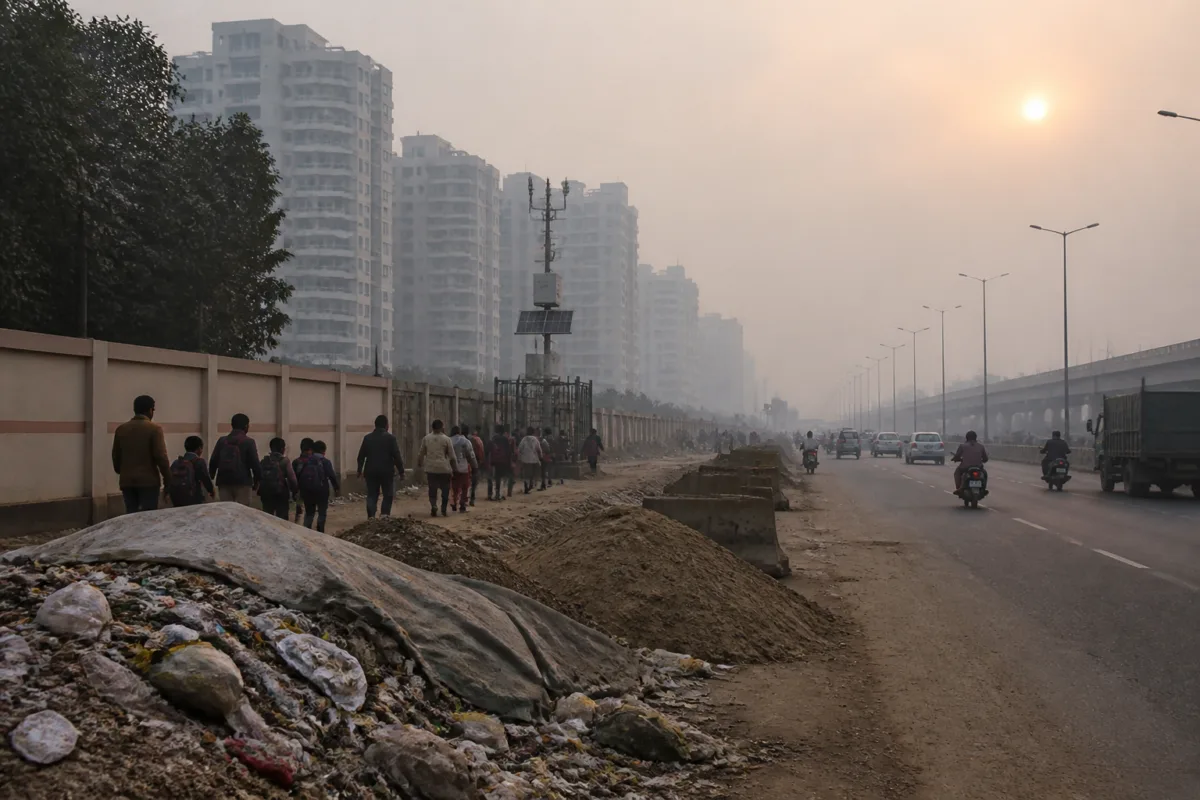
Residents in several parts of Ghaziabad have pointed to visible sources of dust and waste. Devendra Tomar, a resident of Vasundhara, alleged that garbage piles remained in Vasundhara’s Sectors 14 and 15 and in parts of Indirapuram. He also said soil excavated during pipeline work was being left along roadsides, creating additional dust.
Another resident, Sandeep Gupta, tagged the district magistrate and Ghaziabad Municipal Corporation on X while raising concerns about pollution in the Trans-Hindon area. Abhinav Sain, a local resident, alleged that air-quality monitoring systems stopped functioning when pollution levels became very high.
Other residents claimed that a monitoring system in Indirapuram developed a technical fault two days earlier, when pollution levels in the area were already high. The report said these allegations could not be independently verified.
The Uttar Pradesh Pollution Control Board said it had received complaints about violations of restrictions imposed under Stage III of GRAP. Regional Officer Ankit Singh said the department had taken action on some complaints and that a board-created team was monitoring areas to prevent further violations.
AQI monitoring systems recorded particularly high pollution levels in Govindpuram, Loni, New Tehsil Loni, Sanjay Nagar, Vasundhara and Wave City. The spread of high readings across residential and urbanising areas places attention not only on regional air conditions but also on local sources such as road dust, waste accumulation and construction-related excavation identified by residents.
District Magistrate Ravindra Kumar Mandar directed the education department to take precautionary measures in view of the worsening air quality. Basic Education Officer O P Yadav said instructions had already been issued for hybrid classes for children from nursery to Class 5 after Stage III of GRAP came into effect.
The restrictions will continue to be monitored by the Uttar Pradesh Pollution Control Board’s area teams, while schools and the district administration are expected to follow the precautionary directions already issued.

