


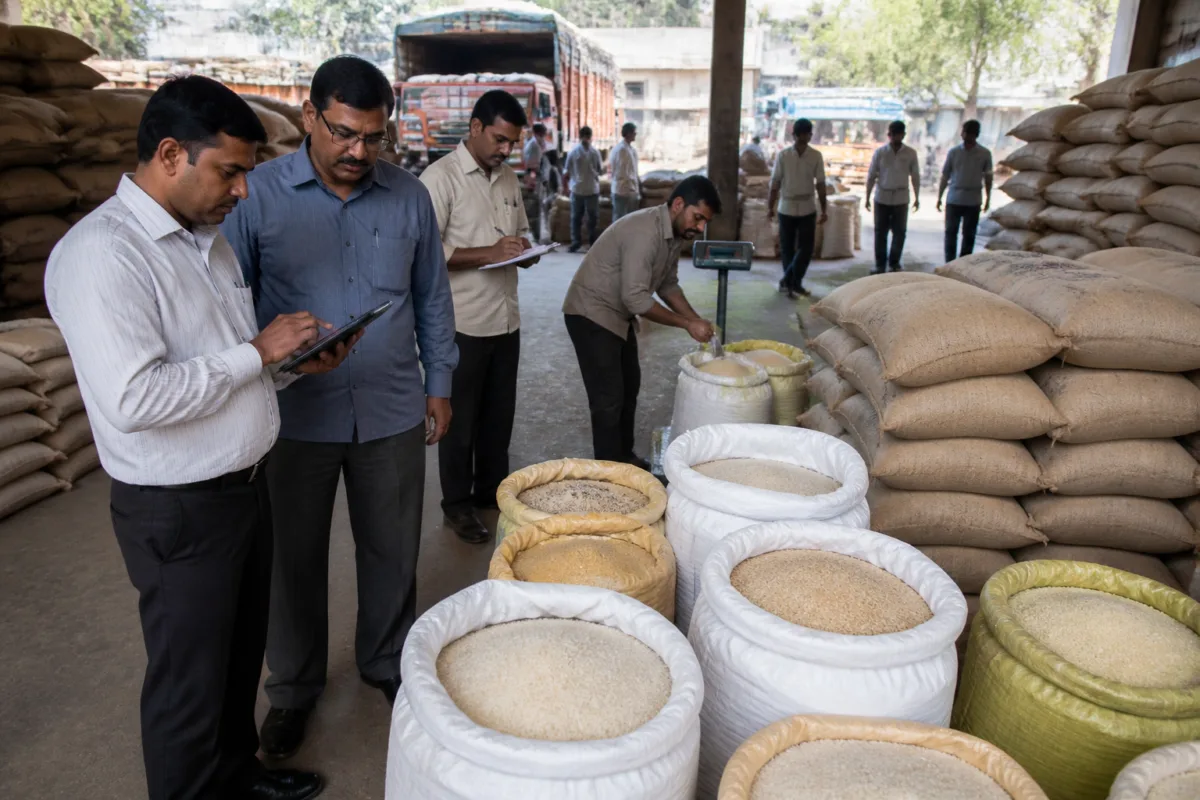
The Centre has operationalised a nationwide rice stock portal requiring traders, retailers, wholesalers, processors and millers to declare their holdings, as the government moves to improve market visibility and contain rising rice prices.
The Food Stock Portal, available at foodstock.dfpd.gov.in, requires every unit holding rice or paddy stocks to update its details every Friday. The requirement applies across all states and Union Territories and covers six categories: Basmati rice, non-Basmati premium rice, non-Basmati rice, parboiled rice, broken rice and paddy.
The system was introduced under an order issued on November 6. Units that do not register on the portal or breach prescribed stock limits may face action under Sections 6 and 7 of the Essential Commodities Act, 1955. The move gives the Centre a recurring reporting mechanism to track inventories across different points in the rice supply chain.
The declaration requirement comes as retail rice inflation accelerated to 8.25 per cent year-on-year in September, up from 5.89 per cent in August. The average retail price was around Rs 48.23 per kg, approximately 12 per cent higher than a year earlier, according to data cited in the PTI report.
Trade and industry experts attributed the price pressure partly to deficient and uneven rainfall, which has affected supplies of some rice varieties and pushed up paddy prices in several markets. The impact has been more pronounced in particular regions and grades, especially premium non-Basmati rice, rather than representing a nationwide supply crisis.
The Centre is also planning additional market interventions. It is allocating more rice stocks to the National Agricultural Cooperative Marketing Federation of India, the National Cooperative Consumers’ Federation of India and Kendriya Bhandar for sale under the Bharat Rice programme. These agencies have been asked to examine distribution channels, with particular attention to southern states.
The government has separately doubled its target for rice sales through e-auctions under the Open Market Sale Scheme (Domestic) for 2026-27, raising it from 25 lakh tonne to 50 lakh tonne. About 25 lakh tonne had been sold to private parties by October 31, compared with 11 lakh tonne during the corresponding period of the previous year.
The supply-management measures coincide with a fall in Kharif paddy acreage. The area under the crop declined by about 4 per cent to 42.68 million hectares in 2026-27, with deficient rainfall cited as a factor. Trade estimates place rice output at around 147 million tonne, lower than the record 154 million tonne produced in 2025-26.
The stock portal, additional Bharat Rice allocations and expanded e-auctions form part of the Centre’s immediate response to uneven supply and higher prices. Entities covered by the November 6 order are required to complete registration and submit their stock declarations each Friday, with enforcement action applicable to non-compliant units.

