


Pune’s decline from eighth to 12th among cities with populations above one million in the Swachh Survekshan 2025-26 rankings is more than a disappointing result for the Pune Municipal Corporation (PMC). It exposes a widening gap between the resources committed to sanitation and the condition of the systems that residents encounter daily: legacy waste remains at Uruli Devachi, sewage treatment is incomplete, air quality rankings have weakened and cleanliness coverage is uneven across the city’s older neighbourhoods and merged fringe villages.
The PMC had reportedly spent ₹3,500 crore on waste management and recruited 3,500 sanitation workers before the latest assessment. Its stated ambition, after finishing eighth in the previous edition, was to enter the top three. Instead, Pune failed to win an award at either the national or state level. Its position among all cities with populations above one lakh also fell to 27th.
The result matters because Swachh Survekshan is not only a public ranking exercise. It has become an annual test of how municipal systems convert budgets, contracts, personnel and infrastructure into visible public services. A city may announce new workers or spend heavily on waste management, but the outcome is ultimately judged through the functioning of collection networks, processing facilities, dumpsite remediation, sewage treatment, public sanitation and citizen experience.
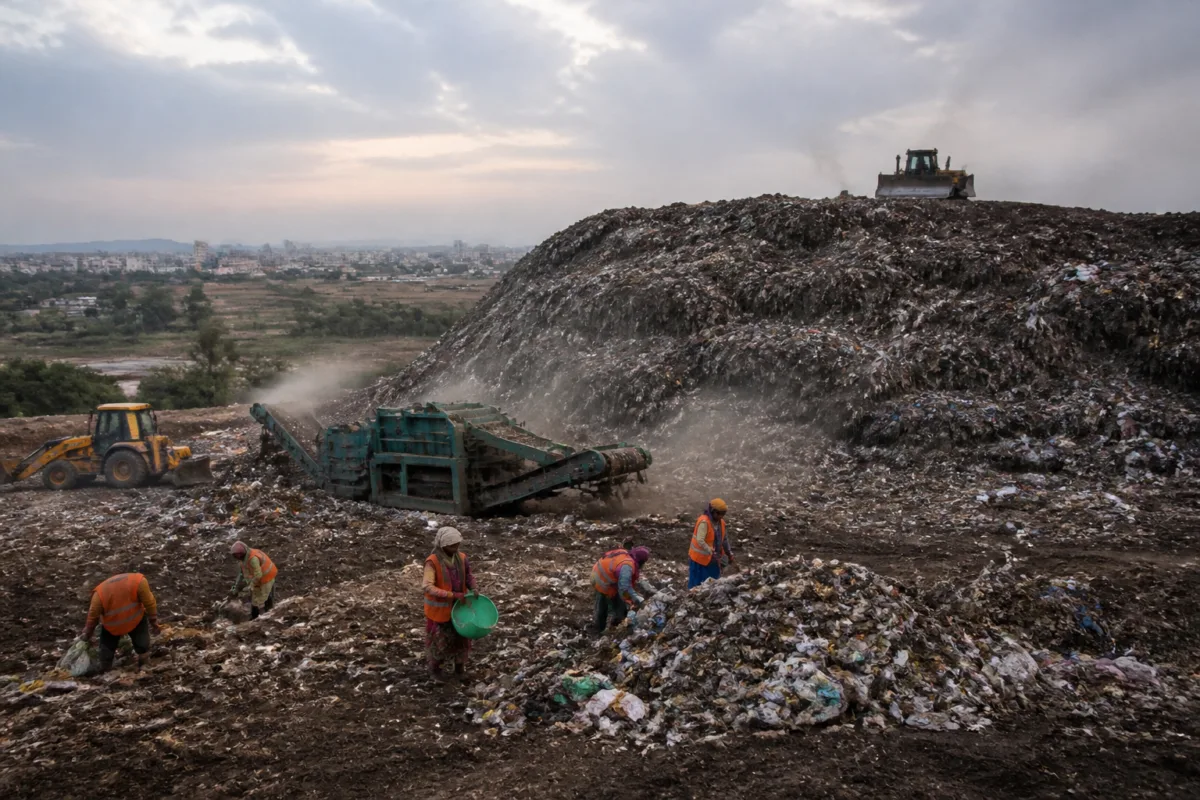
Pune’s most persistent problem is the legacy waste accumulated at the Uruli Devachi depot. The source report puts the remaining stock at around 28 lakh metric tonnes, or 2.8 million tonnes. Such waste is not equivalent to a routine collection backlog. It represents years of accumulated material that requires scientific processing, biomining and safe disposal. Until that stock is addressed, the city continues to carry an environmental and administrative liability that affects both the depot’s immediate surroundings and the credibility of its broader waste strategy.
Legacy dumpsite remediation also reveals a distinction between managing today’s waste and correcting yesterday’s failures. Door-to-door collection and sanitation staffing can improve daily operations, but they do not automatically reduce old waste stored at a landfill. The latter requires dedicated contracts, technical processing capacity, monitoring and a disposal chain for the material recovered through remediation. Pune’s ranking suggests that expanded manpower and expenditure have not yet translated into a complete solution for this structural problem.
The second major weakness identified in the report is sewage treatment. The PMC has not achieved scientific treatment of all sewage generated in the city, and untreated wastewater entering rivers such as the Mula-Mutha affects the city’s Water Plus and ODF++ certification scores. This connects sanitation performance to the wider urban water system. Waste management, sewage treatment and river pollution are often administered through separate contracts and departments, but residents experience them as one environmental condition.
A city can therefore appear cleaner on selected roads while continuing to discharge untreated wastewater into its waterways. It can increase the number of sanitation workers while leaving gaps in sewage infrastructure. The Swachh Survekshan result, as reported, brings these linked systems into the same frame. It indicates that cleanliness cannot be sustained through visible surface-level drives alone when treatment capacity, waste processing and environmental safeguards remain incomplete.
Air quality is another indicator of the gap between municipal activity and urban outcomes. Pune reportedly fell to 18th among 50 cities in the relevant assessment, after earlier occupying sixth and eighth positions. The supplied report does not establish a single cause for this decline, but it records concerns raised by political leaders and civic observers about the effectiveness of the PMC’s environmental initiatives. Waste handling, road dust, construction activity, traffic and weather conditions can all form part of the urban air-quality picture, but the available evidence does not quantify the contribution of each factor in Pune’s case.
The distribution of services within Pune is equally important. The report identifies uneven coverage across the older peth areas and newly merged fringe villages. These parts of the city present different administrative and physical challenges. The peths have dense buildings, narrow streets and high activity levels, while peripheral villages require expanded collection routes and new sanitation infrastructure after their incorporation into the municipal limits. A citywide ranking can conceal these variations unless the PMC tracks performance at the ward and neighbourhood level.
The reported presence of overflowing roadside bins, persistent garbage blackspots and weak segregation points to an implementation problem rather than simply a shortage of funds. Spending can increase the volume of contracts and equipment without ensuring that collection schedules are reliable, households segregate waste, transfer stations function properly and processing facilities have sufficient capacity. The difference between an approved project and a working service is created through supervision, enforcement, data systems and accountability at the local level.
This is where the role of sanitation workers becomes important. Recruiting 3,500 workers may expand the workforce, but staffing numbers alone do not show whether workers are deployed where demand is highest, whether routes are adequately covered, or whether they have the equipment and institutional support required to work safely. Nor do they establish whether the city’s collection and processing capacity has expanded at the same pace. The ranking does not, on its own, answer these operational questions, but Pune’s decline makes them difficult to avoid.
The assessment process itself has also become part of the civic debate. According to the report, three central inspection teams were scheduled to visit Pune, but only the first arrived during June-July, while the remaining inspections were delayed. Administrative circles are discussing whether the staggered assessment affected the final score. This remains a reported concern rather than an established explanation for the result. The PMC’s promised review will need to distinguish between problems caused by inspection coordination and weaknesses that would have affected the city regardless of when teams arrived.
Citizen feedback presents another institutional question. The report says concerns surfaced over alleged instructions to civic employees to log entries during the citizen feedback drive. The material supplied does not independently establish the extent or effect of this practice. However, the issue is significant because public feedback is intended to measure lived experience rather than administrative mobilisation. If participation is driven mainly by official campaigns, the resulting numbers may not accurately capture how residents assess collection, public toilets, waste segregation or neighbourhood cleanliness.
The political response has focused on the contrast between Pune’s expenditure and its ranking. Congress leaders in the PMC criticised what they described as superficial, paper-based and virtual campaigns instead of year-round ground-level sanitation. Those allegations are political claims and cannot, by themselves, establish the reasons for the decline. They do, however, reflect the accountability problem created when large allocations produce no visible improvement in the final public assessment.
The comparison with neighbouring Pimpri-Chinchwad and Navi Mumbai is more useful when treated as an administrative question rather than a simple league table. Both municipal corporations reportedly won honours while Pune did not. The result suggests that peer cities operating in the same broader regional environment may be organising sanitation and waste-management systems differently. The supplied report does not provide comparable spending, staffing, processing or sewage-treatment figures for those cities, so it cannot establish which specific practices account for the difference. It does show that Pune’s outcome cannot be explained solely by the difficulty of governing a large urban region.
The PMC’s institutional response has so far been a promise of review and corrective action. Additional Municipal Commissioner Prajit Nair said a comprehensive review would identify what went wrong and where shortcomings remained, after which further steps would be taken. That statement places the next stage within the municipal administration rather than treating the ranking as a one-time public-relations setback.
For that review to be meaningful, the city’s performance will have to be examined as a chain rather than as separate publicity targets. The chain begins with household and commercial waste segregation, continues through collection and transfer, and ends with processing or safe disposal. It includes the remediation of old dumpsites, sewage treatment capacity, river protection, public sanitation, ward-level monitoring and the authenticity of citizen feedback. A weakness at any one point can reduce the value of improvements elsewhere.
Pune’s Swachh Survekshan result therefore confirms two things from the evidence available. First, the city committed substantial money and additional manpower to sanitation but still recorded a lower ranking and no award. Second, several foundational problems remain unresolved, particularly legacy waste at Uruli Devachi, incomplete sewage treatment and uneven service delivery. What the result does not yet establish is the precise weight of each failure in the final score, or whether delayed inspections materially changed Pune’s position.
The PMC’s promised comprehensive review is the next important milestone. Its findings will show whether Pune responds with another short-term cleanliness campaign or addresses the infrastructure, monitoring and administrative gaps that the latest ranking has brought into public view.

