


The reported Nvidia Jensen Huang resignation has raised questions about the future of China’s AI data-centre expansion, but the central claim remains unverified in the supplied material. Aaj Tak Business reported that Huang had stepped down as Nvidia’s chief executive, board member and managing director, while also linking the development to an investigation and pressure over the company’s China business. No official Nvidia announcement, board filing or independently verifiable document confirming his resignation is identified in the report.
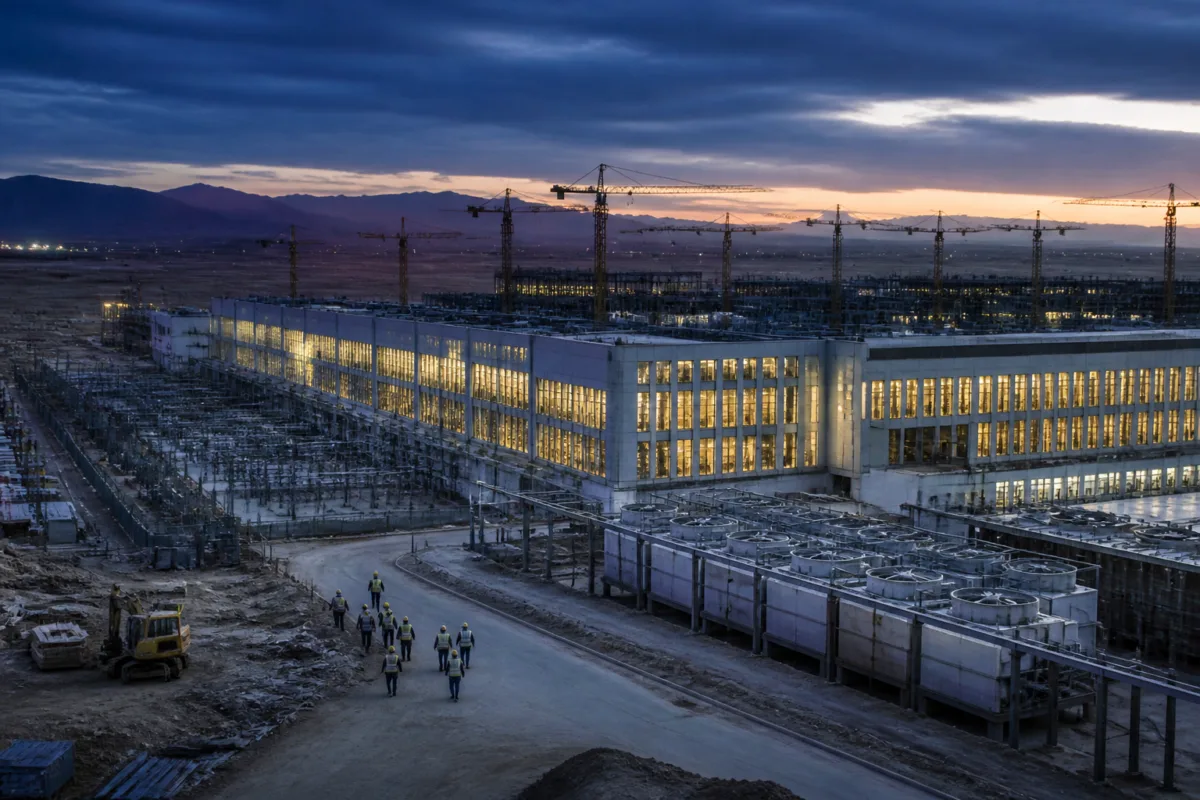
The infrastructure implications described in the report are nevertheless substantial. A Reuters review cited by Aaj Tak Business examined more than 150 Chinese procurement notices, investment plans, construction contracts and corporate disclosures. Together, these documents identified AI projects and equipment agreements worth more than 23 billion yuan, or about $3.2 billion. The projects reportedly span wealthy coastal provinces and technology hubs in China’s western regions.
The review indicates that demand for Nvidia hardware has remained embedded in projects supported by local governments, universities and regional computing centres, despite United States restrictions on China’s access to advanced artificial intelligence chips. The reported project value includes planned investments, signed contracts and completed installations. It covers buildings, power systems and other infrastructure, rather than only spending on Nvidia processors.
This distinction is important because AI computing capacity is not created by chips alone. Large-scale facilities require land, buildings, electricity connections, cooling systems, networking equipment and substantial capital expenditure. If a data centre has been designed around a particular generation of accelerator, restrictions on that hardware can affect not only procurement but also the engineering assumptions behind the facility.
According to the material supplied, some Chinese developers and institutions are advancing data-centre projects designed around Nvidia H100, H200 and H800 processors. Some facilities are already operational or under construction, while others remain at the planning stage. The report gives the example of a facility in north-western Gansu province that was expected to install thousands of Nvidia chips before the end of the year. It says it was unclear whether those processors had arrived.
The Gansu example illustrates the difference between an announced or planned project and usable computing capacity. A project may have procurement documents, construction contracts and a power system in place without having the processors needed to deliver its intended computing performance. Conversely, equipment may be installed but operate below planned capacity if software, networking or electricity infrastructure is incomplete. The supplied report does not establish how many of the identified projects have reached full operation.
The uncertainty is reinforced by the changing United States export-control regime. Washington began restricting exports of advanced Nvidia processors to China in 2022 and has tightened those controls since then. The material also says that the United States administration moved in January to review H200 export licences for eligible Chinese customers on a case-by-case basis. Such rules create a procurement environment in which Chinese data-centre operators may have to redesign facilities, delay installations or seek alternative processors, depending on the status of each project and licence.
Nvidia has said that United States export controls removed it from China’s AI data-centre market and that its estimates exclude Chinese data-centre computing revenue. At the same time, an IDC estimate cited in the report put Nvidia’s share of Chinese AI-accelerator shipments at 34% in the first half of 2026. The two figures describe different parts of the market: Nvidia’s statement concerns its own access to the market and revenue expectations, while the IDC estimate concerns shipments during a specified period. Neither figure, by itself, establishes the operational status of the projects identified in the Reuters review.
The report also describes Huang as a prominent supporter of easing restrictions on Nvidia’s China business. It says he had previously stated that Nvidia’s share of the Chinese market had fallen from 95% to zero after export controls. If accurately attributed, that statement reflects the commercial impact of restrictions on a company that once held a dominant position in the market. It does not, however, establish that Huang’s reported departure occurred because of those controls or because of any investigation.
The supplied material separately refers to claims that Huang’s name had been linked to a Chinese businesswoman who was alleged to be a Chinese spy. It says United States officials suspected an intelligence connection with Beijing. These allegations are not established in the material. The report also states that Nvidia’s board had begun an independent investigation and said there was no reason to believe that company secrets or United States national security had been compromised.
The distinction between allegation and finding is especially important in a story involving corporate leadership, national security and cross-border technology controls. The material says there was no public finding that Huang had violated export-control laws. It also says that Megaspeed denied illegally shipping Nvidia chips to China and that the projects identified in the Reuters review had no connection with Megaspeed or the allegations involving Huang.
From an urban infrastructure perspective, the broader issue is the dependence of regional computing projects on globally controlled components. Local governments, universities and regional computing centres may commit funds to buildings and power systems years before the computing equipment is secured. When access to processors changes, the physical infrastructure remains, but the expected economic and technological output of that infrastructure may be delayed or reduced.
This creates a planning problem that is different from a conventional construction delay. A transport project can often be assessed through physical completion, while an AI data centre depends on a chain that includes semiconductor availability, export permissions, compatible software, power capacity, cooling and network connectivity. The supplied evidence shows the scale of China’s planned and contracted investment, but it does not provide a complete measure of how much of that capacity is functioning.
The institutional responsibilities are also divided. Local governments and regional bodies may support land, power and investment; universities and research institutions may be end users; developers may build the facilities; and chip companies remain dependent on national export-control decisions. Nvidia’s board investigation represents a corporate governance response, while United States export controls represent a national security and trade-policy response. The Chinese projects themselves are shaped by local investment decisions and the availability of imported or domestic hardware.
The reported Nvidia Jensen Huang resignation therefore cannot yet be treated as an established event on the evidence supplied. What can be established from the material is that a large group of Chinese AI infrastructure projects has been identified, that many appear to have been planned around Nvidia hardware, and that export restrictions have created uncertainty over supply and redesign costs. The next material developments to monitor are an official Nvidia statement or filing on Huang’s position, the outcome of the board’s independent investigation, the status of the identified projects and any further changes to United States licensing rules for advanced AI processors.

