


Nvidia’s steepest weekly share-price decline since April 2025 is being treated as a corporate crisis, but the market reaction also exposes the fragile foundations of the artificial intelligence infrastructure boom. The chipmaker’s shares fell 13% over five trading days to close at $162.85, wiping more than $570 billion from its market value, as investors responded to the removal of chief executive Jensen Huang, analyst downgrades and renewed concerns over data-centre expansion, export controls and the sustainability of AI spending.
The immediate trigger was Huang’s departure after the company’s board removed him and appointed chief financial officer Colette Kress as interim chief executive. According to the report carried by Economic Times and attributed to Bloomberg, the decision followed allegations involving Huang’s personal conduct, including an admitted affair with an alleged Chinese spy and a reported relationship with another employee. Huang has agreed to testify before Congress under oath, with the appearance expected before the Thanksgiving holiday later this month.
That sequence matters beyond Nvidia’s corporate structure because the company sits at the centre of the hardware supply chain for AI systems. Its high-end chips are used in the computing infrastructure required to train and run advanced AI models. The construction of that infrastructure has become a major force behind new data-centre development, electricity demand and investment in digital capacity. When confidence in the company weakens, the consequences are not limited to a technology stock: they raise questions about the assumptions underpinning a large physical buildout.
The share-price movement was unusually severe. Nvidia recorded its sixth consecutive week of losses, the longest such run since 2012. The weekly decline was the company’s worst since April 2025, when sweeping tariffs announced by US President Donald Trump unsettled equity markets globally. The report said the value erased from Nvidia during the week was larger than the market capitalisation of 96% of companies in the S&P 500.
Those numbers do not establish that data-centre construction is slowing, nor do they show that AI demand has disappeared. They do, however, reveal how closely the sector’s future is tied to investor confidence in continuing capital expenditure. Nvidia’s shares had already been under pressure after reaching a record high in early October. Before Huang’s removal became public, investors were questioning whether spending on the AI buildout could continue at its existing pace.
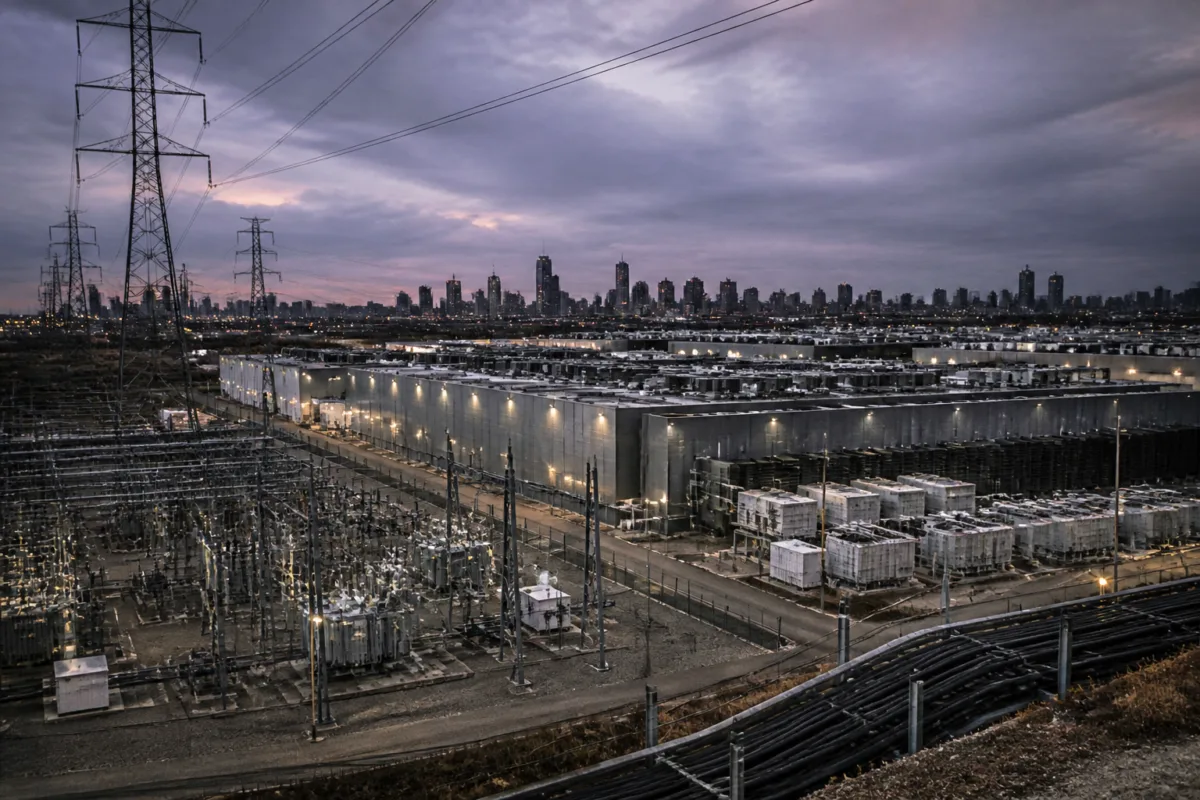
That concern is directly relevant to cities. Data centres are not abstract digital platforms; they are large physical facilities that require land, high-capacity power connections, cooling systems, fibre networks, roads, security infrastructure and, in many cases, new industrial or commercial zoning. Their expansion can alter local infrastructure priorities even when the end users of the computing capacity are located far away.
The report also points to a political response to this physical expansion. After the US midterm elections, several elected leaders were described as opposing the rapid growth of data centres. The supplied material does not identify the affected locations or quantify the projects under review, but the political pushback indicates that the AI infrastructure debate is moving from technology policy into land-use, energy and local governance questions.
This is a crucial shift. Data-centre development is often presented as a private investment story, with attention focused on chip sales, cloud companies and projected demand for computing. Yet local authorities must deal with the practical consequences: whether power capacity is available, how water and cooling requirements are managed, how land is allocated and whether surrounding communities receive economic benefits proportionate to the infrastructure they host. The supplied report does not provide project-level data on these effects, but it identifies the expanding political contest around them.
Nvidia’s corporate crisis adds another layer to that uncertainty. At least 13 analysts covering the company downgraded its shares during the month, most of them during the week of the decline, according to data compiled by Bloomberg. The company had 15 hold ratings, the highest number since 2023. At the same time, 66 analysts retained buy recommendations and only one recommended selling the stock.
This split is significant because it shows that the market has not reached a settled conclusion. Nvidia remains widely viewed by analysts as a central company in the AI hardware economy, but confidence in forecasting its revenue and earnings has weakened. Truist analysts led by William Stein downgraded the shares from buy to hold, writing that Huang’s departure could affect Nvidia’s culture and that the company could face harm if high-end chips reached Chinese hands. They said the investment risks had become too high to forecast revenue or earnings with sufficient confidence to retain a buy recommendation.
The export-control issue connects Nvidia’s business to national security and the governance of advanced technology. Senator Elizabeth Warren, who is expected to take over the US Senate Banking Committee when Democrats take the majority in January, called for closer scrutiny of the company’s dealings with the White House and the role of Commerce Secretary Howard Lutnick. She said officials should explain why export-control loopholes had not been closed and ensure that advanced technology was not supporting China’s military.
For the built environment, export controls matter because they can change the economic case for the facilities being built to house AI computing. A data centre may be designed around a particular generation of chips, a projected customer base or an assumed rate of equipment upgrades. If access to advanced chips changes because of regulation, the expected utilisation and commercial value of that facility can also change. The supplied report does not say that any specific project has been cancelled or redesigned, but it demonstrates how regulatory decisions can reach from foreign-policy debates into physical infrastructure planning.
The same uncertainty applies to the question of demand. Nvidia’s shares have fallen for six weeks, yet most analysts still recommend buying the stock. That contrast suggests that the concern is not necessarily about whether AI computing will exist, but about the pace, profitability and governance of its expansion. For cities and infrastructure providers, these distinctions are important. A long-term requirement for computing capacity does not automatically justify every proposed facility, every power allocation or every land-use decision at the scale initially projected.
The report also places the upcoming quarterly earnings announcement at the centre of the next phase of scrutiny. Nvidia is scheduled to report results on Tuesday, November 17. Those results may provide investors with new information about revenue and earnings, but the supplied material does not establish what the company will report or whether the figures will resolve concerns about leadership, export controls or data-centre spending.
What the evidence confirms is narrower but still consequential. Nvidia has suffered a sharp and measurable loss in market value. Its leadership has changed after a scandal. Analysts have become more cautious even though a large majority still recommend buying the shares. Political opposition to rapid data-centre expansion is growing in parts of the United States. And export controls are being examined as a potential weakness in the flow of advanced computing technology.
What remains uncertain is how much of the current pressure is specific to Nvidia and how much reflects a broader reassessment of the AI infrastructure model. The supplied report does not provide comparable results from other chipmakers, data-centre developers or cloud companies. It also does not quantify electricity demand, construction pipelines, local tax revenues or community impacts. Those gaps prevent a definitive conclusion about the future scale of the physical AI buildout.
The larger urban question is therefore not whether one company’s shares have fallen. It is whether cities and infrastructure institutions are making long-lived commitments based on a technology investment cycle whose costs and returns are still being tested. Nvidia’s market performance cannot answer that question on its own, but the company’s crisis has made the assumptions behind the AI infrastructure boom harder to ignore. The next milestones are Huang’s congressional testimony and Nvidia’s scheduled quarterly earnings report on November 17.

