


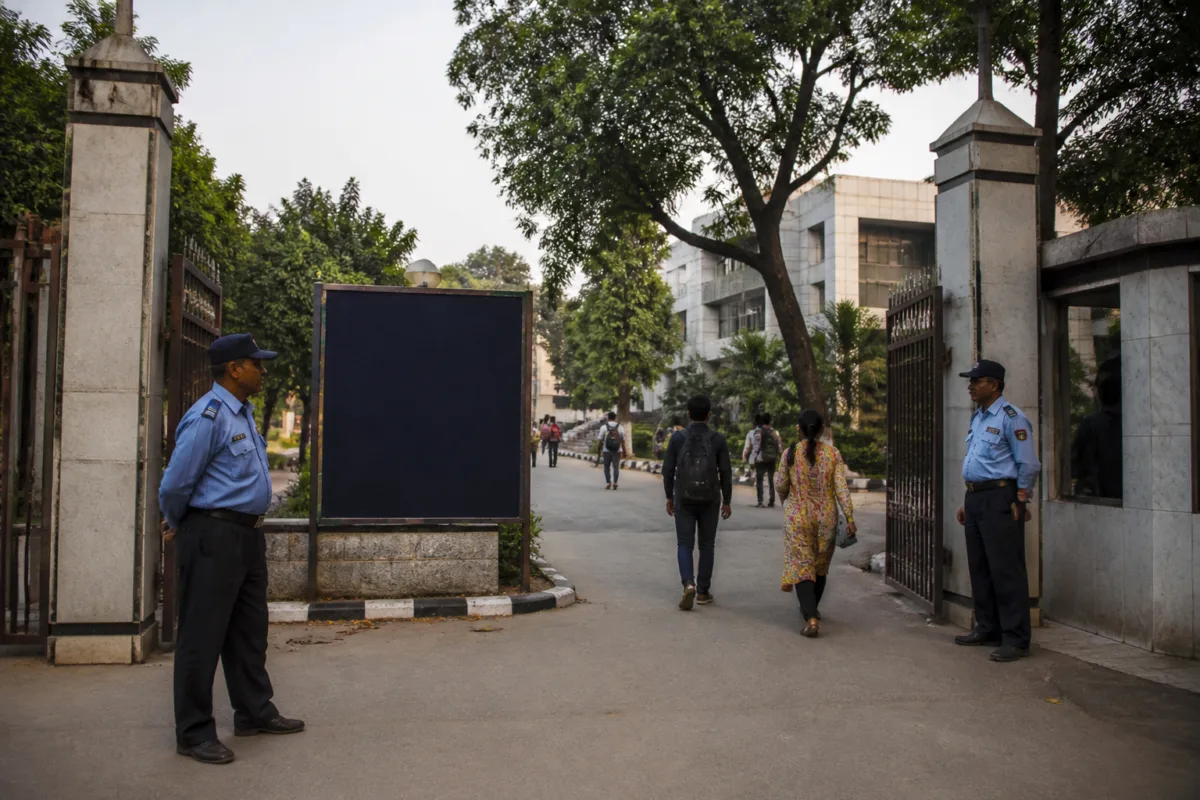
The JNTU Hyderabad security contract case has moved from an internal procurement dispute to a public accountability question, after a research scholar approached the Telangana High Court over the alleged nomination-based award of a contract worth more than ₹5 crore. The case does not establish that funds were misused or that procurement rules were violated. It does, however, bring into focus how a publicly funded university makes high-value contracting decisions, records those decisions and responds when the process is challenged.
Javvaji Dileep, founder-president of the Students Protection Forum, filed a public interest litigation seeking an investigation into the tender process and alleged misuse of university funds. The case was registered on Friday, according to the case history record cited by Deccan Chronicle. Dileep had earlier submitted a complaint dated November 4 to the Director General of Telangana’s vigilance and enforcement department.
The immediate dispute concerns the award of a security services contract to B Secure Protection and Guarding Private Limited. Dileep alleges that two security tenders floated through the state’s e-procurement platform were cancelled at the final stage and that the work was subsequently awarded to the private agency on a nomination basis. He further alleges that the award was made without open competitive bidding or prior approval from the university’s executive council, despite the contract’s estimated value exceeding ₹5 crore.
JNTU Hyderabad management has rejected the allegations in broad terms, stating that the university followed the procedures in force while awarding the contract. It has also denied that the chief engineer was removed because of opposition to the decision, saying appointments to posts were made regularly and that the change was part of the routine process. No court finding on the allegations or the university’s defence was included in the supplied report.
That distinction is central to understanding the case. A PIL filing records a demand for judicial or investigative scrutiny; it is not itself a determination that irregularities occurred. At the same time, the filing identifies a sequence of decisions that can be tested through documents: the original tender notices, cancellation records, reasons for abandoning the e-procurement process, the authority under which the nomination-based award was made, and the approvals obtained before the contract was issued.
The alleged transition from competitive tendering to nomination-based contracting is the most consequential element of the dispute. Competitive procurement is intended to create a documented comparison between eligible service providers. When a contract moves outside that process, the decision requires a clear explanation of the circumstances, the applicable rules and the approving authority. The supplied report does not establish why the tenders were cancelled or what justification the university recorded for the subsequent award. Those unanswered procedural questions are now part of the public-interest concern.
The dispute also illustrates why procurement oversight in universities is not merely an administrative matter. Security contracts affect daily operations across campuses, including access control, protection of buildings and equipment, and the safety of students, employees and visitors. The financial value of the contract adds another layer: a decision involving more than ₹5 crore can influence institutional budgets and the standards of service available across the university’s facilities.
Dileep has alleged that work orders were altered after they were issued. He claimed that orders initially covering one year were changed to three months, and that security guards were asked to pay ₹1,270 for uniforms, ₹450 for shoes and ₹5,000 as a security deposit. These claims remain allegations in the supplied material. If examined by an investigative authority, the relevant evidence would include the work orders, amendments, payroll or deployment records, receipts and any instructions issued to guards.
The allegations also broaden the case beyond a single security contract. Dileep has sought scrutiny of decisions taken by the Vice Chancellor over the previous 18 months, including memoranda of understanding, payments to third-party consultants, foreign travel advances, college inspections, ratifications and contractors’ bills. He has additionally raised questions about payments of ₹80,000 for temporary golf club membership from university funds and ₹8 lakh for permanent membership through an MoU consultant. The supplied report does not state whether these payments were authorised, whether they were connected to official activity or whether any audit has found them improper.
This wider list matters because institutional accountability depends on more than the legality of one contract. Universities operate through several layers of authority, including executive councils, senior officers, finance and engineering departments, procurement systems and external oversight agencies. The strength of that system is visible in the records it produces: who initiated a decision, who approved it, which rule was applied, what alternatives were considered and how the expenditure was reviewed. A dispute becomes harder to resolve when those records are unavailable or when responsibilities are unclear.
The role attributed to the chief engineer is another unresolved part of the matter. Dileep alleged that the officer was removed after opposing the decision. JNTU management denied that the change was connected to the contract and described it as part of a routine process. Establishing the facts would require the relevant appointment or transfer orders, the officer’s tenure details and any documented objections or file notings. The report supplies neither those documents nor an independent finding on the allegation.
The case therefore places two institutional claims in direct tension. The petitioner says that a high-value contract was diverted from competitive procurement and that university funds and work orders require investigation. The university says that applicable procedures were followed and rejects the claimed connection between the contract and the chief engineer’s change of post. The High Court proceedings, or any vigilance or Anti-Corruption Bureau inquiry that may follow, will determine whether these competing accounts are supported by records.
Dileep has sought a vigilance or Anti-Corruption Bureau inquiry, action against officials found responsible, recovery of any misused funds and blacklisting of the agency. These are requested outcomes, not measures reported as having been ordered. The supplied material does not indicate that the court has granted relief, directed an inquiry or ruled on the merits of the allegations.
The larger urban-governance question is how public institutions maintain trust when they spend money on essential services. A university campus is a contained urban environment, with buildings, infrastructure, workers and a large daily population. Its contracts provide a practical test of whether public procurement systems can show not only that a service was delivered, but also that the route used to appoint the service provider was transparent, authorised and capable of independent review.
At this stage, the evidence confirms that a PIL has been filed, that the allegations concern a security contract valued at more than ₹5 crore and that JNTU Hyderabad has denied wrongdoing. It does not confirm misuse of funds, unlawful contracting or retaliation against an official. The next meaningful developments are the court’s treatment of the PIL, any response sought from the university or state authorities, and the production or examination of the procurement and approval records at the centre of the dispute.

