


Chandigarh’s CBDC ration subsidy scheme has exposed a critical weakness in the digitisation of welfare delivery: transferring money to a digital wallet is not the same as enabling people to use it. According to a Times of India report, only around 30,000 of the 53,000 ration cards that received the September subsidy were used during the recorded period. In August, approximately 43,000 of 52,000 beneficiaries had used their subsidy. The decline means utilisation fell by about 26 percentage points in one month, even as the administration continued to credit the subsidy.
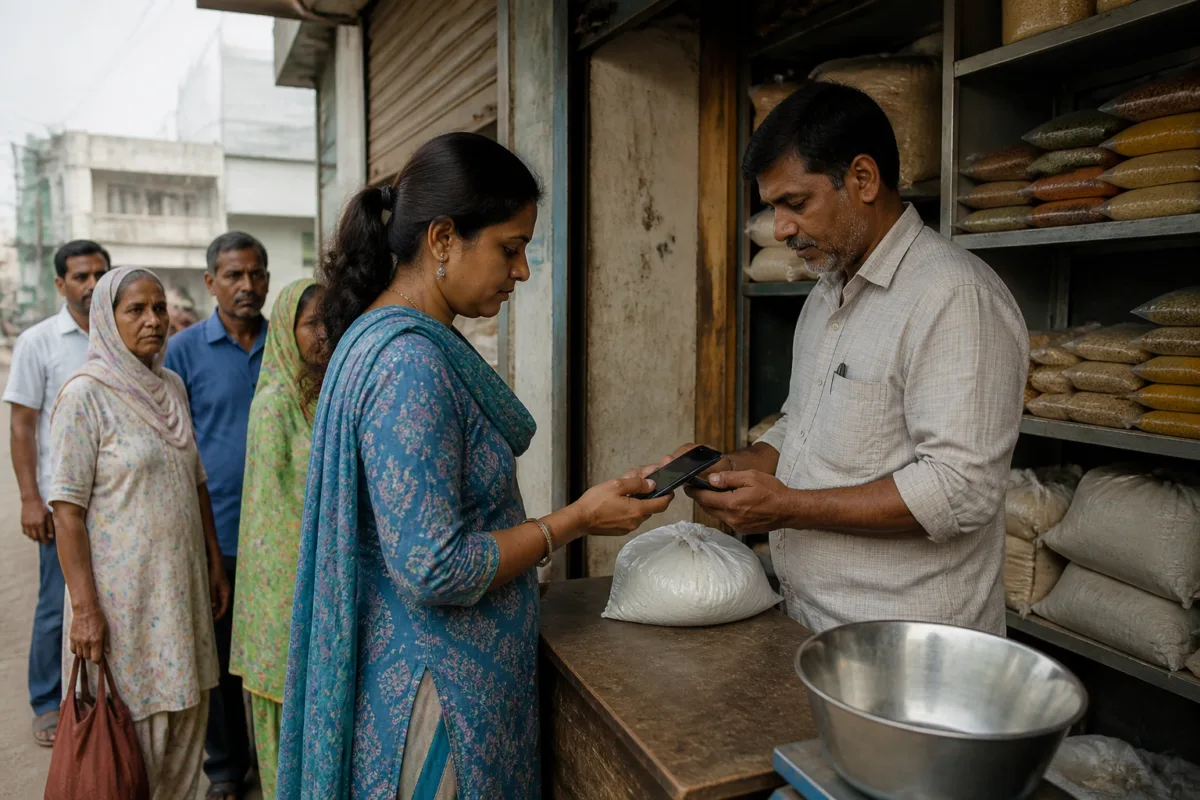
The gap matters because the subsidy is intended for essential food commodities. Under the new arrangement, beneficiaries receive Central Bank Digital Currency tokens rather than a direct transfer into an Aadhaar-linked bank account. The tokens can be spent on foodgrains and other essential commodities at fair price shops, with beneficiaries able to choose a food basket that includes wheat, rice and pulses. But the system has inserted a new operational stage between entitlement and consumption: the beneficiary must access a digital wallet, authenticate the transaction and complete a payment through the required application, while the shopkeeper must also have a functioning CBDC application.
That design changes the meaning of access in the public distribution system. Under the earlier DBT arrangement, the central operational question was whether the subsidy reached the beneficiary’s bank account. Under the CBDC model, access depends on several connected systems working at the same time. A beneficiary may receive a credit but still be unable to purchase food because of an OTP failure, weak mobile connectivity, a wallet problem or an error while the transaction is being processed. The reported experience in Chandigarh shows that the point of failure has shifted from disbursement alone to the final interaction between citizen, merchant and payment infrastructure.
An official of Chandigarh’s food supply department cited OTP authentication failures, mobile connectivity problems, wallet-related glitches and transaction-processing errors as obstacles to redemption. The administration has acknowledged that crediting tokens and redeeming them are separate stages. A successful transfer to a beneficiary’s digital wallet, therefore, does not confirm that the subsidy has become usable at a ration shop. Both the beneficiary-side and merchant-side applications must authenticate and process the transaction successfully.
The September figures provide a clear measure of this distinction. Around 53,000 ration cards received the subsidy, but roughly 22,000 cards did not record utilisation during the period covered by the monthly statement. About 2,500 cards were rejected during the payment process and required additional handling. The report attributes these difficulties to the number of platforms involved, including the National Informatics Centre, the Public Financial Management System, the National Payments Corporation of India and participating banks. Data validation, wallet onboarding and technical synchronisation have added to the administrative workload.
This is not simply a question of whether a payment application is convenient. In a welfare system, redemption is the point at which a state entitlement becomes a material benefit. A system that records successful crediting but does not reliably record successful purchase can produce an administrative appearance of delivery without ensuring access to food. The reported Chandigarh experience consequently raises a broader question for digital public infrastructure: should programme performance be measured by money transferred, wallets created or essential goods actually received?
The transition also illustrates the institutional complexity hidden behind a citizen-facing transaction. Beneficiaries encounter an application and a fair price shop. Behind that interaction are multiple government and financial systems responsible for validating records, transferring funds, onboarding wallets, authenticating users and completing payments. When a transaction fails, responsibility may not be immediately visible to the person trying to redeem the subsidy. The administration must coordinate with the bank and NIC, while the technical problem may involve data or synchronisation across several other platforms.
Mohamed Mansoor L, secretary of the food and supply department, said the department was coordinating with the concerned bank and NIC to resolve redemption-related problems and assist beneficiaries and merchants. He also said the administration was moving from manual processing to automation to improve reliability. The statement indicates that the current system is still undergoing operational adjustment rather than functioning as a fully settled replacement for the previous arrangement.
The scale of the transition is significant because DBT had operated in Chandigarh for nearly a decade. Under that mechanism, subsidies were transferred directly into Aadhaar-linked bank accounts. The CBDC model was launched on August 14 at Tagore Theatre by Union agriculture and farmers’ welfare minister Shivraj Singh Chouhan as a technology-driven intervention intended to make the public distribution system more transparent and targeted. It also restricts the use of subsidy funds to foodgrains and other essential food commodities, unlike an unrestricted cash transfer.
The policy trade-off is therefore visible in the structure of the scheme. CBDC tokens are designed to preserve the purpose of the subsidy and allow beneficiaries to choose among eligible food items. At the same time, that purpose-specific design introduces additional technical conditions. A beneficiary no longer needs only an entitlement and a participating shop; the person also needs a functioning digital wallet, successful authentication, connectivity and a transaction that clears across the relevant systems. The reported fall in usage suggests that the new conditions may be affecting the practical reach of the benefit.
The beneficiary figures add another layer to the story. Chandigarh had approximately 80,000 ration cards in January 2026, compared with around 57,000 in November, according to the report. About 1,500 new cards were subsequently issued, including to some beneficiaries whose earlier cards had been deleted. Under the National Food Security Act, 2013, Chandigarh has been authorised to enrol around 4.75 lakh beneficiaries. Before the CBDC implementation, about 3.50 lakh beneficiaries were enrolled, which was approximately 1.25 lakh below the authorised quota. After the implementation of the new scheme, the beneficiary base was reported at 2.28 lakh.
These numbers should not be treated as evidence of a single cause. The report does not establish that the reduction in ration cards or beneficiaries was caused by CBDC redemption failures. It does, however, show that the payment transition is occurring alongside a changing beneficiary base and a substantial gap between authorised capacity and recorded enrolment. That makes reliable administrative data especially important. When cards are deleted, new cards are issued and payments are rejected, the system needs to distinguish clearly between ineligibility, record correction, technical failure and non-use.
The September utilisation decline also demonstrates why monthly disbursement statistics are insufficient on their own. The administration can report how many cards were credited, but citizens experience the scheme at the fair price shop. The more meaningful service indicator is whether an eligible person could complete a purchase within the permitted period and obtain the food items for which the subsidy was intended. A transfer that remains unused may reflect a technical problem, a data problem, a connectivity problem or a beneficiary decision, and these categories cannot be treated as interchangeable.
For Chandigarh, the immediate governance challenge is to make the chain from eligibility to redemption visible and accountable. The administration’s reported move from manual processing to automation may address some delays, but the supplied report does not establish the nature, timeline or performance targets of that transition. It also does not establish how many beneficiaries were unable to redeem because of each individual failure point. Those details will determine whether the problem is concentrated in onboarding, authentication, merchant readiness, connectivity or backend reconciliation.
The larger urban question is whether digital welfare systems are being designed around institutional efficiency or the conditions in which residents actually use them. A fair price shop is a street-level service point, not merely the final endpoint of a payment network. Its reliability depends on devices, network access, trained merchants, responsive support and clear escalation channels. If any of those elements fail, a technically successful transfer may remain practically unusable.
Chandigarh’s CBDC ration experience does not by itself establish that the model cannot work. It does establish that the success of such a system cannot be judged at the moment a token is credited. The reported decline from approximately 43,000 users in August to 30,000 in September, the 2,500 rejected cards and the stated dependence on several interconnected platforms show that redemption is the decisive test. The next important evidence will be whether automation, bank and NIC coordination, and assistance to beneficiaries and merchants improve utilisation in subsequent monthly statements.

