


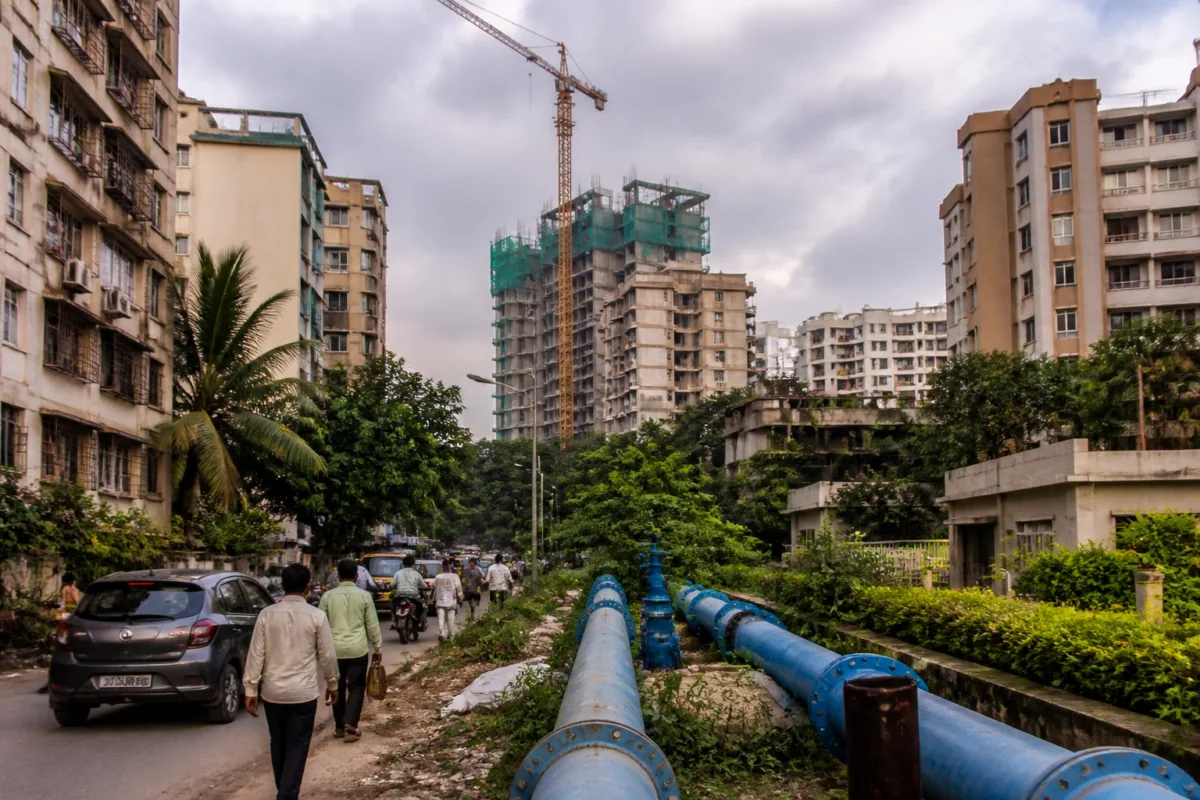
Navi Mumbai’s dispute over cluster redevelopment is no longer only a disagreement about individual buildings. It has become a test of whether the city’s planned form can absorb a substantial increase in built-up area and population without first establishing the capacity of its water supply, roads, internal connectivity, public amenities and environmental systems.
Forest minister Ganesh Naik has said he will continue opposing the Urban Development Department’s Urban Renewal Scheme, or URS, in Navi Mumbai until an impact assessment report is prepared. The Navi Mumbai Municipal Corporation’s general body has separately passed a resolution opposing approvals for notified cluster redevelopment proposals unless the city undergoes a carrying capacity study. The resolution, passed by 60 votes to 31, also authorises legal action if the Maharashtra government proceeds with pending proposals before such an assessment.
The immediate trigger was a directive issued by the Maharashtra government’s Urban Development Department on October 15, 2026, asking the civic body to process notified cluster redevelopment proposals pending before the high-powered committee. NMMC had earlier resolved to keep those proposals on hold. The confrontation therefore involves more than redevelopment policy: it raises the question of which level of government should decide when additional construction is compatible with the infrastructure already serving a planned city.
At the centre of the argument is the relationship between Floor Space Index and municipal capacity. A higher FSI allows more floor area to be built on a plot. But the additional floor area can also mean more residents, vehicles, water demand, sewage generation, waste and pressure on roads and public amenities. Naik has argued that higher FSI without corresponding groundwork would place severe stress on Navi Mumbai’s infrastructure and undermine the city’s clean-city status.
That argument is significant because the proposed scheme is being assessed not only through the condition of individual buildings, but through its cumulative effect on the city. Naik has opposed extending the scheme to buildings that are neither dangerously dilapidated nor at least 30 years old. He cited parts of Simplex Colony in Ghansoli as an example of the concern over widening the scheme beyond buildings that require urgent intervention.
NMMC’s position similarly distinguishes between necessary redevelopment and blanket approvals. Officials said C-1 category dangerous and dilapidated buildings should continue to be redeveloped under the regular development control regulations, allowing residents to relocate. The civic concern is that the existence of such buildings should not become a basis for approving all cluster proposals without first studying their effect on carrying capacity.
This distinction changes the policy question. If a building is structurally dangerous, redevelopment addresses a direct safety problem. Cluster redevelopment, by contrast, can combine multiple plots or buildings and may enable a much larger increase in built-up area. The city’s concern, as described in the report, is that the second process should not be treated as an automatic extension of the first when the infrastructure consequences are different.
The disagreement also exposes a gap between project-level approval and city-level planning. A proposal can be examined as a development site, but its effects may be felt across a wider catchment: on an arterial road, a local water network, drainage systems, schools, open spaces and public facilities. NMMC’s demand for a citywide carrying capacity study reflects the argument that these effects cannot be assessed adequately through individual proposals alone.
The issue is particularly visible in Ghansoli. Sagar Naik, the NMMC leader of the House, said the area was already facing water supply constraints. He also questioned the need for a special URS scheme when redevelopment could proceed under regular development control regulations through land amalgamation. This positions the dispute around administrative necessity: whether the special scheme solves a problem that ordinary rules cannot, or whether it mainly makes higher-density construction easier to approve.
The available account does not establish the technical scale of the proposed additional construction, the number of residents likely to be added, or the precise infrastructure thresholds that would determine whether individual projects are viable. Those missing figures are important. Without them, the debate remains institutionally clear but quantitatively incomplete. The calls for an impact assessment and carrying capacity study are, in effect, demands for those missing numbers to be produced before approvals are granted.
A carrying capacity study would also force the authorities to define what capacity means in Navi Mumbai. It could involve the ability of existing systems to provide water, manage sewage and waste, carry traffic and support public amenities, but the supplied account does not specify the proposed methodology or the agencies that would undertake it. That absence matters because a study is useful only if its indicators, geographic boundaries and approval consequences are clearly established.
The dispute illustrates why FSI debates are rarely only about planning permissions. FSI is a regulatory instrument, but its consequences depend on public investment and the operational performance of civic systems. If additional development is permitted without matching infrastructure, the cost may appear later as unreliable services, congestion or overburdened facilities. If redevelopment is held back without distinguishing unsafe buildings from buildings that can remain occupied, residents may continue living in inadequate or risky conditions. The challenge is to prevent both forms of failure.
Navi Mumbai’s planned layout is another central part of the argument. Naik has warned that indiscriminate approvals could create population over-density, worsen traffic on arterial roads and internal connections, and damage the city’s planned development. The concern is not simply that more people would live in the city; it is that the distribution and intensity of new development could alter the relationship between housing, transport and civic services that planning was intended to establish.
This makes the controversy a test of how a planned city manages renewal. Planned urban form is not preserved by freezing buildings in time. Older buildings eventually require repair, reconstruction or replacement. But renewal can also weaken the original planning logic when additional density is approved without checking whether roads, utilities and public amenities can accommodate it. The conflict over URS is therefore a conflict over the conditions under which renewal should take place.
The institutional structure makes the decision more complex. The state Urban Development Department has directed NMMC to process pending proposals, while the municipal general body has resolved to oppose such approvals without a citywide study. The high-powered committee is part of the approval pathway for the notified proposals. This creates a sequence in which the state may seek movement on pending applications while the local authority argues that the evidence needed for responsible processing has not yet been assembled.
NMMC’s proposed legal response could move the dispute from administrative correspondence to judicial review. Corporator Suraj Patil sought a writ petition under Article 226 of the Constitution and an interim stay on approvals for Cluster 1 and Cluster 2 and other pending proposals. He also asked the municipal commissioner to obtain legal advice, compile the relevant documents and appoint advocates. The account does not say whether the petition has been filed or whether a court has granted any interim relief.
That uncertainty is important. At present, the political and administrative positions are recorded, and legal action has been authorised or proposed, but the final status of the pending approvals is not established in the supplied material. The next stage will depend on whether the state proceeds with the proposals, whether NMMC approaches the Bombay High Court, and whether any court considers the request for interim protection.
The clean-city award has added a public legitimacy dimension to the dispute. Naik said Navi Mumbai’s clean-city status would not last if indiscriminate cluster development were allowed. The award itself does not settle the redevelopment question, but it has become part of the argument over whether the systems supporting the city’s present performance can withstand additional density. The broader issue is whether urban performance is measured only by current outcomes or also by the capacity to sustain them as the city changes.
The evidence currently supports three conclusions. First, there is a live institutional conflict over whether pending cluster redevelopment proposals should be processed before a citywide carrying capacity assessment. Second, the dispute is grounded in specific concerns about water supply, traffic, connectivity, public amenities and the effect of higher FSI. Third, the policy framework distinguishes between redevelopment of dangerous buildings under regular regulations and broader cluster approvals under the URS.
What remains unresolved is equally consequential: the actual infrastructure capacity of the affected areas, the additional population and floor space associated with each proposal, the technical design of any carrying capacity study, and the legal status of the proposed challenge. Until those questions are documented, the Navi Mumbai redevelopment debate will remain caught between two legitimate urban needs—renewing ageing or unsafe buildings and protecting the infrastructure systems that make higher-density development viable.
The next milestones are the processing of the pending proposals, NMMC’s communication of its objections to the Maharashtra government, and any proposed approach to the Bombay High Court. Those steps will determine whether Navi Mumbai’s cluster redevelopment policy proceeds through project-by-project approvals or is first subjected to the citywide capacity assessment demanded by the civic body.

