


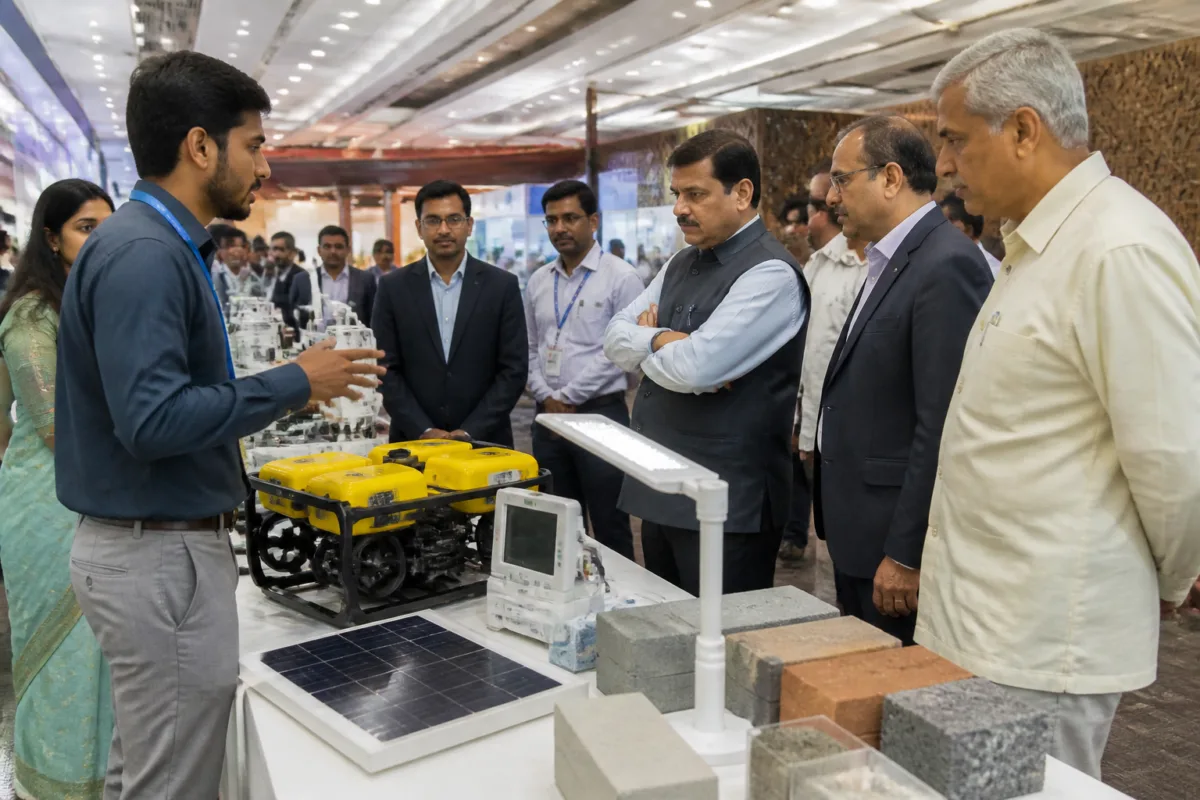
The Andhra Pradesh government has showcased 45 innovative micro, small and medium enterprises (MSMEs) at the 31st CII Partnership Summit in Visakhapatnam, using a dedicated expo to connect local businesses with international buyers, investors and technology partners.
Organised by the state MSME department, the pavilion brings together enterprises from eight sectors, including precision engineering, marine robotics, aerospace and defence, agri-tech, med-tech and women-led businesses. The initiative reflects the state’s stated focus on decentralised industrial development and entrepreneurship beyond established industrial centres.
Chief Minister N. Chandrababu Naidu, Union commerce and industry minister Piyush Goyal, civil aviation minister Ram Mohan Naidu and state MSME minister Kondapalli Srinivas visited the pavilion and interacted with participating entrepreneurs. Naidu reviewed products, technologies and business models displayed by the enterprises and assured participants of government support to scale their ventures, according to the report.
The exhibitors include Kakinada-based Enlight Horizon Solutions, which makes LED solar lighting solutions; Visakhapatnam-based Oceanatics Pvt Ltd, which specialises in marine robotics and autonomous underwater vehicles; Pylon Agrifresh, which has developed patented compostable packaging; Acrivis Healthcare, a manufacturer of medical devices and cosmeceuticals; and Tirupati-based V-Kola, which displayed Srikalahasti Kalamkari products.
The pavilion also includes facilitation desks for regulatory approvals, credit access, quality certification and export promotion. Delegates were shown indigenous robotics, diagnostic equipment and eco-friendly construction materials. GI-tagged products such as Araku Coffee, Bandaru Laddu and Athreyapuram Pootharekulu were also displayed as part of the state’s effort to promote regional products and enterprises.
For MSMEs, the event is positioned as more than a product showcase. Several entrepreneurs told the organisers that high research and development costs remain a major constraint and sought greater government support for innovation and product development. The challenge is significant for smaller firms that may have products or technologies but lack access to testing facilities, certification systems, specialised equipment and market linkages.
In response, Naidu said the state was focusing on common infrastructure to reduce the burden on MSMEs. He said several participating enterprises were being mentored by the Ratan Tata Innovation Hub and outlined plans for an innovation ecosystem linked to universities.
“We are envisioning a Ratan Tata Innovation Hub where common R&D infrastructure, along with forward and backward linkages, will be developed. The output of one MSME can become the input for another. We want to integrate the entire ecosystem and ensure product perfection,” Naidu said in response to questions from Deccan Herald, as cited in the report.
The proposed approach would link research, production, suppliers and markets rather than treating individual enterprises as isolated units. The report did not provide a project timeline, funding allocation or details of the locations planned for the common R&D infrastructure.
The chief minister also said the government was developing the ‘Swayam’ brand, under which products and stock-keeping units developed by self-help groups and MSMEs would be promoted. Packaging units, consultants and other stakeholders would be brought together to improve product quality and market readiness.
“Our goal is to ensure that products made by SHGs and MSMEs reach international markets and become globally recognised brands,” Naidu said, according to the report.
The expo is being organised in line with the chief minister’s stated vision of ‘one family, one entrepreneur’. It is also intended to encourage students, aspiring entrepreneurs and industry stakeholders. The next institutional milestones will depend on how the proposed common infrastructure, university linkages, mentoring arrangements and export facilitation are implemented beyond the summit pavilion.

