


A review of five decades of Indian research has made the health case against air pollution difficult to dismiss, while Bengal’s position in the evidence map exposes a deeper governance problem: pollution is being studied and managed through cities even though its sources and health effects extend across industrial belts, neighbouring districts and rural areas.
The systematic review by the Centre for Research on Energy and Clean Air (CREA), released on Friday, examined 184 peer-reviewed epidemiological studies published between 1975 and 2025. It found that 169 studies, or nearly 92%, reported increased health risks associated with exposure to air pollution. Bengal accounted for 10 studies, placing it fifth among states and Union Territories in the geographical distribution of research.
That ranking is not a measure of the state’s pollution burden or the health damage experienced by its residents. It is a measure of how much research has been conducted and mapped geographically. Delhi led with 26 studies, followed by Punjab with 13, Maharashtra and Uttar Pradesh with 11 each. Tamil Nadu had nine studies, Karnataka eight and Telangana seven. The distribution nevertheless offers an important warning for Bengal: the evidence base remains limited relative to the scale and geographic spread of the problem described in the review.
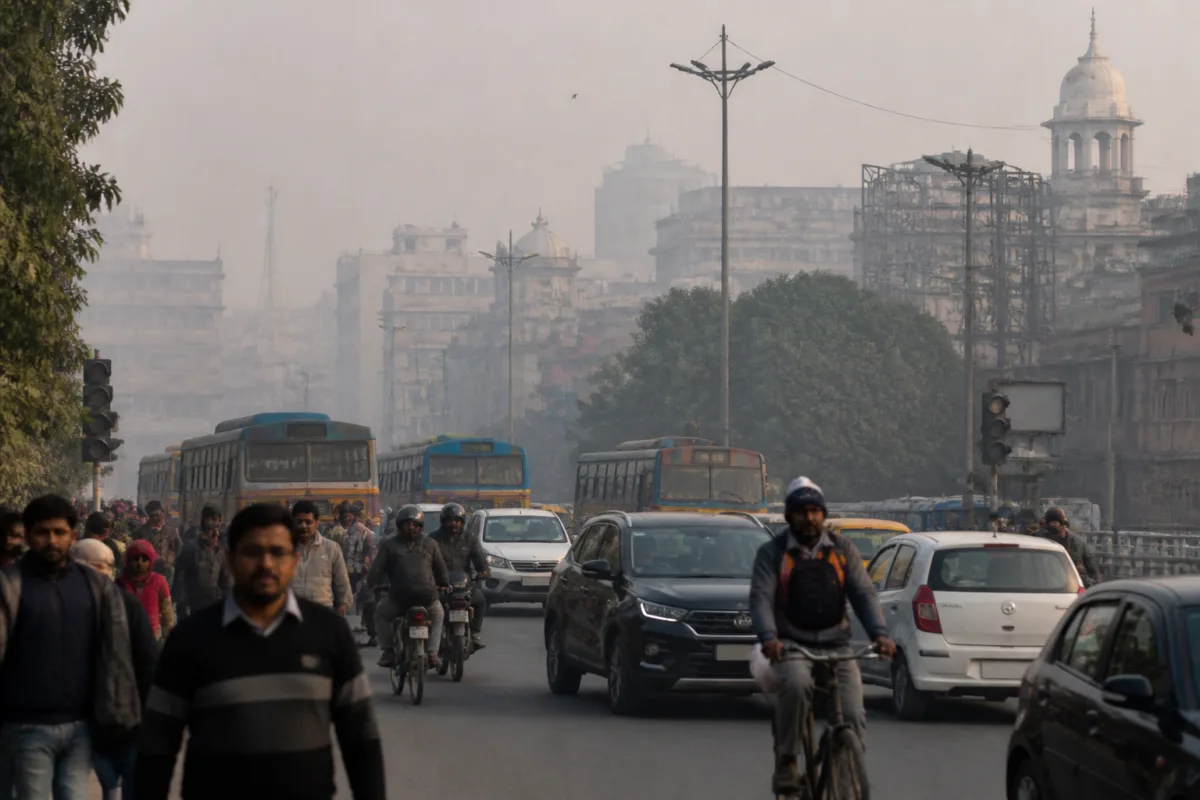
Kolkata is the most visible part of that problem. Particulate pollution routinely worsens in the city during winter, exposing residents to elevated concentrations of fine particles. But the review places Kolkata within a much wider airshed and public-health system. Pollution from vehicles, industries, power plants and household combustion does not respect municipal boundaries, and the health evidence examined by CREA includes populations outside major urban centres.
This is why the review’s call for a regional, airshed-based approach matters. Manoj Kumar, an analyst at CREA, said the findings highlighted the need to move beyond a city-centric approach and explicitly include rural areas in the next phase of the National Clean Air Programme, or NCAP 2.0. For Bengal, that would mean treating the state’s urban and rural pollution risks as connected rather than as separate administrative concerns.
The rural evidence in the review is particularly significant. Of the 40 studies that examined rural populations, 38 reported at least one adverse health association. That finding does not establish that every rural community faces the same exposure or the same health outcomes. It does, however, challenge the assumption that air-pollution policy can be designed mainly around large cities and then extended outward as an afterthought.
The institutional profile of the evidence also gives the review weight. Of the 46 government-funded studies examined, 44 reported adverse health associations. Among 81 studies involving government-affiliated institutions, 77 identified increased health risks. The institutions associated with the research included the Indian Council of Medical Research, the Central Pollution Control Board, AIIMS, central ministries and other scientific organisations.
This pattern is important because it shows that the association between polluted air and health risks is not confined to one type of sponsor or one research network. The evidence reviewed by CREA came from peer-reviewed work conducted over five decades and included studies linked to public institutions. Its consistency does not eliminate the need to examine individual studies, exposure levels or local conditions, but it establishes a broad research direction that public policy cannot reasonably ignore.
Respiratory disease was the most frequently investigated outcome, appearing in 86 studies. The review also covered mortality in 16 studies and cardiovascular disease in 11. Other outcomes included diabetes, pregnancy complications, low birth weight, impaired child growth and neurocognitive disorders. The range matters for urban governance because it expands the air-pollution question beyond hospital admissions during visibly bad-air episodes.
A city’s clean-air strategy is often judged through a narrow set of indicators: particulate concentrations, seasonal peaks or compliance with pollution-control measures. The review indicates that the public-health question is wider. Air pollution is associated in the examined literature with respiratory emergencies, asthma admissions, impaired lung function and mortality, while other studies have investigated impacts involving pregnancy, childhood development and cardiovascular health.
The pollutant mix is equally important. The research did not focus only on PM2.5 and PM10. It also examined nitrogen oxides, sulphur oxides, ozone and carbon monoxide. These gaseous pollutants were associated with respiratory emergencies, asthma admissions, impaired lung function and mortality in the studies covered. They also contribute to the formation of secondary fine particles, which means that a strategy focused on measuring or reducing one pollutant in isolation may not capture the full chain of exposure.
The review states that sulphate and nitrate particles, formed through atmospheric reactions, account for approximately a quarter of India’s PM2.5 concentrations. This finding adds a regional dimension to pollution control. Secondary particles can be formed through atmospheric processes involving emissions from multiple sources and locations. As a result, action limited to a single municipal boundary may not address the pollution that residents ultimately breathe.
For Bengal, this creates a policy challenge involving both geography and institutional responsibility. Vehicles, industries, power plants and household combustion are identified in the review as sources that need to be tackled simultaneously. These sources are likely to fall under different authorities, enforcement systems and reporting arrangements. A city administration may manage some local activities, while state departments, pollution-control agencies and other institutions oversee wider industrial, energy or transport systems.
The significance of an airshed-based approach is therefore administrative as much as scientific. It requires policymakers to look at how emissions move across boundaries and how responsibilities are divided between urban local bodies, state agencies and national programmes. The supplied review does not provide a detailed blueprint for that institutional redesign, but its findings point to a limitation in treating air pollution as a problem that begins and ends within a city.
The National Clean Air Programme is the central policy framework referenced in the review. CREA’s recommendation is that its next phase should explicitly include rural areas, adopt PM2.5-specific targets and use a multipollutant approach. The review also argues that pollution mitigation must not remain confined to city-level interventions. That raises a question about how NCAP 2.0 will define the geographical unit for planning, monitoring and accountability.
A city-focused framework can still be useful. Kolkata’s winter particulate pollution creates an immediate need for local monitoring and action. But the evidence summarised by CREA suggests that city-level measures are not sufficient as the sole organising principle. If rural populations are also showing adverse health associations, and if gaseous pollutants contribute to secondary fine particles, then policy must connect local action to regional emissions and atmospheric processes.
Bengal’s fifth-place ranking in research coverage also raises a data question. Ten studies provide a meaningful base, but they are fewer than the totals recorded for Delhi, Punjab, Maharashtra and Uttar Pradesh. The ranking cannot by itself show whether Bengal has more or less pollution-related illness than those states. It does show that research attention is uneven, and that evidence for industrial, peri-urban and rural parts of the state may need to be developed more systematically.
That gap matters because policy decisions depend not only on pollution measurements but also on knowledge about who is exposed, where exposure occurs and which health outcomes are being affected. The review’s evidence on rural populations, government-funded research and multiple pollutants indicates that a fuller picture requires more than monitoring air quality at a few urban locations.
The larger urban question is whether India’s clean-air governance is organised around the places where pollution is measured rather than the systems that generate and transport it. Bengal illustrates the tension clearly. Kolkata is the state’s most prominent urban pollution hotspot, but the research reviewed by CREA points to health risks across a wider geography and across several pollutant categories.
The evidence confirms three broad points: most of the Indian epidemiological studies examined by CREA found increased health risks; Bengal has a substantial but comparatively smaller body of mapped research; and rural populations and multiple pollutants must be included in the policy response. What remains to be established is how the findings will be translated into enforceable regional plans, clearer institutional responsibilities and measurable targets under the next phase of the National Clean Air Programme. Those will be the developments to watch as India moves from documenting health risks to redesigning how clean-air action is organised.

