


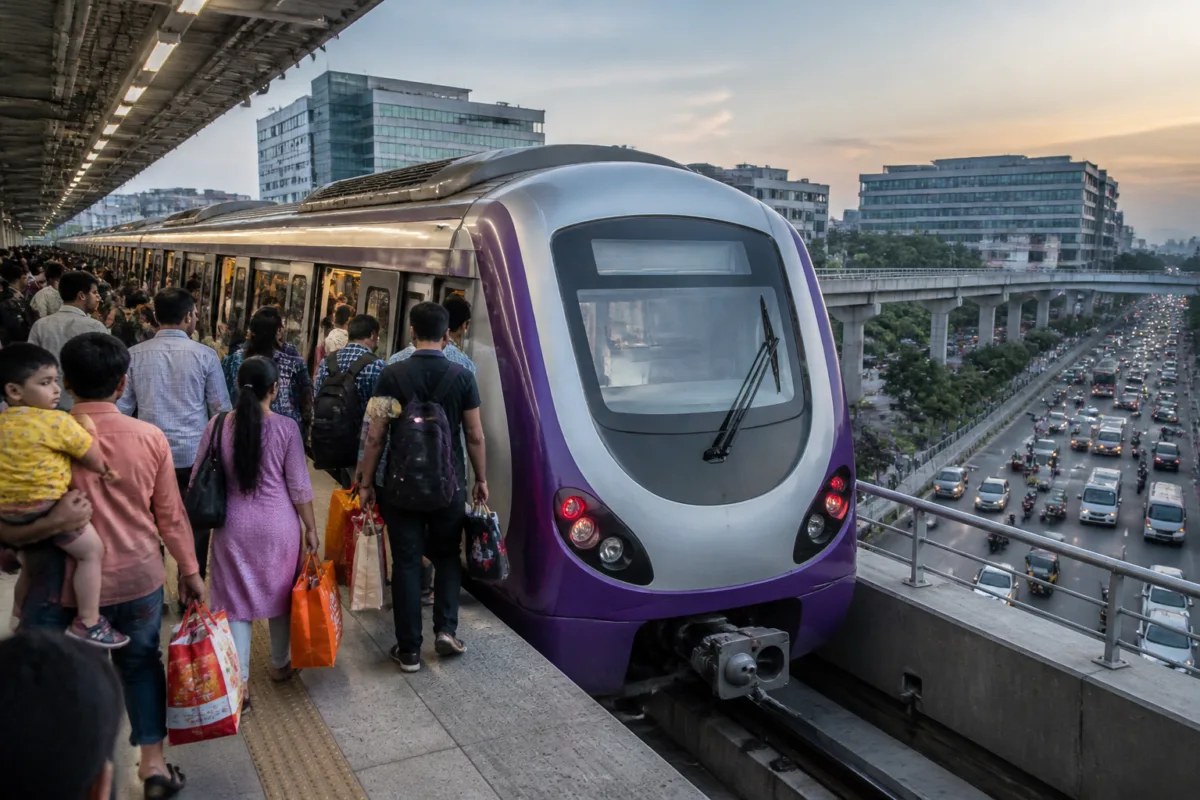
The Hinjewadi Shivajinagar Metro route carried 2,65,650 passengers from 4 November during the Diwali period, offering residents of Maan, Hinjewadi and surrounding areas an alternative to private vehicles for shopping, family visits and leisure travel. The figure is more than a festive footfall number: it provides an early indication of how a new public transport connection is being used beyond the conventional office commute.
According to a report by Sakal, the route became operational shortly before the Diwali shopping rush. Residents travelling towards Pune’s markets would otherwise have faced two familiar urban constraints—traffic congestion on the road and the difficulty of finding parking after reaching the destination. The metro gave them a way to separate the journey from the parking problem, particularly during a period when shopping activity increased across Pune and Pimpri-Chinchwad.
The reported ridership also matters because Hinjewadi is described in the report as a major origin point for people travelling towards Pune. The source identifies travel time as an important concern for residents making that journey. The new metro service therefore entered the transport system at a moment when demand was not limited to daily commuting. It was also tested by passengers travelling for shopping, social visits and family outings.
This distinction is important for understanding early public transport use. A new line can attract attention because people want to experience it, especially during a holiday period. But the reported passenger mix suggests that the service was also being used for practical urban trips. The account includes office commuters, families, people visiting relatives and residents taking guests around the city. That does not establish long-term ridership patterns, but it shows that the route was immediately legible to passengers as a city-access service rather than only as a work corridor.
The strongest evidence in the report is the passenger count itself and the comparison with Pune Metro’s Purple Line. During the seven days of Diwali, approximately five lakh passengers travelled between Pimpri and Swargate on the Purple Line. The route served residents travelling from Pimpri-Chinchwad towards central Pune markets, where festive shopping generated additional demand. Taken together, the two figures show that both western and north-western metropolitan travel corridors experienced heightened metro use during the same period.
The comparison also reveals the geography of festive mobility. The Hinjewadi-Shivajinagar route connected an employment-intensive western area with central Pune, while the Pimpri-Swargate corridor connected Pimpri-Chinchwad with the city’s central markets. In both cases, passengers were reported to have chosen the metro partly to avoid the friction associated with taking private vehicles into crowded commercial areas. The source does not provide a private-vehicle reduction estimate, so the ridership figures cannot be converted into a quantified congestion impact. They do, however, show where public transport became an attractive option when road and parking conditions were likely to be less convenient for travellers.
The experience shared by Saurabh Thakur, identified as an IT professional from Hinjewadi, illustrates the decision-making behind that choice. He said his family selected the metro because taking a vehicle during a busy period could mean losing considerable time searching for parking. He also described the journey as comfortable and said it left more time for shopping. This is a small, individual account, but it identifies the practical exchange that public transport must offer: not only movement from one station to another, but a more predictable overall trip to the destination.
That wider trip is especially relevant in areas where employment, housing, retail and civic destinations are distributed across different parts of the urban region. The source does not provide travel-time comparisons between the metro and road journeys, nor does it state how many passengers shifted from cars or two-wheelers. It is therefore not possible to conclude from the available evidence that the new route has already changed travel behaviour at scale. What can be said is that, during the reported festive period, passengers considered the service useful for trips that would otherwise have included road congestion and parking uncertainty.
The passenger count reported for the Hinjewadi-Shivajinagar route should also be read in relation to timing. The service had recently begun when Diwali shopping and family travel increased. A festive surge can raise usage above ordinary weekday levels, while the novelty of a newly opened route can also influence passenger numbers. The supplied report does not include daily ridership, weekday and weekend comparisons, station-wise demand, ticket revenue, repeat-usage data or figures for periods outside Diwali. Those missing measures are necessary before the route’s normal operating performance can be assessed.
Even with those limitations, early use can provide transport authorities with useful operational signals. The report says that the service was used by office-goers as well as families and visitors. This broad pattern suggests that demand may be spread across different time periods and trip purposes rather than being concentrated only in conventional peak-hour commuting. The source does not state whether additional services, longer operating hours or crowd-management changes were introduced. It reports instead that teams were prepared to prevent inconvenience during the festive period.
Rinaz Pathan, identified as PMRDA’s chief engineer, said the metro had provided citizens with a new travel option and that more than 2.5 lakh passengers used the service during the period. The official statement is consistent with the more precise figure of 2,65,650 passengers reported for the route. Pathan’s comment also places responsibility for the festive operation with the project and operating teams, although the supplied material does not detail staffing levels, service frequency, station capacity or incident records.
The institutional dimension is significant. The route’s value is not determined only by the number of trains or stations; it is also shaped by whether passengers can use it conveniently for the complete journey. The report focuses on access to markets, parking pressure and travel from Hinjewadi towards Pune, but it does not provide information about feeder buses, walking connections, interchange arrangements, last-mile services or parking facilities at stations. These factors remain outside the evidence supplied here, yet they will influence whether festive passengers continue using the metro for regular travel.
The figures from both corridors also underline the importance of measuring metro performance by more than inauguration milestones. Passenger totals can show immediate acceptance, but they do not by themselves reveal service quality, affordability, reliability or network integration. To understand whether the Hinjewadi-Shivajinagar route is becoming a durable part of Pune’s transport system, future reporting would need to examine ridership after the holiday period, passenger volumes by time of day, the share of work and non-work trips, and the connection between stations and final destinations.
There is another limitation in comparing the two reported figures. The Hinjewadi-Shivajinagar count is given as 2,65,650 passengers from 4 November, while the Pimpri-Swargate figure covers seven days of Diwali and is described as approximately five lakh passengers. The periods and levels of precision are not identical. The numbers demonstrate heavy festive use on both corridors, but they should not be treated as a direct performance ranking between the two lines.
The broader urban question is whether new mass-transit services can make difficult city journeys easier at the moments when road space is under greatest pressure. The Diwali experience described by Sakal suggests that the metro can become attractive when the combined cost of driving—time spent in traffic, uncertainty over parking and the burden of navigating crowded market areas—rises. That attractiveness was visible among both individual commuters and families, according to the report.
What the evidence confirms is limited but meaningful. The new Hinjewadi-Shivajinagar service carried 2,65,650 passengers during the reported period, and residents used it for employment, shopping, family visits and leisure travel. The Purple Line recorded approximately five lakh passengers over seven Diwali days. What remains unestablished is the route’s normal demand, its effect on private-vehicle use and the extent to which passengers will continue choosing it after the festive surge and initial novelty have passed. Those are the measures that will determine whether the early success becomes a sustained shift in how western Pune connects to the city.

