


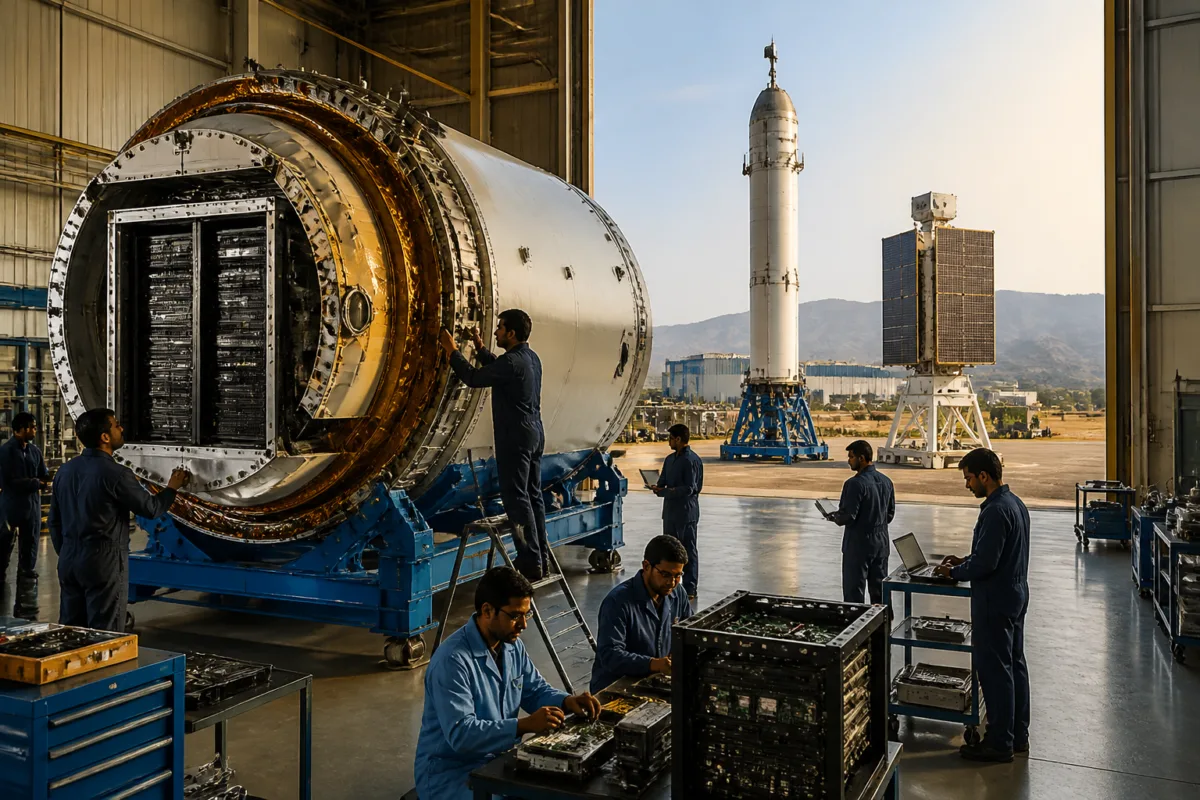
Agnikul Cosmos’s planned ₹510-crore orbital data centre facility in Andhra Pradesh is more than a new manufacturing investment. It is an early sign that the infrastructure supporting artificial intelligence may increasingly be designed across two environments: the conventional data centre on land and a proposed new class of computing platform in orbit.
The Chennai-based space-tech company signed an agreement with the Andhra Pradesh government on Friday to establish the facility in Tirupati district. Agnikul says the centre will build orbital data centre units that can be integrated with the upper stages of its launch vehicles. The company is positioning the facility as a link between rocket manufacturing, satellite platforms and high-density AI computing.
That combination matters because data centres have traditionally been treated as large industrial and digital-infrastructure assets. They require substantial electricity, water and cooling systems, while their expansion is increasingly tied to the growth of cloud services and AI workloads. Agnikul’s proposal addresses those constraints not by changing the terrestrial data centre, but by shifting part of the computing platform into space.
The company said the planned facility would provide a platform for semiconductor companies to develop GPU stacks that could be integrated directly with the upper stage of its launch vehicle. GPUs are central to many AI computing systems, and Agnikul’s proposal would allow the upper stage to function as a satellite bus hosting the data centre. The company has described this as an extension of its patented technology for making an upper stage an independent data centre platform.
Srinath Ravichandran, Agnikul’s co-founder and chief executive officer, said the company wanted to build a facility dedicated to orbital data centre units and that the planned centre would be the first of its kind in Asia and among the first globally. Those claims establish the ambition of the project, although the announcement does not provide an operational date, the expected capacity of the facility, the number of units to be manufactured or the full value of the associated launch programme.
The project already has an identified customer. Bengaluru-based NeevCloud has signed up with Agnikul to develop an AI data centre module through its AI SuperCloud platform, which Agnikul plans to launch into orbit. The arrangement gives the proposal a specific commercial use case rather than leaving it solely at the level of research or concept development. However, the supplied announcement does not disclose the module’s computing capacity, launch schedule, cost, orbit or the regulatory approvals required for deployment.
Agnikul says orbital data centres could draw power from sunlight, benefit from natural cooling and handle high-density AI workloads, cloud-enabled storage and data processing. These are company-stated advantages, not yet demonstrated outcomes for the proposed Andhra Pradesh facility. The distinction is important because moving computing hardware into orbit does not eliminate infrastructure requirements; it changes where those requirements are met and adds the constraints of launch, space operations, communications and maintenance.
The investment also places Andhra Pradesh within a wider competition for emerging technology infrastructure. The state government’s agreement with Agnikul gives Tirupati district a role in a sector that sits between aerospace manufacturing, semiconductor integration and cloud computing. The location of the planned unit may therefore be as significant as the technology itself: the facility would need to connect local manufacturing and testing capabilities with launch infrastructure, specialised suppliers and customers developing space-based computing systems.
The announcement comes as global technology and space companies explore similar ideas. The report said SpaceX, Google, Axiom Space and Blue Origin are working on space-based data centre concepts. It also noted that Google’s Suncatcher prototype space data centre went online after being launched on a SpaceX Falcon 9 rocket. The examples show that orbital computing is moving into active commercial and technical experimentation, but they do not establish that the concept has reached large-scale deployment.
The economic logic behind the proposal is tied to the physical limits of terrestrial computing infrastructure. A conventional data centre needs a reliable electricity supply, cooling equipment, land, network connectivity and, in many cases, access to water. As AI systems require more computing power, the pressure on these inputs becomes part of the infrastructure question. Agnikul’s proposal is based on the idea that solar power and the space environment can address some of those constraints. The company has not, however, provided comparative figures on energy use, cooling performance, launch costs or lifecycle emissions.
This creates a different administrative challenge for governments. A terrestrial data centre is largely governed through land-use permissions, electricity connections, construction approvals, environmental requirements, water access and data regulations. An orbital data centre would require an additional chain of permissions and institutional responsibilities linked to launch operations, spectrum and communications, space-object registration, in-orbit operations and the eventual disposal or de-orbiting of hardware. The announcement confirms the state-level investment agreement but does not specify how those responsibilities will be coordinated.
For Andhra Pradesh, the proposed project is also a test of what an investment announcement means in an industry where manufacturing, launch services and digital infrastructure are inseparable. The state is not simply receiving a conventional factory. It is being asked to host a facility that may support hardware integration for systems that operate beyond national territory while depending on terrestrial engineering, testing and supply chains. The project’s eventual urban and industrial impact will therefore depend on the facilities, skills, vendors and public infrastructure that accompany the headline investment.
Agnikul’s own development history provides the immediate context for the proposal. In May 2024, the company’s Agnibaan SOrTeD mission lifted off from India’s first privately operated launchpad at Sriharikota. The mission demonstrated technologies including the company’s 3D-printed semi-cryogenic engine. In September, Agnikul inaugurated two new units at its assembly and testing facility in Chennai, expanding its ability to test reusable rocket stages under flight-like conditions and manufacture critical launch vehicle components in-house.
The company’s next stated milestone is a launch expected during the first half of next year. Ravichandran said the mission would showcase Agnikul’s reusable launch vehicle and upper-stage technologies. That milestone is relevant to the orbital data centre plan because the proposed platform depends on the upper stage doing more than completing a launch. It would need to become a functioning and reliable host for computing hardware after reaching orbit.
The proposed facility therefore sits at the intersection of two infrastructure transitions. The first is India’s expanding private space sector, where companies are developing launch vehicles, engines and associated platforms. The second is the growth of AI computing, which is increasing demand for specialised hardware and data-processing capacity. Agnikul is attempting to connect the two by treating the rocket upper stage as a future computing platform rather than only as a disposable component of a launch system.
The evidence currently supports the conclusion that Andhra Pradesh is becoming the location of a planned manufacturing and integration facility, that Agnikul has identified NeevCloud as an initial customer, and that the company is preparing for a further launch demonstration. It does not yet establish the commercial scale, operating economics or regulatory pathway of orbital data centres. Those details will determine whether the project becomes a working infrastructure model or remains an early-stage experiment.
The larger urban question is how cities and states will plan for infrastructure whose boundaries are no longer limited to land. The proposed facility would be built in Tirupati district, supported by terrestrial industrial systems, connected to a launch ecosystem and intended to operate in orbit. For policymakers, the relevant issue is not only the size of the investment but also how such projects are integrated into power, manufacturing, research, connectivity and regulatory frameworks. Agnikul’s next launch and the development of the NeevCloud module will provide the next concrete indicators of whether the orbital data centre concept can move from announcement to operational demonstration.

