


Madhya Pradesh’s stolen antiquities problem is larger than a series of isolated thefts: 142 objects reported missing from Archaeological Survey of India-protected monuments account for nearly one-third of the national total recorded between 1961 and 2024. Most remain untraced, exposing a protection system that often begins investigating only after an object has disappeared and may lack the documentation needed to prove what was stolen.
The scale of the gap was underlined by the disappearance of a nearly 400-year-old, 3.5-tonne cannon from Narwar Fort in Shivpuri in July 2026. The case demonstrated that the vulnerability is not limited to small idols or portable sculptures. Large objects can also be removed from poorly protected heritage sites, while the absence of systematic records can make identification and recovery difficult.
The issue was discussed at a two-day workshop in Bhopal on October 26 and 27, organised by the Archaeological Survey of India’s Regional Director’s Office, Central Region. The workshop brought together ASI officials, state authorities, investigators, researchers and specialists working on provenance, archives, technology and international recovery. Discussions held ahead of the International Day against Illicit Trafficking of Cultural Property focused on moving from individual recoveries towards documentation, prevention and coordinated enforcement.
The numbers show that Madhya Pradesh is not facing a marginal problem. Of approximately 488 antiquities reported stolen from ASI-protected sites across India between 1961 and 2024, 142 were from Madhya Pradesh. Rajasthan, with 91, and Uttar Pradesh, with 86, followed. Together, the three states accounted for nearly 65% of recorded thefts.
Within Madhya Pradesh, thefts are concentrated across a connected belt. Guna has recorded the highest number, followed by Gwalior, Morena, Shivpuri and Vidisha. Bhind, Raisen, Katni, Khandwa, Satna, Damoh and Barwani were identified as additional hotspots. Hindu and Jain idols have also been repeatedly stolen from temples in Chhatarpur, Mandla, Narsinghpur, Katni and Rewa.
This geographic concentration matters because it gives the state a basis for targeted prevention. Yet the reported proposals also suggest that the current system has not converted known patterns into a permanent protection architecture. A campaign focused on hotspot districts could bring collectors, police, museums, temple managers and archaeology officials into a common operating framework, but its effectiveness would depend on whether it becomes routine administration rather than a time-bound public campaign.
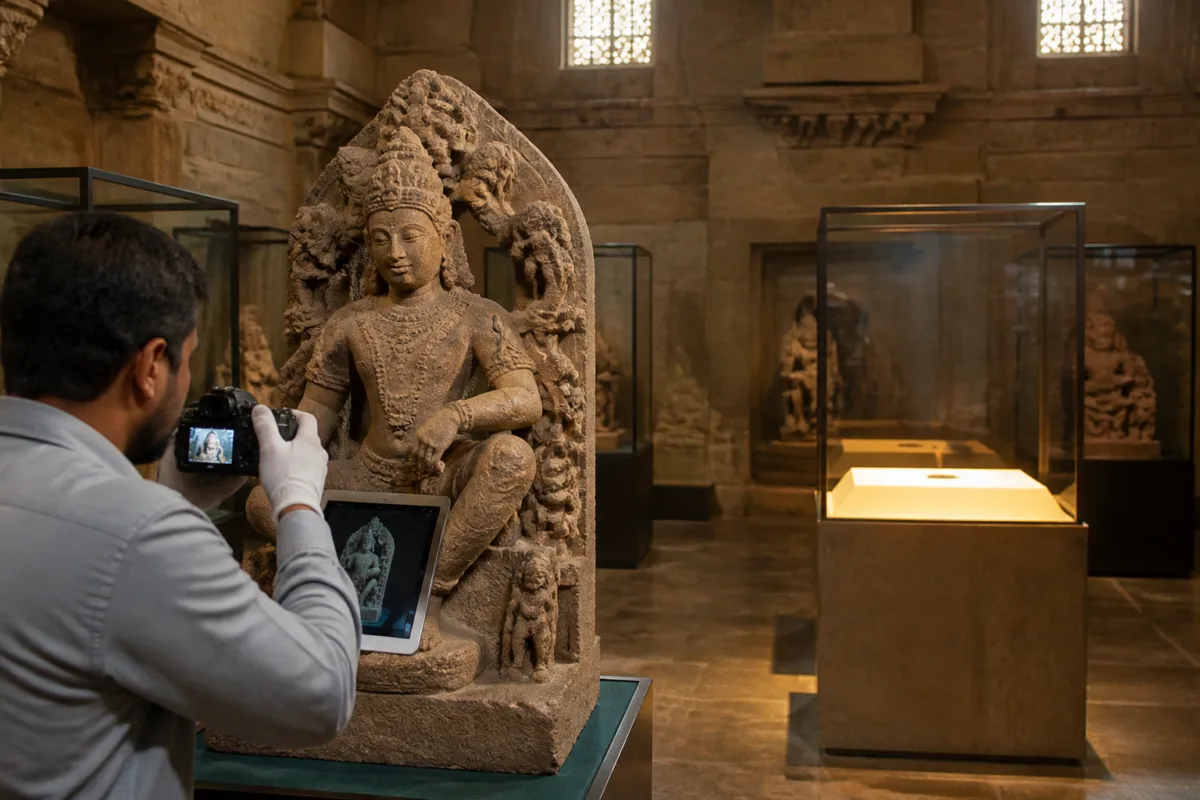
The most important weakness identified at the Bhopal deliberations was the absence of a comprehensive photographic inventory. Many idols and sculptures were never photographed or catalogued. When such an object disappears, investigators may have limited evidence to establish its identity, dimensions, appearance, ownership or original location. That creates a problem at every later stage, from filing a police case to issuing an international alert or making a legal claim for repatriation.
Documentation is therefore not a secondary conservation activity. It is part of security infrastructure. A photograph linked to measurements, material, location, ownership records and an object’s conservation history can provide the baseline required to recognise it after it has moved through several intermediaries. Without that baseline, a recovered object may be difficult to match conclusively to a particular temple, museum or monument.
The reported trafficking chain also shows why a local theft can quickly become an international enforcement problem. Investigative inputs cited in the report indicate that antiquities may be cut from temple walls or removed from sculpture sheds, passed through local intermediaries and moved abroad using forged provenance papers. WhatsApp groups and other online networks are reportedly used to locate buyers.
Once an object leaves India, recovery involves more than the police station where the theft was reported. Police, customs, museums, international agencies and diplomatic channels may all become relevant. The greater the delay in registering a theft and circulating a precise record, the more difficult it can be to establish the object’s route and ownership. The administrative chain is consequently as important as the physical security of the site.
State records point to a similar vulnerability in museums and state-monitored monuments. The Directorate of Archaeology, Archives and Museums has recorded eight thefts since 2001. Seven involved museums: Gujari Mahal Museum in Gwalior accounted for three, Maharaja Chhatrasal Museum in Dhubela for two, while Pichhore Museum and the State Museum in Bhopal accounted for one each. The eighth case involved the Narwar Fort cannon.
Seven of those eight objects have not been recovered. The only recovery recorded in the report involved the State Museum in Bhopal, where a suspect was caught on the premises during an attempted break-in in September 2024. The figures indicate that museums, which are expected to provide controlled environments for heritage objects, also require regular security audits, access controls and incident-response procedures.
The international record provides evidence that recovery is possible, but also that it can take years and require multiple institutions. The Celestial Dancer, or Devata, associated with Madhya Pradesh returned from the United States in 2024. The Bharhut Yakshi was seized in New York, and a dancing Ganesha was among the antiquities returned during a US repatriation exercise in 2026. The Vagdevi idol associated with Bhojshala in Dhar remains in the British Museum.
These cases reveal two different stages of the same system. International returns may demonstrate the value of investigative work, provenance research and diplomatic engagement. The objects that remain missing, however, show the consequences of weak records and delayed coordination. Recovery cannot be measured only by the number of successful returns; it must also be assessed against the ability to prevent theft and identify missing objects quickly.
The proposed campaign, titled “Every God Has a Home: Record, Protect, Report”, attempts to connect these stages. Its measures include publishing a photographic list of stolen antiquities, holding an exhibition of missing, traced and recovered objects, conducting district-level protection drives and encouraging temples and museums to photograph and register their holdings. It also proposes training for police and monument staff on identifying antiquities, registering first information reports, issuing lookout notices and monitoring online sales.
The proposals assign responsibilities across several layers of government. District drives would be supervised by collectors and superintendents of police, while a proposed state steering committee would operate under the director of archaeology. District committees, a dedicated helpline and a state police cell for idol theft are intended to create clearer lines of coordination. The long-term suggestion that every theft be promptly reported to the ASI and other agencies addresses a basic institutional problem: information must move quickly between authorities that hold different parts of the enforcement process.
Security audits are another proposed component. They would examine locks, lighting, closed-circuit television systems, storage arrangements and access control at vulnerable museums, temples and sculpture sheds. These measures are practical, but their value would depend on regular follow-up, documented compliance and funding for repairs and upgrades. The supplied report does not establish whether a statewide audit system currently exists or how the proposed measures would be financed.
Technology could strengthen the documentation system, but it cannot replace institutional records. Workshop presentations covered archival photographs, provenance research and the use of artificial intelligence for object identification. Such tools may help compare images and identify similarities, but the foundation remains accurate source data: photographs, measurements, location histories and ownership records created before an object is stolen.
Public participation is also part of the proposed approach. School competitions, heritage walks during World Heritage Week and a media campaign are intended to make protection a public responsibility. The proposal includes camps explaining the Antiquities and Art Treasures Act, 1972, and asks temples and museums to register their idols and antiquities. These steps could widen awareness, although the report does not specify how participation, registration quality or compliance would be monitored.
The central urban and institutional question is whether heritage protection will be treated as a continuous public-asset management function. Madhya Pradesh’s archaeological sites, museums, temples and monuments are spread across districts with different administrative capacities. Protecting them requires more than guards at individual locations. It requires a shared inventory, clear reporting protocols, trained investigators, site-level audits and an enforcement chain that remains active after media attention fades.
The evidence confirms the scale of the loss: 142 antiquities from ASI-protected monuments in Madhya Pradesh, eight recorded thefts from state museums and monuments since 2001, and seven of those eight objects still unrecovered. The proposed campaign offers a framework built around recording, protecting and reporting. Its real test will be whether photographic inventories, security audits, police coordination and recovery mechanisms become permanent practices across the state rather than remaining proposals announced around a heritage-awareness event.

