


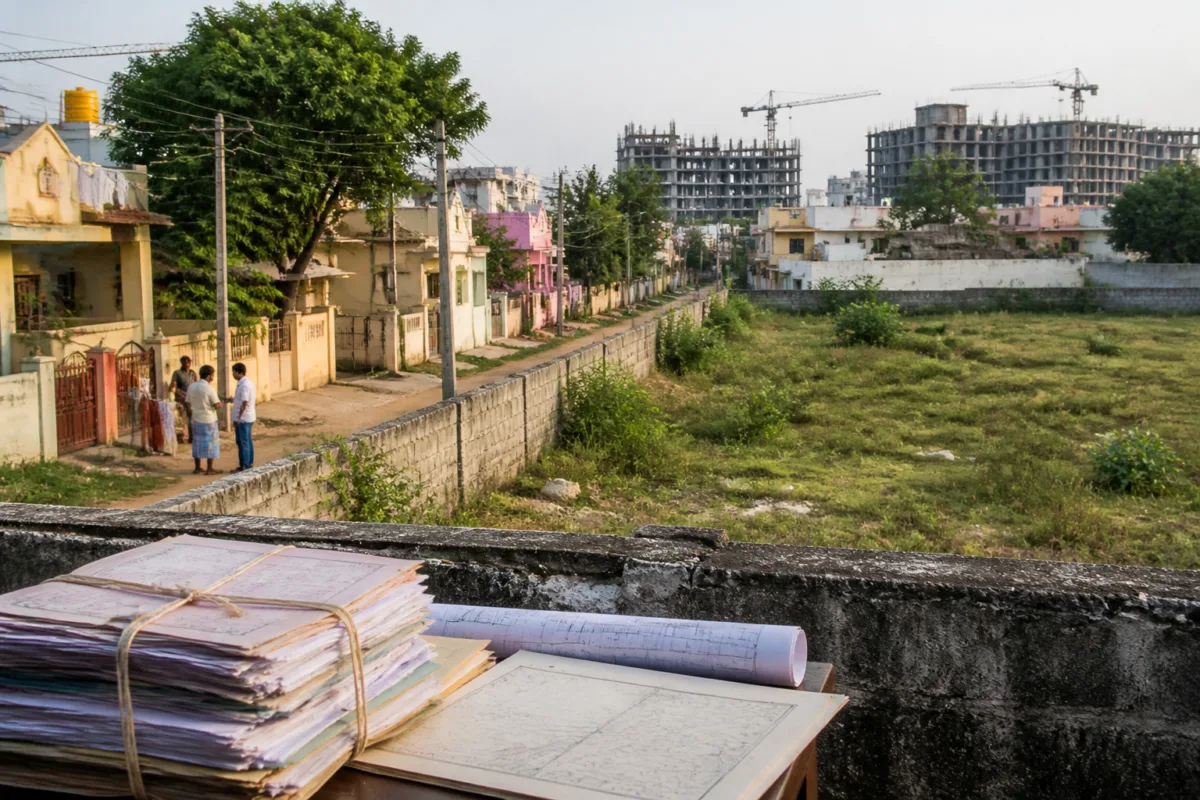
Tamil Nadu Housing Board land release has become a test of how the state manages land acquired for future housing plans but left unused for years. A report by Dinamalar says work to release such land has stalled, leaving existing landholders seeking no-objection certificates and construction permissions in uncertainty.
The issue concerns 10,047 acres identified across several districts for possible future residential schemes. According to the report, much of this land remains unused, while former owners have built houses and continue to live on portions of it. This has created a contradiction at the centre of the Housing Board’s land administration: land reserved for possible future projects is not being used for those projects, but its ownership and development status continues to restrict the people occupying it.
The immediate dispute is not only about land titles. It is also about whether residents can obtain the administrative clearances needed to build or regularise construction. The Housing Board had been issuing individual no-objection certificates for construction permissions on such parcels. When the state began examining the release of unused land, however, the process of issuing these certificates was reportedly stopped for new construction proposals.
That interruption has converted an unresolved land decision into a day-to-day governance problem. People who may have been living on the land for years are required to approach the same institution that has not completed the process of deciding whether the land is still needed. Until that decision is made, the absence of a certificate can affect construction activity and leave residents repeatedly seeking documentary proof that the Housing Board has no active claim on the property.
The scale of the numbers makes the issue larger than a set of isolated property disputes. Of the land covered by preliminary acquisition notices, 5,910 acres were examined under the release exercise. Government orders were issued to release 3,710 acres, according to the report. The remaining land was referred for a decision by a two-member committee.
The difference between the land examined and the land released is 2,200 acres. The report does not establish the present legal or administrative status of each parcel within that remainder. It does, however, say that the committee’s work was affected after a change of government, with members reportedly stepping down. The resulting institutional gap appears to have left the release exercise incomplete.
This sequence shows how a land policy can lose momentum even after a formal decision has been taken for a substantial part of the affected area. A government order covering 3,710 acres provides an administrative route for release, but the unresolved balance continues to affect people whose properties fall within the wider land history. The report does not say whether the pending parcels are uniformly occupied, whether all are subject to the same acquisition stage, or whether individual cases require separate scrutiny. Those distinctions are important because land release cannot be implemented effectively through a single blanket administrative action if the underlying records differ from parcel to parcel.
The Housing Board’s role adds another layer of complexity. It had selected land in multiple districts for future residential schemes, but the land remained unused. At the same time, former owners were living in houses on the property. This suggests that the planning decision to retain land for possible future development did not translate into timely construction or acquisition. The report does not provide the dates of the original selections, the reasons projects did not proceed, or the financial and legal status of the acquisition process. Without those details, it is not possible to determine whether the delay arose from funding constraints, litigation, changes in housing demand, planning decisions or administrative inaction.
What is clear is that retaining land without using it can produce costs beyond the land itself. Residents may be unable to move ahead with construction, while the public authority must continue managing records, applications and competing claims. Construction professionals quoted in the report allege that no-objection certificates were stopped for new projects during the release process, although they also claim that certificates are now being issued to some applicants. The report does not independently establish the criteria being applied or explain why some applications are progressing while others are not.
That reported variation is central to the governance concern. A certificate system is most credible when applicants can understand the rules, the required documents and the expected timeline. If decisions are made parcel by parcel, the authority must still communicate why one application qualifies and another remains pending. Otherwise, a process intended to protect public land can appear unpredictable to residents and builders alike.
The construction sector’s demand is therefore connected to a broader public administration question. No-objection certificates are not merely technical paperwork when land ownership or acquisition status remains unresolved. They become the mechanism through which the state signals whether it continues to have an interest in the property. Any delay or selective issuance can affect the ability of households to construct, alter or use buildings, even when those households have been occupying the land for a long period.
The Housing Board official quoted by Dinamalar said that the recommendation of a high-level committee on releasing unused land is under government consideration and that government orders will be issued soon. This is the clearest stated next step in the report. It also indicates that the administrative process has moved beyond the original two-member committee and is now awaiting consideration at a higher level.
The statement, however, does not provide a timetable, identify the parcels covered by the recommendation or clarify whether no-objection certificates will be restored uniformly while the government’s decision is pending. Those details will determine whether the announcement produces a practical resolution or only begins another stage of review. The report also does not record a response from affected landholders or explain whether applicants have access to an appeal or grievance mechanism.
The episode highlights a recurring structural tension in public land management. Housing agencies acquire or reserve land because future schemes require a land bank. But when schemes are delayed, cancelled or reconfigured, the original acquisition rationale can remain embedded in official records long after the physical project has disappeared. Residents then encounter an administrative system designed around a future development that may no longer be active, while the agency must decide whether releasing the land could undermine its housing plans or resolve an obsolete reservation.
For cities and towns, the consequences are practical. Land that is physically occupied but administratively frozen cannot easily support planned construction or orderly redevelopment. At the same time, releasing land without a transparent record review could create new disputes over title, compensation, encumbrances or future public use. The balance depends on accurate parcel-level information and clearly communicated decisions, neither of which is provided in detail in the supplied report.
The Tamil Nadu case therefore raises three linked questions. First, how should the state identify land that is genuinely no longer required for public housing? Second, how should residents receive a timely and consistent decision when they already occupy or depend on that land? Third, what institutional process should prevent a committee-level review from stalling when its members leave or political administrations change?
The available evidence confirms that 10,047 acres remain central to the dispute, that 3,710 acres were ordered to be released, and that a further 2,200 acres were left for decision after preliminary notices covered 5,910 acres. It also confirms that construction approvals and no-objection certificates have become part of the conflict. The current extent of the remaining land, the criteria for issuing certificates and the date of any new government orders remain unclear. Those are the developments that will show whether the promised release of unused Housing Board land becomes a functioning administrative process or remains an unfinished policy exercise.

