


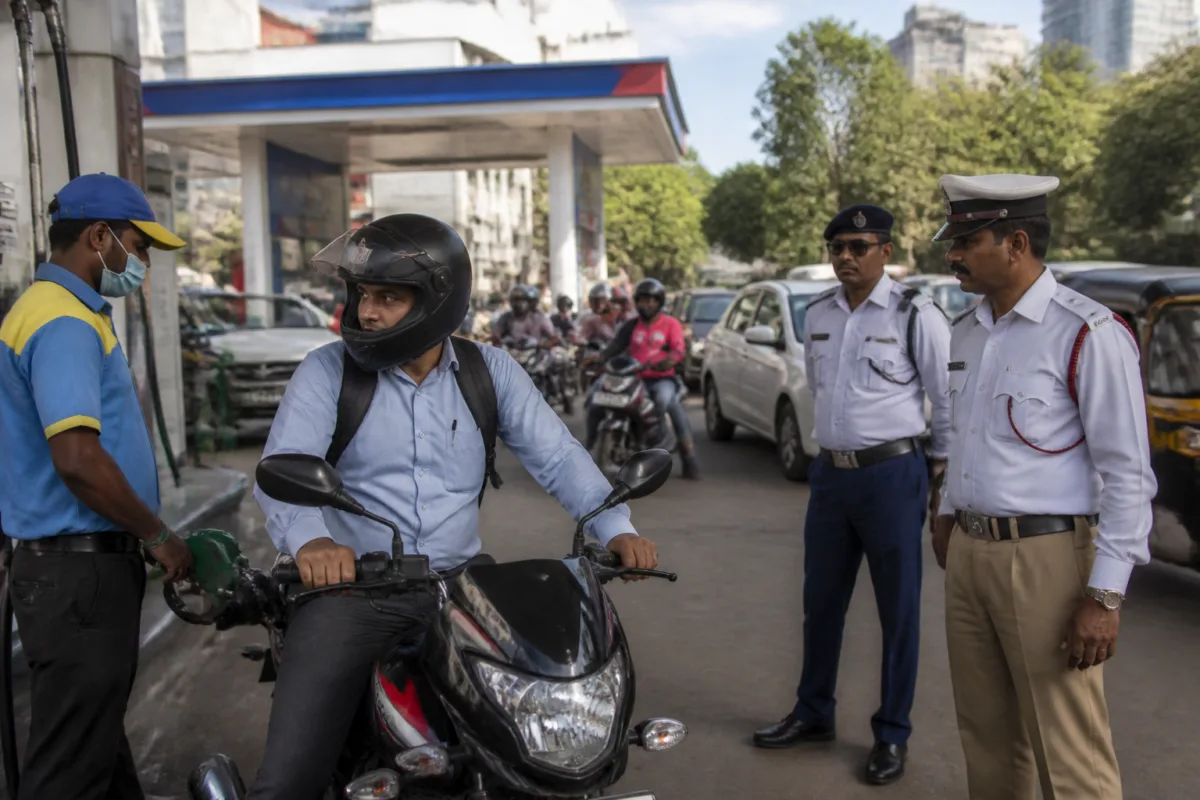
Nagpur district authorities have been directed to consider a “no helmet, no petrol” policy to improve two-wheeler safety, along with tighter enforcement of seat-belt rules, better road engineering and faster medical assistance for crash victims. The directions were issued by former Supreme Court judge Abhay Sapre, who chairs the Supreme Court’s Road Safety Committee, according to details reported from a road-safety meeting in Nagpur.
The proposed policy would deny fuel to two-wheeler riders who arrive at petrol pumps without helmets. However, the measure has not been implemented yet. Sapre directed the administration to examine whether the policy could be introduced as part of efforts to increase helmet use across the district.
The directions also include preventing entry into government departments, industrial establishments and educational institutions for people arriving without helmets on two-wheelers or without seat belts in cars. The report does not specify an implementation date, enforcement mechanism or whether the proposed restrictions would apply uniformly across all petrol stations and institutions.
The meeting highlighted the scale of road-safety challenges in Nagpur district and across India. The country records approximately five lakh road accidents each year, resulting in around two lakh deaths, according to figures cited during the proceedings. Maharashtra has nine districts among India’s 100 accident-prone districts, with Nagpur included on that list.
Officials noted that road accidents are more frequent in rural areas of the district than in the city. The meeting’s presentation identified narrow roads, heavy-vehicle movement, unsafe driving practices and inadequate street lighting as major contributing factors. The directions therefore extended beyond helmet compliance to coordination among departments responsible for roads, traffic management, vehicle movement and lighting.
Sapre said that regulations alone would not be sufficient without strict enforcement and sustained public awareness. The directions called for coordinated action by the relevant departments to address infrastructure and behavioural causes of crashes rather than relying only on penalties after violations occur.
Emergency response was another focus of the meeting. The health department was asked to ensure that injured people are shifted quickly to the nearest hospital after an accident. Timely hospitalisation is particularly important in the period immediately following a crash, but the report does not provide details of the hospitals, ambulances or response-time standards that would be used under the proposed arrangement.
Sapre also called for special efforts to reduce deaths in road accidents, referring to Japan as a model for lowering road-fatality rates. The immediate next steps are for the district administration and concerned departments to examine the proposed fuel-station and institutional restrictions and to coordinate measures addressing unsafe roads, heavy-vehicle traffic, street-lighting gaps, enforcement and post-crash medical care.

