


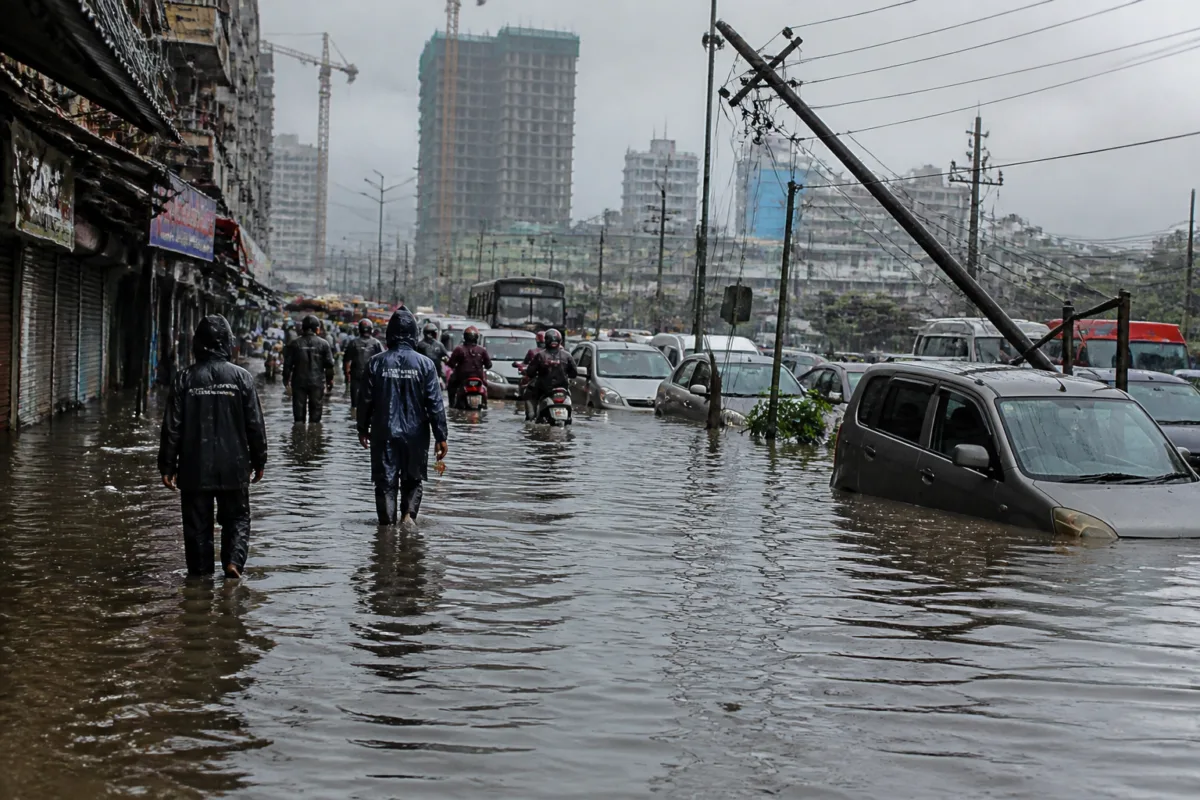
The debate over climate risk insurance is no longer limited to whether households can recover after a flood, heatwave or cyclone. It is increasingly about whether homes can obtain loans, whether businesses can remain financially viable, whether infrastructure can withstand future weather extremes and whether public budgets will be forced to absorb losses that private markets will not cover. A webinar organised by Climate Trends on November 12 placed this risk-transfer problem at the centre of the climate finance debate.
The discussion, titled “Climate Risk, Insurance and Who Will Pay: What Can Nepal’s West Learn?”, brought together specialists in climate change, public finance and insurance law. The participants examined the financial consequences of rising climate hazards, the limits of insurance, the exposure of banks and investors, and the possibility of making high-emitting companies contribute to recovery and adaptation costs.
Its central message was clear: climate change is already a financial and development problem. The question is not only how much money will be mobilised for clean energy or adaptation, but also who will bear losses that cannot be prevented, insured or recovered through existing systems.
That distinction matters for Indian cities. A major climate event rarely remains confined to a damaged property or a flooded street. It can disrupt electricity generation and transmission, transport networks, local employment, agricultural supply chains, business cash flows and the ability of households to repay loans. When these systems are financially connected, the cost of a disaster travels through the urban economy.
The webinar’s discussion of Nepal’s recent destructive flooding illustrated this chain. According to the report, the floods affected hydropower projects, electricity supply, transmission networks, transport and local livelihoods. The example showed how infrastructure damage can become an economy-wide disruption, particularly where public utilities, private businesses and household incomes depend on the same physical networks.
The same pattern is visible in the way climate risk is distributed across India. Abinash Mohanty, director and global sector head for climate change and sustainability at IP Global, cited research indicating that eight out of 10 people in India are exposed to some form of extreme weather risk. He also said around 75 per cent of India’s districts have become hotspots for extreme weather events. These figures were presented during the webinar and are not independently examined in the supplied report, but they point to the scale of the exposure that financial institutions and public authorities must assess.
Mohanty further said that about 40 per cent of Indian districts are experiencing a change in the nature of their climate risks. Areas historically associated with floods may face drought, while drought-prone areas may face greater flood risk. This change complicates conventional disaster planning, because infrastructure and insurance systems often rely on past patterns to estimate future exposure.
For cities, the implication is particularly important. Roads, power networks, buildings, drainage systems and transport infrastructure are designed to operate for decades. If their design assumptions are based on older weather data, their physical life may extend well into a period of more volatile conditions. Mohanty said infrastructure typically has an average life of 40 to 50 years, while much of it was designed using historical weather information.
He offered street lights and electricity poles as an example of a possible standards gap. According to the report, many such installations in India are designed to withstand wind speeds of about 60 kilometres per hour, while cyclonic conditions can produce winds of up to 110 kilometres per hour. The comparison does not establish that every installation follows the same standard, but it raises a direct institutional question: are construction and maintenance norms being updated quickly enough to reflect changing hazards?
This question goes beyond engineering. If an asset is damaged repeatedly, the cost may be borne by a municipal agency, a utility, an insurer, a lender or the affected citizen, depending on ownership and coverage. Where no clear risk-transfer mechanism exists, the loss eventually moves to public funds or household savings. That makes climate resilience a question of fiscal governance as much as physical design.
Insurance is expected to distribute risk across a broad pool of policyholders. However, the specialists at the webinar described a system under pressure as hazards become more frequent, severe or difficult to price. Insurers may respond by raising premiums, reducing coverage or withdrawing from some locations. These responses can be financially rational from the perspective of an insurer, but they can leave the most exposed households and businesses with the fewest resources to recover.
Insurance law specialist Yves Ayo Dite said insurance remained a mechanism for sharing risk and reducing the burden on individuals and families, but warned that it was not accessible to everyone. The concern is particularly serious where incomes are unstable or where property and livelihood losses are not fully covered. If coverage becomes unaffordable, a household may remain formally part of the financial system while being practically unprotected against a major disaster.
The consequences also reach housing finance. A property that cannot be insured may become more difficult to finance, mortgage or rebuild. The webinar’s moderator, Archana Chaudhary, referred to warnings from senior insurance professionals that rising climate risks could make it harder to insure several properties, businesses and economic activities. She noted that the impact could extend to home loans, banking, investment and the wider financial system.
Suranjali Tandon, associate professor at the National Institute of Public Finance and Policy, connected this risk to bank balance sheets. She said more than half of India’s total credit system operates through banks and related non-banking financial institutions. If floods, heat and other extreme events damage the assets of people and companies, their ability to repay loans can weaken. Banks may then face a rise in stressed assets at the same time that borrowers require fresh capital for repair and recovery.
Tandon said Indian financial regulators had begun addressing climate risk through disclosures and reporting. Guidelines issued for banks in 2023 addressed climate-related disclosures and reporting, although the report said they were not mandatory. Larger financial institutions have nevertheless begun assessing emissions and climate risks, while banks, insurers and capital-market participants are considering how climate exposure should influence financial decisions.
The limitation is that financial institutions cannot compensate for every loss generated by a climate disaster. Tandon therefore emphasised the role of governments and public financial institutions, particularly in supporting workers affected by heat-related productivity losses, disaster relief and social protection. This creates a difficult public-finance problem: states may have to spend more on emergency response and recovery while climate disruption simultaneously reduces economic activity and weakens household incomes.
The policy landscape therefore has at least three layers. The first is prevention through stronger construction standards, climate-sensitive land-use planning and resilient infrastructure. The second is risk transfer through insurance, credit arrangements and other financial instruments. The third is public recovery through relief, social protection and reconstruction. The webinar argued that concentrating only on the third layer—spending after a disaster—would leave the underlying exposure unchanged.
The discussion also raised a question about the role of insurers as investors. Dite said insurers do not merely assess risk and provide cover; they also invest the capital collected through premiums. This creates a potential contradiction if insurers restrict coverage because of climate risk while investing in fossil-fuel industries that contribute to greenhouse-gas emissions. The report presents this as a question of institutional responsibility rather than proof of wrongdoing by any particular insurer.
Rachel Westrate, assistant professor at Vermont Law and Graduate School, argued that taxpayers and ordinary citizens should not bear the entire cost of climate damage. She referred to the “polluter pays” principle, under which parties responsible for environmental harm may be required to contribute to remediation. She also discussed climate lawsuits against fossil-fuel companies and cited climate superfund laws in Vermont and New York, which seek financial contributions from fossil-fuel companies based on historical emissions.
According to the report, such funds could support recovery in affected areas, infrastructure strengthening and future adaptation. Their relevance to India remains a matter for legal and policy development; the webinar did not establish that an equivalent framework currently operates in the country. Westrate also referred to a 2025 advisory opinion of the International Court of Justice, saying it highlighted countries’ responsibilities in addressing climate change and the possibility of linking emissions to the activities of companies as well as states.
The legal route is not simple. International law may not easily compel countries to act against domestic economic or political priorities. However, the discussion suggested that domestic courts could become important arenas for testing the responsibilities of governments and companies. That possibility does not remove the need for stronger public planning, disclosure or regulation, but it changes the debate about who may ultimately be asked to pay.
The employment dimension adds another layer to the urban risk picture. Mohanty cited an International Labour Organization estimate that heat risk could affect between three and four crore jobs in India by 2030. The supplied report does not provide further details of the estimate, but its inclusion underlines how climate losses can appear not only as destroyed assets, but also as reduced working hours, lower productivity and declining incomes.
For planners and infrastructure agencies, the evidence presented at the webinar points to a mismatch between the long life of urban assets and the shorter time horizons often used for risk assessment. For banks and insurers, it indicates that property values and repayment capacity cannot be separated from the resilience of the surrounding transport, power, drainage and employment systems. For governments, it shows why relief budgets alone cannot provide a durable climate-finance strategy.
What the webinar establishes is the breadth of the problem: climate risk is moving through insurance markets, public finance, banking, construction, infrastructure and household security at the same time. What remains uncertain is how India will distribute the resulting costs, whether insurance will remain affordable in high-risk locations, and which institutions will finance adaptation before losses occur. Those questions will determine whether climate resilience becomes a planned public function or an unstructured burden passed from one affected group to another.

