


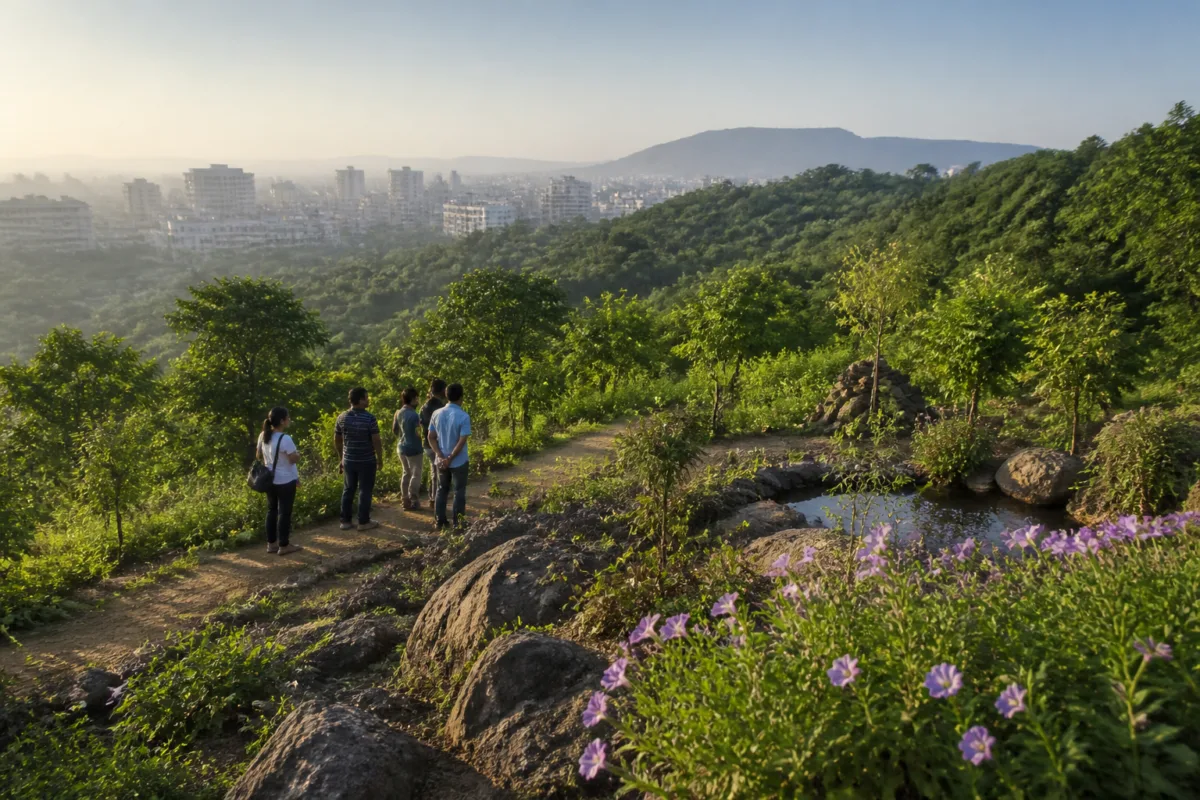
A barren hill in Pune’s Narhe area has been transformed into a biodiversity garden through a citizen-led effort that has reportedly helped conserve more than 23,000 trees since 2017. The initiative, run through the Zade Lava, Zade Jagva Foundation, shows that urban greening depends not only on planting trees but also on the less visible systems required to keep them alive: water supply, soil care, maintenance infrastructure and long-term community participation.
The project began with an idea among morning walkers and developed into a sustained plantation and conservation campaign. According to a report by Pudhari – Pune, the hill now supports more than 183 native plant species, 72 types of birds and 34 varieties of butterflies. These figures position the site as more than a landscaped open space. They indicate an attempt to rebuild a functioning urban habitat on land that had previously remained largely barren.
That distinction matters in a city where tree-planting drives are often measured by the number of saplings planted. The Narhe initiative has placed equal emphasis on survival. The foundation has arranged tanker water during summer, installed underground pipelines and created 23 water tanks to support the plants. Organic fertilisers have also been used, according to the report. Together, these interventions point to the practical challenge behind urban biodiversity: planting is a one-time activity, while ecological recovery requires repeated care across seasons.
The site’s reported transformation also illustrates the importance of choosing plants suited to local conditions. The presence of more than 183 native species suggests an approach that seeks to create a diverse habitat rather than a uniform plantation. Native vegetation can provide food and shelter for local insects and birds, while a varied plant structure can make an urban green space more ecologically useful than a collection of ornamental trees. The supplied report does not provide a species-by-species assessment or an independent ecological audit, but it identifies biodiversity as a central outcome of the project.
The foundation has also developed a butterfly garden with guidance from naturalist Suhas Kadu and financial support from Cummins India Limited. The stated objective is to create a suitable habitat for butterflies, bees and other pollinating organisms. This adds another layer to the project. A public green space can function as a recreational area for residents, but it can also support pollinators whose role is connected to wider ecological systems.
The reported presence of 34 butterfly varieties and 72 bird types gives the site a public-facing ecological identity. It also creates an opportunity for citizens to experience biodiversity within the city rather than treating nature as something located outside the urban boundary. For Pune residents, the hill can serve as a place for walking, observation and environmental learning. The foundation’s proposal for an open nature classroom appears intended to formalise that educational role.
However, the project’s current achievements have been built through a substantial maintenance effort. Watering a large number of trees during summer requires logistics, storage capacity and reliable access to water. The 23 tanks and underground pipeline represent an operating system behind the visible landscape. Tankers provide an additional seasonal supply, but the report does not establish the source, cost or long-term sustainability of that water. Those details will become important if the project expands or if similar models are adopted elsewhere.
The next phase proposed by the foundation includes continuous contour trenches, soil and water conservation work, repairs to farm ponds and development of the open nature classroom. These measures focus on retaining water and improving the hill’s capacity to support vegetation. The planned work suggests that the initiative is moving from plantation management towards landscape restoration, although the source does not provide technical details about the proposed contour-trenching or pond-repair projects.
The foundation estimates that between Rs 70 lakh and Rs 80 lakh will be required for the planned development. Its president, Pravin Bhosale, has appealed to citizens and companies to contribute through social responsibility programmes and public participation. This funding requirement highlights a central governance question for community-managed urban landscapes: who pays for the transition from a volunteer project to a durable public environmental asset?
The report attributes the garden’s financial support in part to Cummins India Limited, while the foundation appears to remain responsible for implementation and stewardship. This arrangement reflects a common structure in urban environmental projects, where civil-society groups bring local participation, companies provide corporate social responsibility support and residents contribute time or donations. Such partnerships can enable work that may otherwise remain outside routine municipal budgets. They can also raise questions about accountability, maintenance responsibilities and the continuity of funding when an initial corporate or community partnership changes.
The Narhe case therefore offers a useful way to understand the difference between an urban plantation drive and a long-term biodiversity project. A plantation campaign can focus on a target number of saplings. A biodiversity garden requires a wider set of indicators: survival rates, plant diversity, water availability, soil retention, habitat quality and the return of birds, butterflies and other organisms. The figures cited in the report—more than 23,000 conserved trees, 183 native plant species, 72 bird types and 34 butterfly varieties—provide a starting point, but they do not by themselves establish how the site has changed over time or how many plants survive each year.
That evidence gap does not diminish the project’s civic value, but it defines what would be needed to assess its performance more rigorously. A regular public record of tree survival, water use, species observations and expenditure could help residents understand how the hill is being managed. It could also allow the project to distinguish between planting activity and measurable ecological recovery. The supplied report does not say whether such monitoring is already in place.
The location is significant because urban hills are often exposed to multiple pressures, including construction, land-use change, erosion and unmanaged access. The source does not provide details about land ownership, planning status or municipal involvement at the Narhe site, so those institutional questions remain unestablished. Even so, the project demonstrates how a neglected or barren landscape can become a focus for collective action when residents, environmental practitioners and corporate funders align around a long-term objective.
The public-space value of the garden is also inseparable from its ecological function. Morning walkers were involved at the beginning, and the proposed nature classroom could expand participation beyond regular visitors. If designed and managed carefully, such a space can connect recreation with environmental education. It can help residents understand why native plants, pollinators, soil conservation and seasonal water management matter within a rapidly urbanising area.
At the same time, public access must be balanced with habitat protection. The supplied report does not describe visitor rules, carrying capacity or management arrangements for the butterfly garden. These details will matter as the site becomes more popular. Increased footfall can support public awareness, but unmanaged activity can also disturb habitats or damage young plants. The report provides no evidence that such pressures have emerged, only that the site is being developed for wider public engagement.
Pune’s Narhe biodiversity garden is thus best understood as an evolving urban restoration effort rather than a completed green-space project. Its reported achievements show what sustained local stewardship can accomplish when it is supported by water infrastructure, technical guidance and external funding. Its proposed next phase shows that ecological work does not end when a hill turns green; the harder task is to strengthen soil, retain water, maintain habitat and finance care over time.
The evidence currently available confirms the scale of the reported intervention and the range of biodiversity associated with the site, while leaving several questions open about land governance, independent monitoring, water costs and long-term maintenance. The next developments to watch are the proposed soil-conservation works, pond repairs, open nature classroom and the mobilisation of the Rs 70 lakh to Rs 80 lakh required for them. The Narhe experience will ultimately be judged not only by how many trees were planted or conserved, but by whether the urban ecosystem and the institutions supporting it remain resilient over the years.

