


Mysuru’s decline in the national cleanliness rankings is less a story about one missed award than a measure of how difficult it is for a city to sustain visible cleanliness without fixing the systems beneath it. A decade after ranking first in the country, the cultural city has failed to secure national recognition this year, according to a report by Prajavani – Mysuru. The report says Mysuru received recognition as Karnataka’s promising clean city, but did not come close to an award in any of the three national categories in which it competed.
The contrast with Mysuru’s earlier performance is stark. The city ranked first nationally in 2015 and 2016, third in 2019, 11th in 2021 and 14th in 2022. In 2023, it ranked 27th overall while securing second place in the category for cities with populations between three lakh and 10 lakh. It received recognition in the Super Swachh League category in 2024–25. In 2025–26, its recognition was limited to the Karnataka-level promising clean city award.
That sequence shows that the problem is not the disappearance of cleanliness work from Mysuru. Door-to-door collection of household waste is reported to be functioning well. The deeper difficulty is that collection has not been matched by equally reliable processing, disposal and environmental management. In a cleanliness assessment, the visible removal of waste from homes is only one part of the municipal service chain. The destination of that waste, the condition of treatment facilities and the management of sewage and drains determine whether a city can convert collection into a durable public-health outcome.
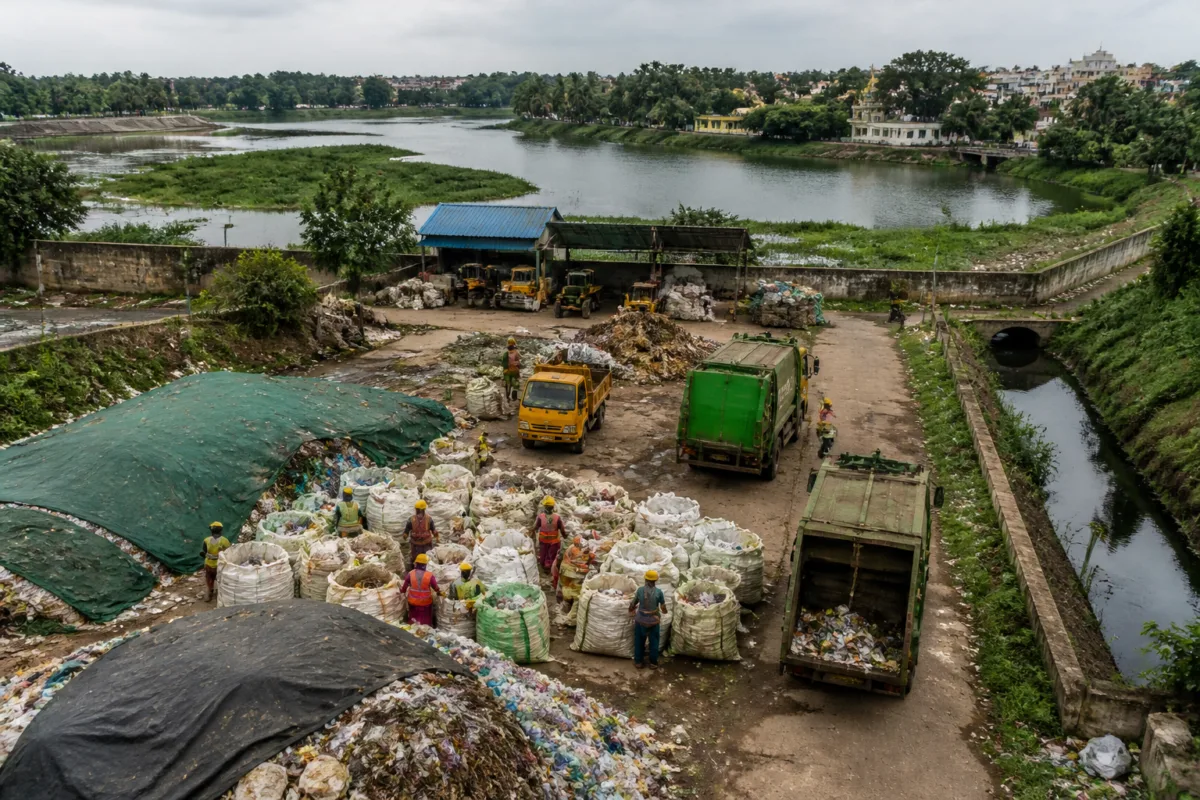
Mysuru’s most visible unresolved problem is the legacy waste accumulated at the Sewage Farm unit in Vidyaranyapuram. The report says the site held about seven lakh tonnes of waste built up over decades. Work to remove or process it has continued for several years, and about five lakh tonnes has reportedly been handled. Yet two lakh tonnes of old waste remain, even as new waste continues to accumulate. The result is a waste mound that has not disappeared despite years of remediation.
The legacy waste issue is compounded by the volume of fresh material entering the municipal system. More than 100 tonnes of solid waste and construction waste are generated or collected daily within the city, according to the report. The city has not yet achieved scientific management of this entire stream. A processing facility planned near Sathagalli at a cost of ₹11 crore is still incomplete. Until such infrastructure becomes operational, the city remains caught between the need to clear old waste and the continuing arrival of new waste.
This is an institutional problem as much as an engineering problem. Legacy waste remediation requires land, processing capacity, contracts, monitoring and a system that prevents fresh waste from being added to the same site. A delayed facility therefore affects more than one project milestone. It leaves the municipality without enough capacity to separate, process and safely manage the waste generated every day. It also makes the success of household collection less meaningful because the service chain remains incomplete after the collection vehicle leaves the doorstep.
The report identifies sewage entering Mysuru’s lakes as another major reason for the city’s weaker performance. Hebbal Lake underwent rejuvenation work costing ₹105 crore, and an eight-million-litre-per-day sewage treatment plant was established. However, untreated sewage is still reported to be reaching the lake. The city has also not been able to prevent sewage from entering Lingambudhi and Kukkarahalli lakes.
The gap between treatment infrastructure and actual water quality is important. A sewage treatment plant can demonstrate installed capacity, but the cleanliness of an urban water body depends on whether sewage is intercepted before it enters the lake, whether treatment systems operate as intended, and whether the wider drainage network is maintained. The report’s account suggests that the presence of a treatment plant has not by itself solved the problem of sewage flows into the city’s lakes.
Mysuru has also not achieved complete segregation of wet and dry waste at source, although such segregation is taking place in households. This distinction matters because partial segregation limits the value of downstream processing. Organic waste, recyclable material, construction debris and residual waste require different handling systems. If separation is inconsistent, the municipality must manage a more contaminated and difficult waste stream, increasing the burden on processing facilities and reducing the possibility of recovery or reuse.
The Swachh Survekshan system is designed to test these connected services rather than rely only on a city’s public image. The survey has been conducted across selected Indian cities since 2015–16 by the Union Ministry of Housing and Urban Affairs through the Quality Council of India. According to the report, the evaluation takes place through three broad stages. Municipal bodies submit records covering waste processing, toilet maintenance, sewage treatment and related services. Central teams then make unannounced visits to assess conditions on the ground. Public feedback is also collected through the survey website and the Swachhata app and contributes to the assessment.
This structure creates a built-in test of municipal credibility. Documents can show that a facility exists, while field inspections can reveal whether it is functioning. Public feedback can indicate whether residents experience the service as reliable. For Mysuru, the movement from national leadership to lower recognition suggests that the gap between reported infrastructure and everyday outcomes has become more consequential.
The city’s ranking history also indicates that recognition is not permanent. Mysuru’s early first-place results established a strong reputation, but subsequent rankings show that performance has fluctuated as evaluation categories and service expectations have evolved. The city’s position in 2023, followed by Super Swachh League recognition and then a state-level award, demonstrates that past success does not protect a municipality from current deficiencies. Cleanliness rankings measure continuing administrative performance, not historical reputation.
The responsibilities involved are distributed across several municipal functions. Waste collection and processing require the city administration to maintain vehicles, segregation systems, treatment facilities and disposal arrangements. Sewage management requires functioning networks, interception systems and treatment plants. Lake protection depends on preventing polluted inflows and maintaining the surrounding drainage system. Rajakaluves, or major stormwater channels, also require regular upkeep. The report identifies setbacks in sewerage, rajakaluve maintenance and related services alongside waste and lake pollution.
That distribution can make accountability difficult for residents to see. A failed waste-processing plant, a blocked drain and sewage entering a lake may appear to be separate problems, but they are linked by the capacity of urban institutions to plan, fund, operate and monitor basic services over time. A city can perform well in one visible function, such as door-to-door collection, while falling behind in less visible functions that determine environmental safety. National cleanliness assessments bring these gaps into the same frame.
Mysuru’s case also highlights the difference between project expenditure and service outcomes. The city has undertaken costly interventions, including the ₹105 crore Hebbal Lake rejuvenation and the planned ₹11 crore waste-processing facility at Sathagalli. Yet the report says untreated sewage continues to enter lakes and the new processing facility remains unfinished. These details do not establish that the projects were ineffective in every respect, but they show that spending and installed assets cannot substitute for completed, functioning and monitored systems.
The central urban question is therefore not whether Mysuru can regain a ranking in the next survey. It is whether the city can close the operational gaps that the ranking has exposed: the remaining legacy waste, incomplete processing capacity, incomplete source segregation, sewage inflows into lakes and weaknesses in sewerage and drainage management. The recognition received from Karnataka indicates that the city retains a functioning cleanliness base. Its loss of national recognition indicates that this base is not yet translating into consistent citywide outcomes.
The evidence supplied in the report confirms a decline in national recognition and identifies specific service gaps behind it. It does not establish the precise scores awarded under each Swachh Survekshan indicator or assign responsibility for individual failures. Those details would require the underlying survey records and municipal documentation. What is clear is that Mysuru’s cleanliness challenge has moved beyond collection and appearance. The next milestones are the completion of the Sathagalli processing facility, the handling of the remaining legacy waste, effective sewage interception for the city’s lakes and stronger management of segregation, sewerage and rajakaluves.

