


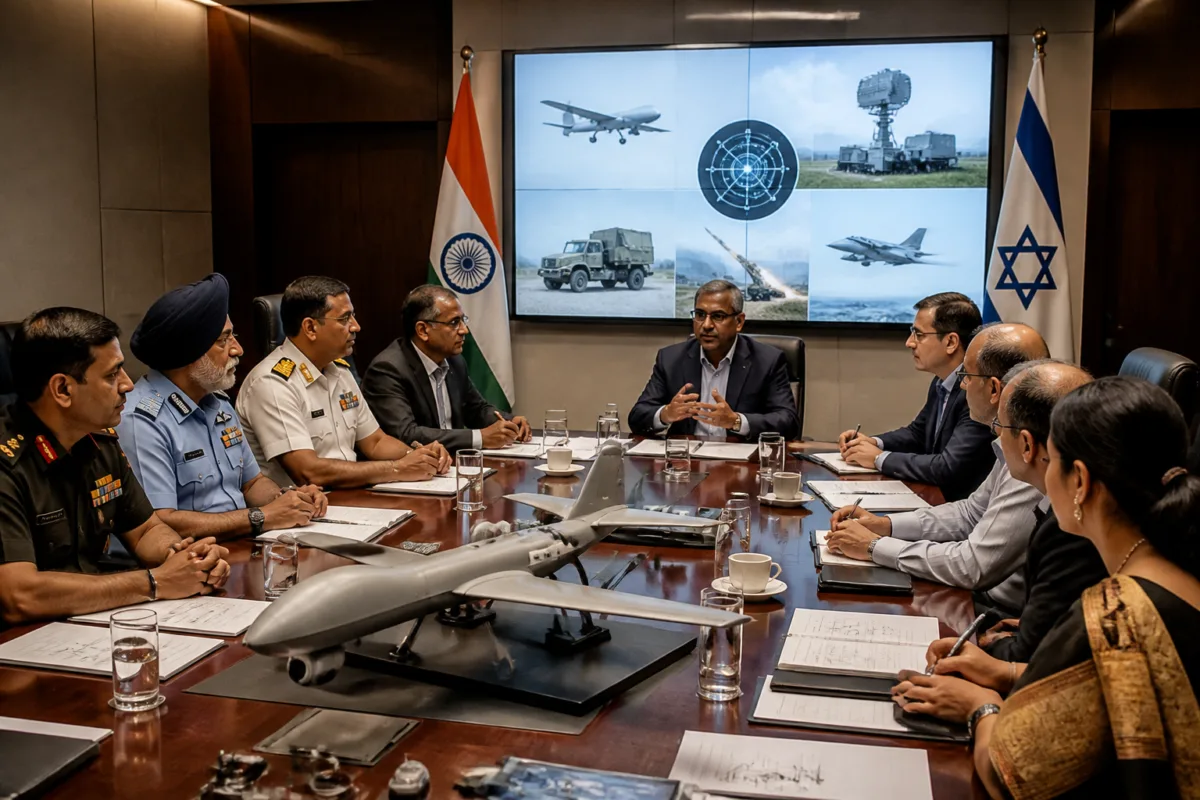
A defence dialogue in Chandigarh has placed a difficult institutional question at the centre of India’s self-reliance mission: can the country build an industrial system that delivers not only weapons, but also the upgrades, repairs, replenishment and technological adaptation required during a conflict?
The Combat Power and Capability Building Partnership Dialogue, organised by Gyan Setu Think Tank and the Chandigarh Citizens Foundation at the Confederation of Indian Industry headquarters, brought together military professionals, defence planners, procurement specialists, industry representatives, researchers and an Israeli delegation. Its focus was not limited to the manufacture of individual platforms. It examined the wider architecture needed to sustain combat capability, including indigenisation, strategic partnerships, technology transfer, multi-domain operations and wartime sustainment.
That distinction matters. A country can increase domestic production and still remain dependent on external suppliers for critical technologies, components, maintenance or replenishment. The discussions in Chandigarh framed self-reliance as the ability to decide what India must control, what it can secure through partnerships and what it must be able to substitute before a crisis. This is a more demanding test than simply increasing the number of defence products made within the country.
The dialogue also showed why defence manufacturing is increasingly an urban and industrial question. The capabilities discussed—drones, counter-drone systems, artificial intelligence, autonomous systems, air defence, munitions, intelligence, surveillance and reconnaissance systems—depend on a network of companies, laboratories, engineering institutions, skilled workers and public agencies. Their development requires coordination across procurement, research, manufacturing and military operations rather than isolated production contracts.
The case for this broader approach was made by General V P Malik, former Chief of the Army Staff and chairperson of the Chandigarh Citizens Foundation. According to the report, Malik argued that the changing nature of warfare requires the military, academia and industry to work in sync. He also said foreign partnerships should help India access advanced technologies rather than force the country to repeat technological paths already explored elsewhere.
This position identifies one of the central tensions in the self-reliance debate. Domestic capability cannot be built by treating every technology as a completely new project, particularly when military requirements are changing quickly. At the same time, foreign collaboration does not automatically create sovereign capability. The value of a partnership depends on what technology is transferred, how much of the supply chain is localised, whether Indian firms can absorb the know-how and whether the resulting systems can be maintained and upgraded without unacceptable external dependence.
The dialogue’s emphasis on retrofitting adds another layer to that challenge. India operates legacy platforms that cannot all be replaced at once. Extending their service lives through upgrades can preserve operational capability and reduce the pressure created by long acquisition cycles. But retrofitting is not merely a technical exercise. It requires access to components, design information, integration expertise, testing facilities and long-term maintenance arrangements. It also requires the military and industry to agree on which older systems remain worth upgrading and which should be replaced.
Drones and counter-drone systems emerged as a major priority in the discussions. Malik, as reported by the Times of India, described long-endurance drones and effective anti-drone systems as essential as warfare changes. He referred to the Ukraine conflict to underline the ability of drones to strike strategic assets far beyond conventional frontline areas. The implication is that airspace protection can no longer be viewed only through the lens of traditional aircraft and missile systems.
The discussion on drones also exposes the need for a complete capability chain. A drone ecosystem involves platforms, sensors, communications, software, data processing, trained operators and repair arrangements. A counter-drone system similarly requires detection, identification, decision-making and response capabilities. The operational value of any one product depends on how effectively it connects to the wider air-defence architecture.
The Chandigarh programme treated artificial intelligence and autonomous systems in a similarly measured way. The discussions recognised their growing role but did not present them as replacements for conventional weapon platforms. Existing systems, according to the report, will still require upgrades to remain effective as technology changes. This is significant because the transition to newer systems will be gradual, and defence forces must manage the coexistence of legacy equipment with digitally enabled capabilities.
The four-session structure of the dialogue reflected this layered problem. The first session examined lessons from the Iranian attacks, sustained operations, Israeli combat capability, air and missile defence, technology change, repair and replenishment. The second focused on air defence and counter-unmanned autonomous systems in contested airspace. The third examined weapon systems, munitions, ISR systems and the expansion of the battlespace into space, cyber and cognitive domains. The fourth turned to the relationship between military requirements and industrial capacities, including possible cooperation with Israeli industry.
Together, these subjects move the debate beyond procurement. Procurement is often measured through contracts, deliveries and platform numbers. Combat sustainment is measured through whether equipment remains available, adaptable and repairable under pressure. The sessions described in Chandigarh suggest that India’s industrial planning must account for both stages. A platform that enters service but cannot be replenished, upgraded or repaired efficiently does not provide the same level of resilience as a system supported by a mature domestic ecosystem.
The institutional challenge is particularly visible in the relationship between large corporations, MSMEs, research institutions and the armed forces. Malik said rising security requirements could create opportunities for MSMEs and larger companies to collaborate with foreign firms and manufacture advanced equipment jointly in India. That model could widen the industrial base, but its success depends on whether smaller firms can access testing, finance, technical information and predictable demand. The supplied report does not establish the scale of such opportunities or identify specific contracts, so the immediate outcome of the dialogue remains institutional rather than financial.
The presence of representatives from the Terminal Ballistics Research Laboratory, Base Repair Depot and academic institutions pointed to another requirement: connecting organisations that perform different parts of the capability-building process. Research laboratories may develop technologies, military units define operational requirements, repair depots understand maintenance constraints, universities contribute specialised knowledge and private firms build products. Without mechanisms to translate information across these institutions, innovation can remain disconnected from field needs.
The proposed role for international partnerships must also be assessed through this institutional lens. The Israeli delegation, led by Shay Gal of Line of State, discussed sovereign combat capability, air and missile defence, technology cooperation and transfer, and operational lessons from recent conflicts. The report says the delegation outlined areas of cooperation that could benefit both countries. However, it does not record specific agreements, investment commitments, technology packages or implementation timelines. The dialogue should therefore be understood as a platform for defining areas of cooperation, not as evidence that a new defence production arrangement has already been concluded.
That distinction is important for evaluating India’s self-reliance programme. The language of indigenisation can refer to several different outcomes: assembly within India, local production of components, domestic design ownership, independent maintenance, or control over upgrades and future modifications. These outcomes have different implications for strategic autonomy. A meaningful assessment requires clarity on which part of the capability is being localised and which dependencies remain outside the country.
The discussion also raises a planning question about how India prioritises defence research and manufacturing. The sessions identified drones, autonomous systems, air defence, munitions, ISR and multi-domain operations as important areas. Yet the report does not provide quantified production targets, procurement schedules, research budgets or performance benchmarks. Those details would be necessary to judge whether the priorities discussed can move from strategic conversation to sustained industrial capacity.
For cities such as Chandigarh and the wider northern region, the defence-industrial question has a direct economic and institutional dimension. The dialogue brought together military organisations, industry and academic institutions already located within or connected to the region. If such interactions lead to durable research, manufacturing and maintenance networks, they could deepen the region’s role in advanced engineering and defence production. The supplied material, however, does not establish that such a network has yet been created.
The larger urban question is whether India’s defence ecosystem can be planned as a connected industrial geography rather than as a series of separate facilities and contracts. Advanced manufacturing depends on reliable infrastructure, specialised skills, research capacity, testing facilities and supply-chain coordination. The same conditions that support defence production also shape the growth of high-value urban economies. But the dialogue makes clear that institutional coordination is as important as physical capacity.
The Chandigarh meeting therefore offers a useful measure of where the self-reliance debate currently stands. The strategic priorities are becoming clearer: India needs greater control over critical capabilities, carefully structured foreign partnerships, stronger links between military users and manufacturers, and systems that can be sustained during prolonged operations. What remains unestablished is how these priorities will be converted into funded programmes, measurable technology-transfer outcomes and operationally tested industrial capacity. Those implementation details will determine whether the dialogue becomes part of a durable capability-building process or remains another high-level exchange.

