


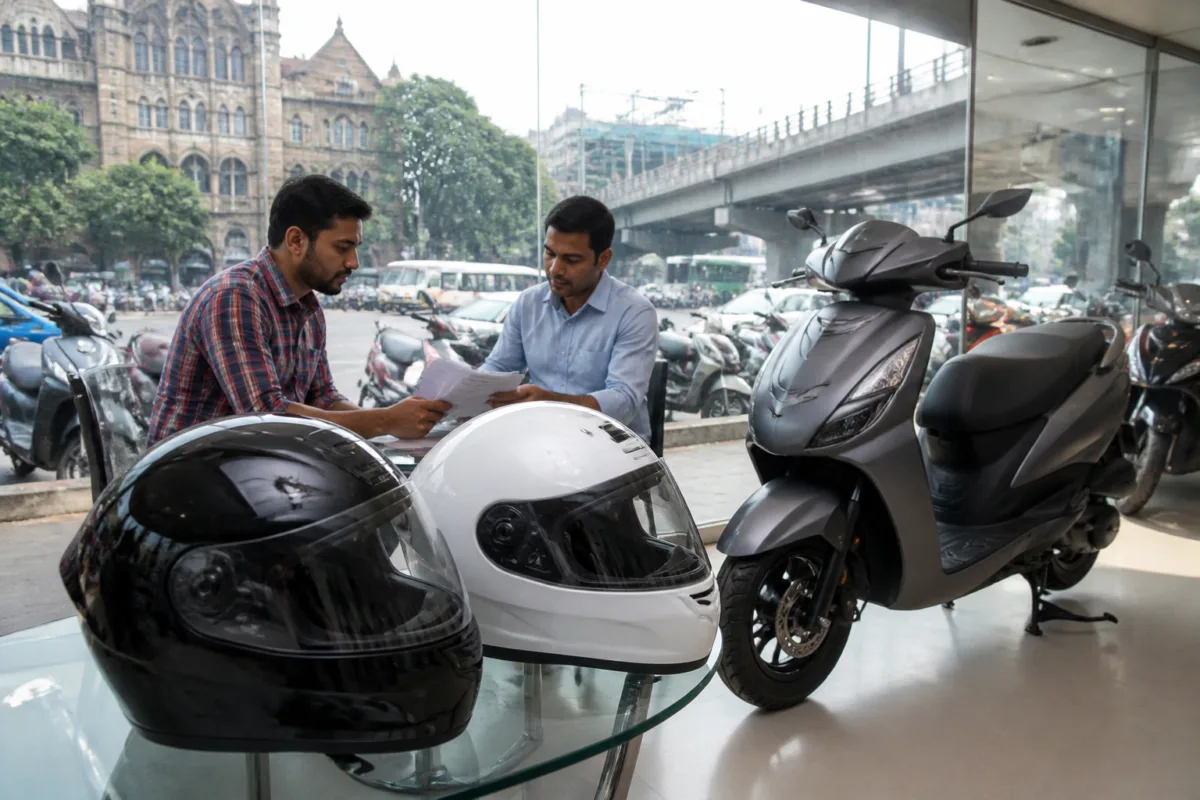
The Bombay High Court’s decision to seek replies from the Centre and Maharashtra on the supply of BIS-compliant helmets with every two-wheeler sale brings an old road-safety obligation into focus. The case is not only about whether buyers receive protective headgear at dealerships. It also raises a more consequential administrative question: why a requirement introduced through the Central Motor Vehicles Rules, and reiterated by Maharashtra’s transport department, has allegedly remained weakly implemented in practice.
The petition before the court has been filed by Delhi-based NGO Utprarit Consumer Foundation. It seeks implementation in Maharashtra of a rule requiring helmets conforming to Bureau of Indian Standards specifications to be supplied when a two-wheeler is sold. The organisation has also sought action through the Regional Transport Office against manufacturers and dealers who fail to comply.
According to the petition, the relevant rule was introduced through an amendment to the Central Motor Vehicles Rules in September 2005 and brought into force in March 2006. In February 2016, Maharashtra’s transport commissioner issued a press release stating that two-wheeler manufacturers had been directed to provide two helmets at the time of sale. Registering authorities were also directed to verify that the helmets had been supplied.
The significance of the present case lies in the gap between that stated administrative process and its alleged operation at the point of purchase. The petition says the 2016 direction has not been implemented in practice and alleges that manufacturers and dealers fail to supply even a single BIS-compliant helmet. It further alleges that buyers may instead receive sub-standard or counterfeit helmets, or be compelled to purchase helmets separately.
That distinction matters because vehicle registration is not merely a back-office step in the sale of a two-wheeler. The petition describes registering authorities as part of the proposed compliance chain. In principle, the dealer’s supply obligation and the registering authority’s verification function create two points at which the requirement can be checked: first when the vehicle is sold and then when it enters the official registration system. The court proceedings put the effectiveness of that chain under scrutiny.
The petitioner has framed non-compliance as a public safety and consumer protection issue. It says the absence of assured access to standardised and certified protective headgear leaves purchasers with difficult choices: use helmets that may not meet the required standard, buy another helmet at additional cost, or ride without one. The petition states that these circumstances expose riders and pillion passengers to a heightened risk of fatal and grievous injuries.
The report cited in the petition provides the scale of the road-safety concern. The Ministry of Road Transport and Highways’ Road Accidents in India 2023 report recorded 54,568 two-wheeler deaths, including 39,160 riders and 15,408 pillion riders. Together, these deaths accounted for 31.6% of all road accident fatalities cited in the petition.
Those figures do not, by themselves, establish that failures to supply BIS-compliant helmets caused any particular death or injury. They do, however, explain why the court case has significance beyond a dispute between consumers and dealerships. The petition is linking a product-supply obligation to a large category of road users and to the performance of institutions responsible for transport regulation and vehicle registration.
The case also shows how a safety rule can lose force when responsibility is distributed across several levels. The Central Motor Vehicles Rules provide the regulatory basis identified in the petition. The state transport department issued a direction in 2016. Manufacturers and dealers are expected to provide helmets. Regional Transport Offices are expected to take appropriate action against erring parties and, according to the 2016 statement cited by the petitioner, registering authorities were expected to verify supply.
Each role appears identifiable in the account before the court. What remains unclear from the supplied material is how frequently verification has occurred, what records are maintained, how non-compliance is detected and what penalties have been imposed. The petition’s central allegation is that the existence of these responsibilities has not translated into reliable compliance at dealerships across Maharashtra.
This is the institutional issue at the heart of the proceedings. A rule can be formally valid and publicly announced yet remain ineffective if compliance is not made visible, measurable and consequential. In this case, the proposed verification point is particularly important because registration creates an administrative interaction involving every newly purchased vehicle. The petition suggests that this interaction has not consistently guaranteed the delivery of compliant helmets.
The consumer dimension is equally significant. A buyer may assume that a safety item supplied with a new vehicle meets the applicable standard, particularly when it is presented by a manufacturer or dealer. The petition alleges that this assumption may not be safe, citing the supply of sub-standard or counterfeit BIS helmets. It also alleges that some buyers are asked to purchase helmets separately, shifting a cost and responsibility that the rule is intended to address at the time of sale.
The court has not, based on the supplied report, issued a final finding that all manufacturers or dealers are violating the requirement. The allegations remain part of the public-interest litigation and have prompted the court to seek responses from the Centre and Maharashtra. That distinction is important: the proceedings are examining whether the rule is being implemented and enforced, rather than establishing a final liability against every actor named in the petition.
The NGO has also sought public awareness campaigns informing consumers of their right to receive BIS-compliant helmets and encouraging them to report non-compliance. This request indicates that the petitioner sees enforcement as partly dependent on consumer awareness. If buyers do not know what they are entitled to receive, or how to report a failure, the transaction may end without a recorded complaint even when the requirement has not been met.
At the same time, awareness cannot substitute for institutional verification. The petition specifically seeks action through the Regional Transport Office, placing the enforcement question within the transport administration rather than leaving it entirely to individual buyers. The court’s response will therefore be watched for how it addresses the relationship between consumer reporting, dealer obligations, manufacturer responsibility and the registration process.
The case has a wider lesson for urban governance. Road safety is often discussed through driving behaviour, traffic enforcement and accident response. This petition directs attention to an earlier stage: the design of the vehicle purchase and registration system. A safety requirement is more likely to work when it is built into a routine administrative transaction, supported by documentary checks and followed by action when the requirement is ignored.
The supplied material does not establish how many two-wheelers are sold in Maharashtra without compliant helmets, how many dealerships have been inspected, or whether the state has maintained a public record of violations. It also does not provide the responses of the Centre or Maharashtra to the court’s notice. Those are important gaps because they will determine whether the case reveals isolated non-compliance, a widespread enforcement failure or a breakdown in coordination between regulatory and registering authorities.
The Bombay High Court’s intervention has consequently shifted the issue from an individual purchase complaint to a question of administrative implementation. The rule identified in the petition has existed since the mid-2000s, and the state’s transport department publicly reiterated the requirement in 2016. The current proceedings ask whether those formal steps have produced a reliable outcome for riders and pillion passengers.
The court adjourned the hearing to November 30 after seeking replies from the Centre and Maharashtra. The responses, along with any account of enforcement by the transport authorities, will clarify whether Maharashtra’s helmet-supply requirement is functioning as an enforceable road-safety measure or remains largely a rule on paper.

