


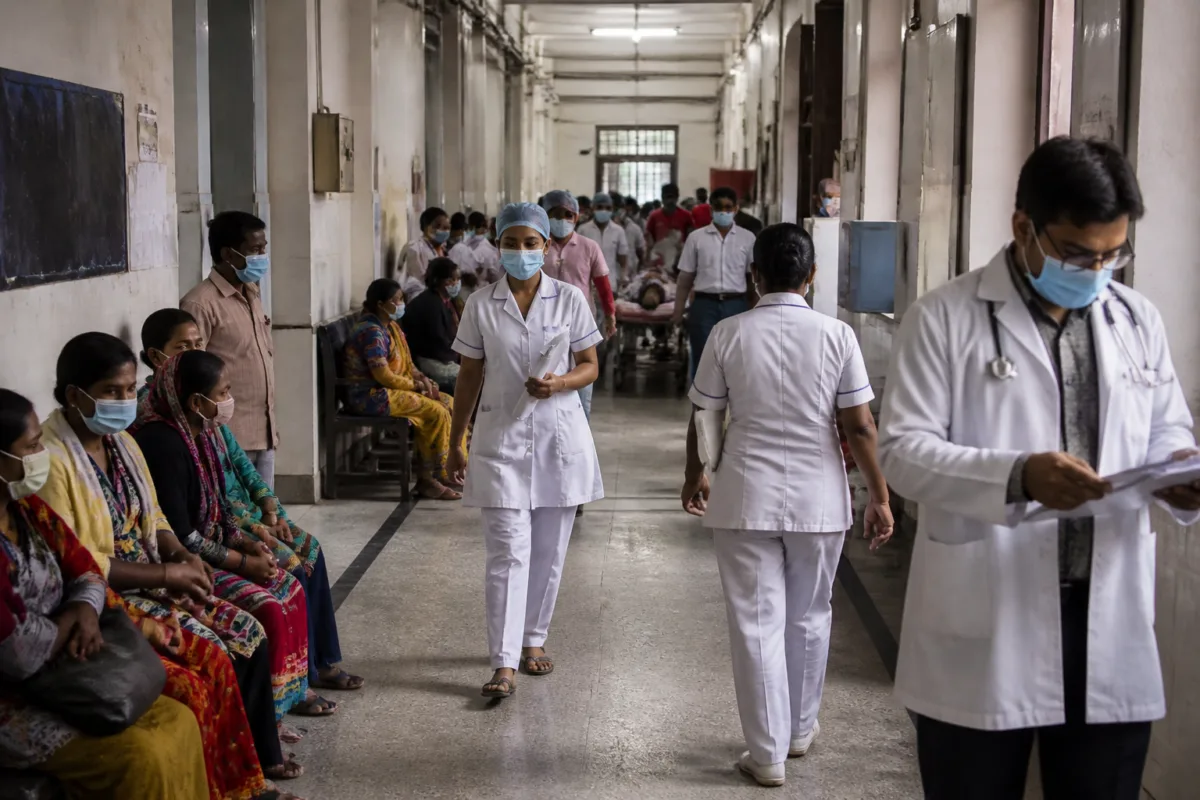
West Bengal’s plan to hire more than 2,000 doctors and 8,000–10,000 nurses on contract is not merely a recruitment announcement. It is an administrative response to a public healthcare system where the formal route to fill vacancies can take up to two years, leaving hospitals, medical colleges and district facilities to operate with unresolved staffing gaps.
Health minister Sharadwat Mukherjee said the recruitment process would begin from Friday and would be initiated by individual hospitals. The proposed hiring would cover facilities ranging from rural hospitals to medical colleges, as well as supporting health staff, including Group D employees. The stated objective is to prevent the health department from remaining short-staffed while the regular appointment process moves through the Public Service Commission.
The decision places speed at the centre of workforce administration. Mukherjee said regular recruitment involves advertisement, examinations, interviews and medical tests, and takes one-and-a-half to two years. For a hospital facing an immediate shortage, that timeline creates a gap between the recognition of a vacancy and the arrival of a person to fill it. Contractual recruitment is intended to close that gap by allowing institutions to hire staff when they need them rather than waiting for a centralised process to conclude.
That gap is visible in the state’s recent recruitment record. Notifications issued before the last Assembly elections covered 1,227 general duty medical officers, 622 assistant professors, 6,443 Grade-II staff nurses, 350 pharmacists and 809 medical technologists. Against roughly 9,450 vacancies, the state health recruitment board recommended 8,500 appointments to the health department. The figures show both the scale of the staffing requirement and the administrative lag between identifying vacancies, completing recruitment and placing staff in facilities.
The new system is not being presented as a replacement for regular recruitment. Mukherjee said the eligibility criteria for contractual hiring would be the same as those used for regular appointments. He also said contractual staff could retain their jobs if a shortage remained after regular recruitment. If the shortage disappeared following regular appointments, their contracts would be kept suspended. The arrangement therefore creates a temporary staffing layer whose continuation would depend on the department’s assessment of need.
That design could give the health department flexibility, but it also makes the definition of a shortage an important administrative question. The supplied account does not specify how hospitals will calculate vacancies, who will approve individual appointments, how long contracts will run or how performance will be assessed. Since recruitment will be initiated by individual hospitals, the process will place greater responsibility on institutions that may themselves be dealing with staff shortages and operational pressure.
The state’s decision also builds on an existing public health financing and recruitment framework. The National Health Mission and National Urban Health Mission allow urgent, decentralised contractual recruitment of doctors and nurses to address staff shortages and public health emergencies. Under these arrangements, contractual staff receive consolidated monthly remuneration rather than pay under regular pay commission scales. In West Bengal, NHM and NUHM are administered by the state health department and funded on a 60:40 basis between the Centre and the state.
Contractual recruitment drives under this framework had already begun in East Midnapore, East Burdwan, Birbhum and Diamond Harbour, according to the report. The latest announcement indicates an expansion of this approach across a wider range of health facilities. It also suggests that the state is using an existing institutional mechanism to respond to a broader staffing problem rather than creating a separate emergency system.
The distinction between regular and contractual employment is central to the debate. The government’s argument is operational: patients cannot be made to wait for a recruitment process that can take two years. Critics, however, argue that temporary employment may affect the ability of public facilities to attract and retain experienced professionals. Senior radiation oncologist Subir Ganguly warned that contract doctors may not be committed to their work and that the process could create opportunities for nepotism. Arnab Sengupta, a retired professor from Medical College Hospital, raised concerns about the quality of doctors hired and the possible effect on government medical facilities.
Other medical organisations have questioned whether contractual appointments can provide the stability required by the public health system. Biplab Chandra of the Medical Service Centre said capable medical students might avoid government facilities if employment is contractual. Utpal Bandyopadhyay of the Association of Health Service Doctors, which has written to the health minister opposing the move, said permanent appointments were necessary to attract capable and committed doctors.
These objections identify two risks that the supplied evidence does not resolve: the quality of decentralised selection and the long-term retention of staff. The government has said eligibility standards will remain the same, but eligibility is only one part of recruitment. The eventual effect on public facilities will also depend on how hospitals advertise posts, conduct selection, verify qualifications, supervise staff and handle complaints. The report does not provide details of these procedures.
The possibility of private practice adds another layer to the employment model. Mukherjee said doctors appointed on contract would not be barred from continuing private practice. That provision may make contractual posts more attractive to some doctors, but it also raises questions about working hours, availability, conflicts of interest and the boundaries between public duties and private work. No detailed rules governing these matters are provided in the report.
The state’s staffing challenge is therefore not limited to the number of vacancies. It involves the relationship between centralised recruitment, local hospital management, funding arrangements and the terms offered to healthcare workers. Regular recruitment offers a formal employment structure but can take a considerable amount of time. Contractual recruitment can respond more quickly but may create uncertainty over tenure, remuneration, professional commitment and institutional accountability.
The transfer of doctors and medical staff, another issue mentioned by the health minister, reflects the same administrative tension. Mukherjee acknowledged that transfers create stress and pressure for staff, while saying that the health department must be run properly. Transfers can help redistribute personnel, but they do not by themselves resolve the underlying need for a predictable recruitment pipeline. Nor does contractual hiring establish whether facilities will receive stable staffing over the long term.
West Bengal’s proposed appointments thus represent a test of whether a public health system can use temporary recruitment to manage a structural vacancy problem. The available figures confirm a large staffing requirement and a lengthy regular recruitment process. They do not yet establish how many contractual workers will actually be appointed, which facilities will receive them, how hospitals will select them or how the arrangement will be evaluated.
The next stage will be the recruitment process beginning at individual hospitals. Its transparency, eligibility checks, remuneration terms, contract conditions and coordination with regular appointments will determine whether the policy functions as a short-term bridge or becomes a parallel employment system. Those details will be essential to understanding whether faster hiring improves public healthcare capacity without weakening the institutional safeguards attached to permanent recruitment.

