


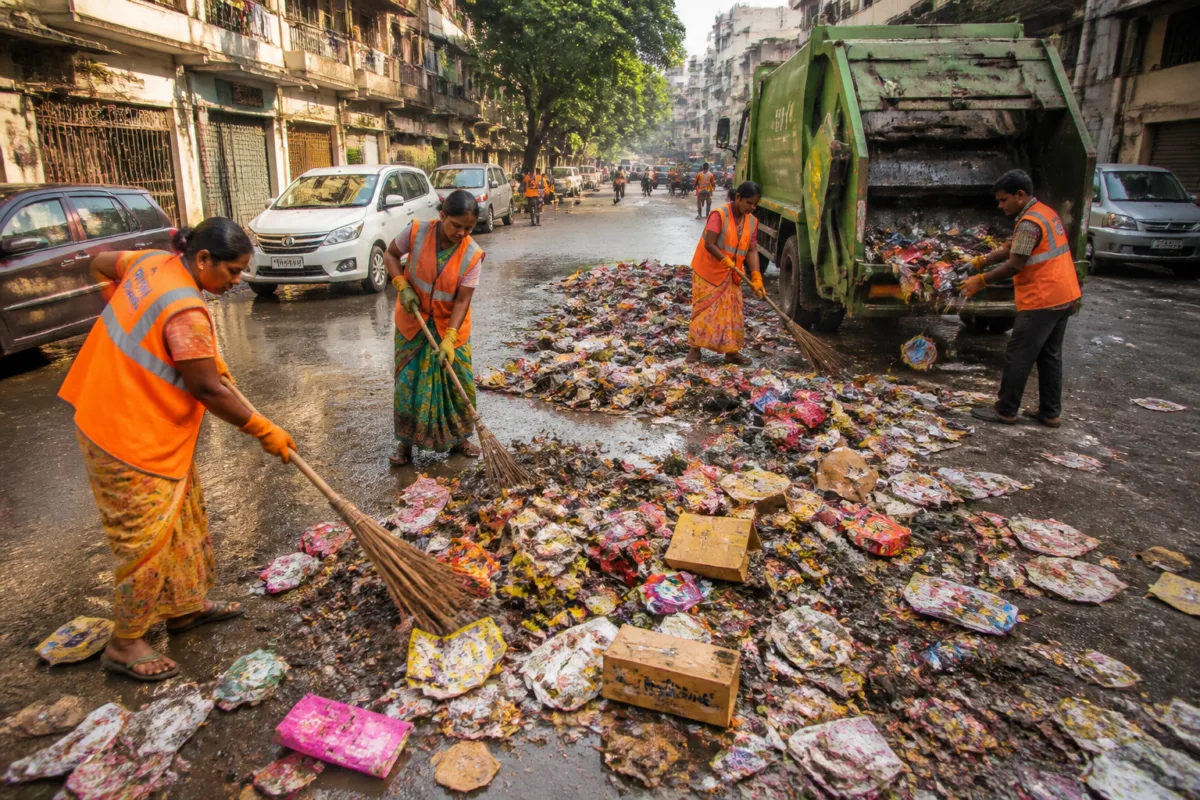
Mumbai’s Diwali waste figures reveal more than a seasonal spike in garbage. Between November 7 and 11, the Brihanmumbai Municipal Corporation collected and transported 36,445.06 metric tonnes of municipal solid waste through 6,787 vehicle trips, about 443 metric tonnes more than the five-day volume estimated from the city’s October daily average. The numbers offer a compact view of how the city’s sanitation system absorbs short-term pressure while relying on a large, largely invisible workforce to keep public spaces functional.
The BMC recorded an average daily waste collection of 720.040 metric tonnes in October, according to the report by Mid-Day. On that basis, the expected collection over five days was about 3,600.2 metric tonnes. The reported Diwali total therefore indicates an increase over the baseline used by the civic body. November 7 recorded the highest collection during the period, at 781.026 metric tonnes, transported through 1,399 vehicle trips. That was around 61 metric tonnes above the stated usual daily average.
The figures matter because festive waste is not generated in a single, easily managed location. The BMC said its teams focused on firecracker waste, gift boxes, packaging material and other festival-related garbage found on roads, in markets, residential areas and public spaces. These streams arrive through different channels and at different times. The operational challenge is therefore not simply to move a larger quantity of waste, but to identify, sweep, collect and transport material from a dispersed urban environment.
The five-day operation described by the BMC included road sweeping, door-to-door garbage collection, cleaning of vulnerable waste-dumping spots and transportation to designated facilities. The reported 6,787 vehicle trips indicate the logistical layer behind the headline figure. Collection depends on coordinated movement between workers on the street, drivers, helpers, supervisors and the facilities receiving the material. A rise in waste volume consequently places pressure on the entire chain rather than on collection crews alone.
## The city’s waste system is also a labour system
The BMC’s account places sanitation workers at the centre of the festive response. Sweepers, drivers, helpers, supervisors and other employees involved in collection and transportation remained on duty while residents celebrated Diwali. Their work ensured that waste generated across neighbourhoods, markets and public spaces was removed during the festival period.
That detail changes how the collection data should be read. The additional 443 metric tonnes were not only an administrative statistic; they represented additional material that had to be handled through labour-intensive processes. The report does not provide a separate breakdown of how much of the increase came from firecrackers, packaging, household waste or commercial activity. It does, however, identify the categories that received special attention and the locations where the civic body expected waste to accumulate.
The BMC’s appeal to residents to segregate waste and hand it only to authorised collection workers also points to the limits of a system that must manage both volume and material quality. Residents were asked not to dump or burn garbage in public places. These requests are relevant to the operating model because waste that is mixed, abandoned or burned in public areas can require additional municipal intervention beyond routine door-to-door collection.
The supplied figures do not establish whether segregation rates improved or declined during the five-day period, nor do they show the final treatment or disposal destination for each waste stream. What they establish is the scale of collection and transportation and the municipal measures deployed to maintain cleanliness during the festival.
## From festive spike to municipal planning problem
A five-day collection total is useful because it places a temporary event against a stated baseline. The October average provided by the BMC allows the Diwali period to be assessed not as an isolated number but as a departure from ordinary daily operations. The difference was not described as a system failure. Instead, the BMC presented it as an increase managed through additional attention from sanitation teams.
That distinction is important for urban administration. Cities must plan not only for average demand but also for predictable peaks. Festivals, public events and holiday periods can change the timing, location and composition of waste. In Mumbai’s case, the BMC identified firecracker remnants, gift packaging and other festival material as specific sources requiring prompt removal. This indicates that seasonal planning involves targeted deployment as well as additional collection capacity.
The reported trip count provides another measure of the system’s response. With 36,445.06 metric tonnes moved in 6,787 vehicle trips, the operation involved a substantial number of repeated collection and transportation movements across the city. The source does not provide vehicle capacities, ward-wise data, route details or the additional number of vehicles deployed compared with an ordinary period. Those omissions prevent a more precise assessment of productivity or resource efficiency, but they do not diminish the value of the available operational count.
The absence of a ward-level breakdown also leaves an important part of the urban picture unresolved. A citywide increase may be distributed evenly, concentrated in markets and high-density residential areas, or associated with particular public spaces. Without that information, the total shows the scale of the municipal response but not the geography of festive waste generation.
## Sanitation infrastructure and worker accommodation
The report links the Diwali collection operation to a wider BMC plan involving the sanitation workforce. The civic body is undertaking phased redevelopment of 146 sanitation worker colonies across Mumbai. Deputy Chief Minister Eknath Shinde said the project would provide workers with 300-square-foot homes in place of existing 150-square-foot accommodation. The BMC aims to provide service accommodation to all its 29,000 sanitation workers.
This housing plan adds an institutional dimension to the waste figures. The city’s ability to maintain daily cleanliness depends on a workforce whose working conditions and accommodation are part of the same urban system. Service housing is not separate from municipal operations when workers are responsible for essential, time-sensitive services across a large city. The stated redevelopment programme therefore places sanitation labour within the built environment and housing policy questions that accompany civic infrastructure.
At the same time, the supplied report does not provide the implementation schedule, financing details, colony-wise redevelopment plan or construction status for the 146 colonies. It also does not specify how accommodation will be arranged during redevelopment or when all 29,000 workers are expected to receive the proposed homes. These are central details for assessing whether the stated housing objective has moved from policy announcement to delivery.
The connection between the collection operation and the housing plan should therefore be understood carefully. The Diwali figures document the work performed during a defined five-day period. The colony redevelopment plan describes a broader civic commitment concerning the people who perform that work. The two issues are related through the sanitation system, but the available material does not establish that the housing project directly changed collection capacity during the festival.
## What the numbers confirm—and what they leave open
The evidence confirms four specific points. The BMC collected and transported 36,445.06 metric tonnes of municipal solid waste between November 7 and 11. It did so through 6,787 vehicle trips. The total was around 443 metric tonnes above the five-day estimate based on October’s average daily collection. November 7 was the highest-collection day in the reported period, with 781.026 metric tonnes moved through 1,399 vehicle trips.
The evidence also identifies the civic response: continued sweeping, door-to-door collection, cleaning of vulnerable dumping spots and transportation to designated facilities, with special attention to firecracker waste and packaging. It records an appeal for segregation and authorised handover, and it acknowledges the sanitation workforce that remained on duty.
What remains unestablished is equally important. The report does not include a ward-wise comparison, a material-wise breakdown, disposal or processing outcomes, collection costs, worker numbers assigned specifically to the festive operation, or a comparison with previous Diwali periods. It also does not provide independent data on whether public dumping or waste burning changed during the period. These gaps limit the conclusions that can be drawn from the total.
Still, the figures show why seasonal waste management is a governance issue rather than only a cleanliness issue. The city must estimate additional volumes, keep collection routes active, move material through its transport network and maintain public spaces while demand rises. The operation’s success depends on both visible municipal systems and the working conditions of the people who operate them.
Mumbai’s Diwali waste data ultimately provides a snapshot of how the city absorbs a predictable urban shock. The BMC has reported the volume collected, the vehicle movements used and the measures taken to manage festival-related waste. The next questions for public accountability are whether the civic body publishes more granular data, how the additional waste was processed, and how the proposed redevelopment of sanitation worker colonies progresses for the 29,000 workers identified by the BMC.

