


Karnataka’s decision to position investment beyond Bengaluru as a central theme of its upcoming Global Investors Meet is an attempt to address one of the state’s most persistent urban and economic imbalances: the concentration of opportunity in its capital. Senior ministers have presented regional diversification as a government priority, but the evidence supplied so far shows a policy direction rather than a completed investment geography.
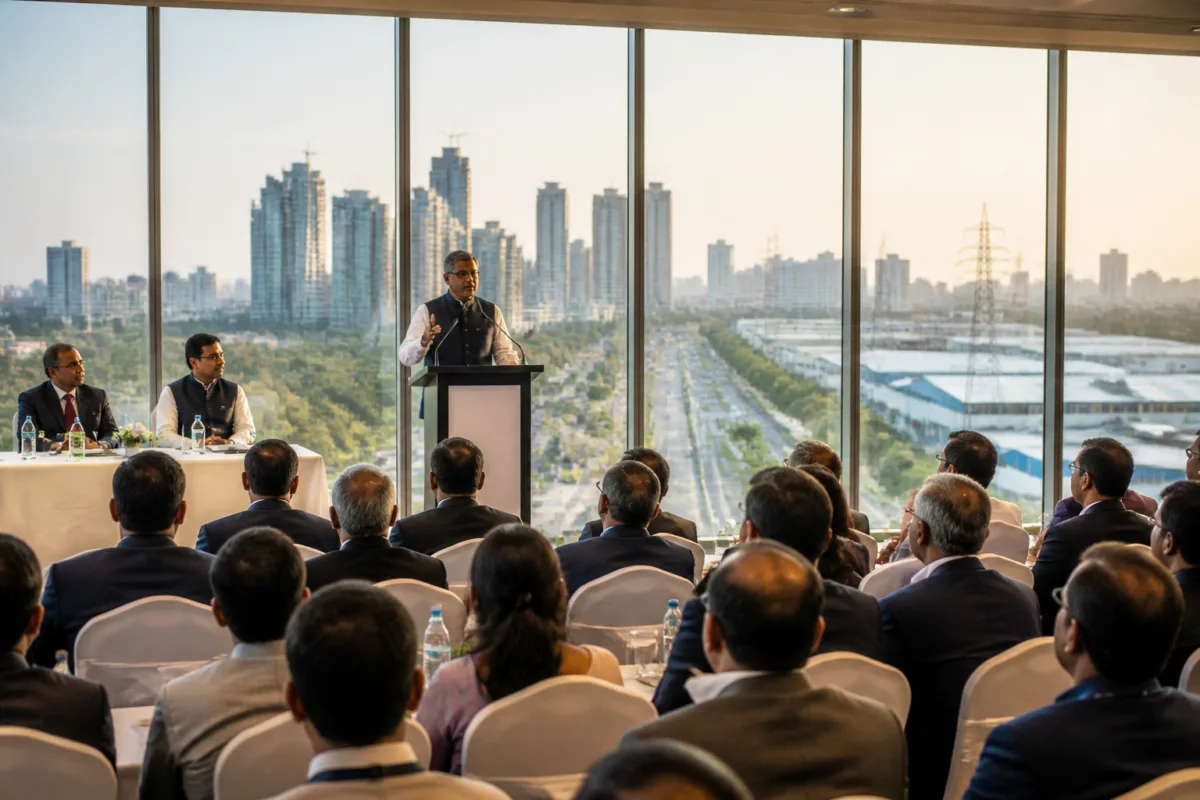
The Global Investors Meet will be held from April 20 to 22 at Bengaluru’s Palace Grounds. At a preparatory event, Chief Minister D.K. Shivakumar said he had met more than 200 investors globally and assured them that the entire state government would support investors. Deputy Chief Minister G. Parameshwara said Bengaluru’s position as a global technology and innovation centre would be strengthened, but added that Karnataka’s future should not be limited to the capital.
The distinction is important. Bengaluru is not being presented as a location that the government intends to weaken. Instead, the stated approach is to retain and expand the city’s technology and innovation role while creating credible investment opportunities in other parts of Karnataka. That makes the proposal less a choice between Bengaluru and the rest of the state than an effort to build a more distributed economic system.
The immediate question is how that distribution will be achieved. Large investment announcements do not automatically produce new industrial towns, employment centres or functioning regional economies. They must be connected to land, industrial infrastructure, utilities, transport, worker housing, skills, environmental approvals and administrative capacity. The report does not provide details on these elements, but the government’s own statements indicate that industrial parks and a more integrated industrial system are being developed as part of the response.
Industries Minister M.B. Patil said the government wanted development to be experienced across the state. He announced that a North Karnataka Investors’ Programme would be organised in the future to present opportunities in the Kittur Karnataka and Kalyana Karnataka regions to investors. The statement identifies two broad regions as targets for outreach, but it does not specify the projects, investment volumes, sites, infrastructure commitments or employment outcomes expected from the proposed programme.
That absence of detail matters because regional investment policy operates through more than investor conferences. A summit can create visibility and commitments, but the translation of those commitments into factories and jobs depends on what happens after the event. Patil cited the previous Global Investors Meet as evidence of progress: investment commitments worth ₹10.27 lakh crore were reported, and 65 per cent of that investment had already appeared in the form of manufacturing units.
The figure offers a significant basis for examining implementation, although the supplied report does not explain how the 65 per cent was calculated, the time period used, the geographic distribution of those manufacturing units or whether the figure refers to investment value, projects or another measure. Those distinctions are essential when assessing whether a summit has changed the spatial pattern of economic activity. A large commitment total and a manufacturing unit on the ground are not the same indicator, even when they are connected in the government’s account.
Still, the government’s use of the previous summit’s record suggests that implementation is being made part of the investment pitch. Shivakumar said his team would remain with investors at every step, while Patil said the government would provide more information on the industrial parks being developed for different sectors. These statements point to an administrative concern that often sits behind investment announcements: investors require a coordinated system capable of moving projects through multiple approvals and infrastructure requirements.
The proposed industrial parks are therefore more consequential than a promotional detail. Patil said parks for different industry sectors were being developed to create an integrated industrial system in the state. The report does not name the sectors, locations or delivery agencies, so the structure of the programme remains unclear. But the stated objective indicates an effort to organise industrial growth through planned clusters rather than relying entirely on individual projects seeking separate sites and facilities.
For cities outside Bengaluru, that approach could have implications beyond factory construction. New industrial activity generally requires supporting settlements, worker accommodation, roads, public transport, water supply, power connections, waste management, schools and healthcare. None of these outcomes is confirmed in the supplied material, and the government has not, according to the report, released a detailed regional infrastructure framework alongside the summit announcement. The urban question is therefore not simply whether investment will move geographically, but whether the receiving places are prepared to absorb it.
The government’s regional language also carries an institutional signal. Patil referred specifically to Kittur Karnataka and Kalyana Karnataka, while the proposed North Karnataka programme is intended to familiarise investors with opportunities in those regions. This suggests that the state is treating investor awareness as one barrier to regional diversification. However, awareness alone cannot resolve differences in connectivity, land availability, utility reliability, supply-chain access or the availability of skilled and affordable labour. The supplied report does not establish how those constraints will be addressed.
The policy architecture described so far has three visible layers. The first is global outreach, represented by the Chief Minister’s investor meetings and the forthcoming summit. The second is regional targeting, represented by the proposed North Karnataka programme. The third is industrial spatial planning, represented by sector-specific industrial parks and the stated ambition of an integrated industrial system. Together, these layers show an attempt to connect promotion, geography and project infrastructure.
What remains missing is a public account of how success will be measured. The previous summit’s ₹10.27 lakh crore commitment and the reported 65 per cent conversion into manufacturing units provide one implementation reference, but the report does not mention targets for regional distribution, operational jobs, local procurement, completion schedules or the share of investment expected outside Bengaluru. Without such measures, the phrase “development across the state” can remain broad enough to accommodate very different outcomes.
This is particularly relevant because investment figures can conceal concentration. A project may be located outside Bengaluru while depending heavily on the capital for finance, specialised services, management, research or logistics. Conversely, a manufacturing project in a smaller city can create a wider economic base if it is linked to local suppliers, training institutions and urban services. The source material does not provide enough information to determine which pattern Karnataka expects from the upcoming summit.
The comments from ministers also place considerable emphasis on state support. Shivakumar said the government would stand with investors, and Patil said his team would listen to every suggestion. Such assurances may help attract firms, but they also raise questions about the capacity of the administration to coordinate delivery across departments and regions. The report identifies the promise of support, but not the institutional mechanism, responsible agencies, timelines or public reporting system through which that promise will be assessed.
For Bengaluru, a more distributed investment strategy could alter the state’s development conversation without reducing the capital’s importance. The deputy chief minister’s statement explicitly combines continued support for Bengaluru’s technology and innovation role with a rejection of a Bengaluru-only future. The policy challenge is to make those goals complementary: the capital can remain a high-value economic centre while other cities and regions gain durable industrial and employment functions.
The evidence currently confirms an intention, a forthcoming summit, a planned regional investor programme and a set of claims about the previous summit’s implementation. It does not yet establish how much new investment will be directed outside Bengaluru, where it will be located, which sectors will lead it, or what infrastructure and housing arrangements will accompany it. Those details will determine whether the policy becomes a genuine rebalancing of Karnataka’s urban economy or remains primarily an investment-promotion promise.
The next important evidence will come from the Global Investors Meet itself and from the further information promised on sector-specific industrial parks. The location of announced projects, the conversion of commitments into operational units and the distribution of resulting jobs will show whether Karnataka’s regional investment agenda has moved from political priority to measurable spatial change.

