


Ujjain Municipal Corporation has ranked first in the 3–10 lakh population category at the Swachh Survekshan Awards 2025-26, securing the national cleanliness honour for the second consecutive year as the city prepares for the large visitor demand expected during Simhastha 2028. President Droupadi Murmu presented the award in New Delhi on Wednesday to Ujjain mayor Mukesh Tatwal, council president Kalawati Yadav and municipal commissioner Abhilash Mishra.
The award is Ujjain’s third in the national cleanliness survey, following wins in 2019 and 2025. The recognition covers the city’s work in solid-waste processing, source segregation, technology-enabled collection and sanitation operations across its 54 municipal wards.
According to commissioner Abhilash Mishra, the municipal corporation has achieved 100% remediation of legacy waste by clearing 1.47 lakh metric tonnes of garbage from the Gondia and MR-5 dumpsites. The reclaimed land has been developed into public parks. Mishra said the corporation had transformed civic sanitation through systematic waste processing, technological integration and social empowerment.
Door-to-door waste collection is carried out through 96 vehicles. The municipal corporation said segregation at source exceeds 95%, with waste separated into wet, dry, sanitary and domestic hazardous categories. A 156-member information, education and communication team oversees segregation, while the vehicles are tracked through GPS linked to the Integrated Command and Control Centre.
Sanitation workers clean public areas three times a day and are provided personal protective equipment and uniforms. Along the Kshipra riverbanks, a 25-member Kshipra Kavach team works in two shifts to prevent plastic use and the discharge of soap and shampoo into the river. The team also ensures that religious offerings, or nirmalya, are placed in designated pits.
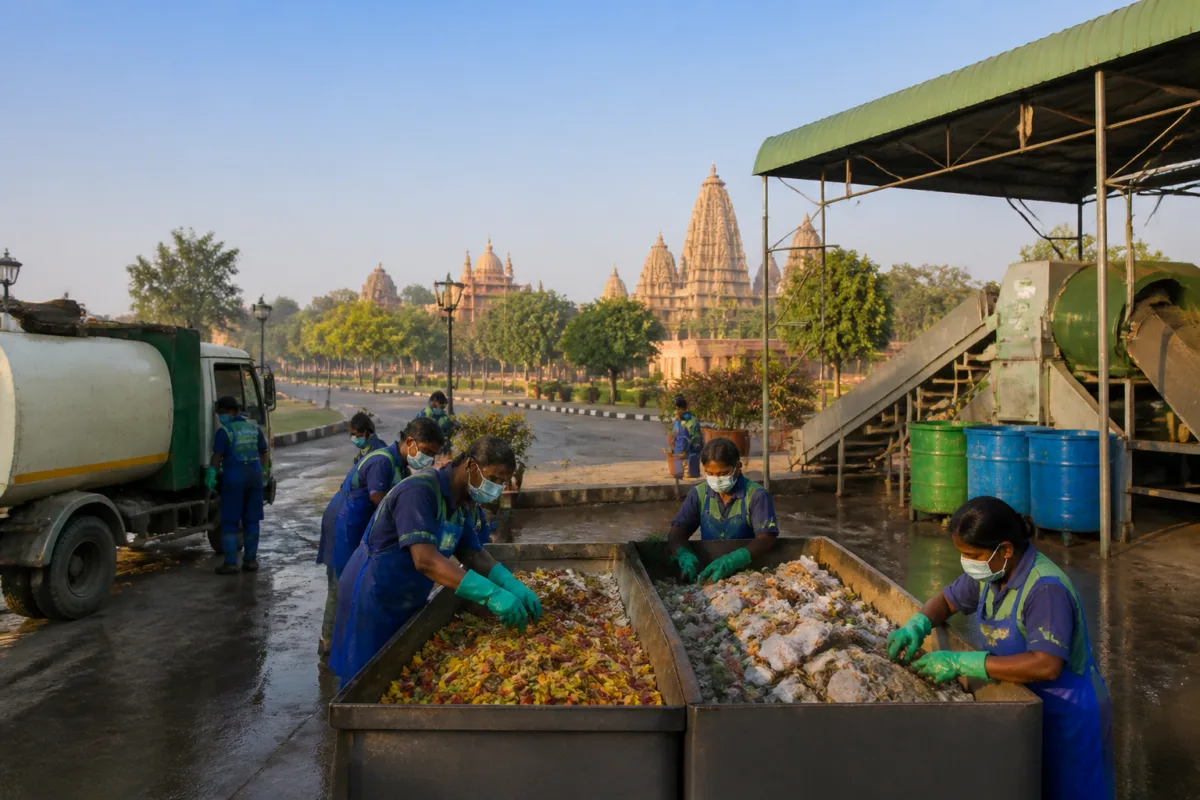
Religious and market waste is being processed through dedicated facilities. A 3-tonne-per-day floral waste plant on Mangalnath Road converts offerings from the Mahakaleshwar, Mangalnath and Kalbhairav temples into incense sticks, dhoopbatti and natural gulal. The plant is operated by women from the Shiv Arpan Self-Help Group, with capacity planned to increase to 10 tonnes per day. Clothes left at the ghats are converted into paper bags at a facility near Depot Chauraha managed by the Soumya Self-Help Group.
A 5-tonne-per-day biomethanation plant on Maksi Road processes wet waste from markets and bulk generators to produce electricity, which is sold to the state power distribution company. A 100-tonne-per-day construction and demolition waste plant on MR-5 Road produces paver blocks for footpaths and parks. The corporation has also registered 42 bulk waste generators, each producing more than 100 kg of waste daily, for mandatory on-site processing.
During 2025-26, health officials issued 5,536 fines and collected Rs24.40 lakh. Under the Swachh Shehar Jodi framework, Ujjain has provided technical support, GPS-tracking assistance and IEC support to Unhel Nagar Parishad. The municipal corporation has also issued public-private partnership tenders for green-waste processing, footwear and cloth recycling, and waste cafes.
Further facilities are being developed under Swachh Bharat Mission 2.0. A 175-tonne-per-day compressed biogas plant and a 145-tonne-per-day material recovery facility are being set up at Dabri village in Ghatiya tehsil. The projects are expected to generate annual royalty of Rs4.11 crore for the municipality, according to the report. The new systems will form part of Ujjain’s sanitation preparations as the corporation moves towards Simhastha 2028.

