


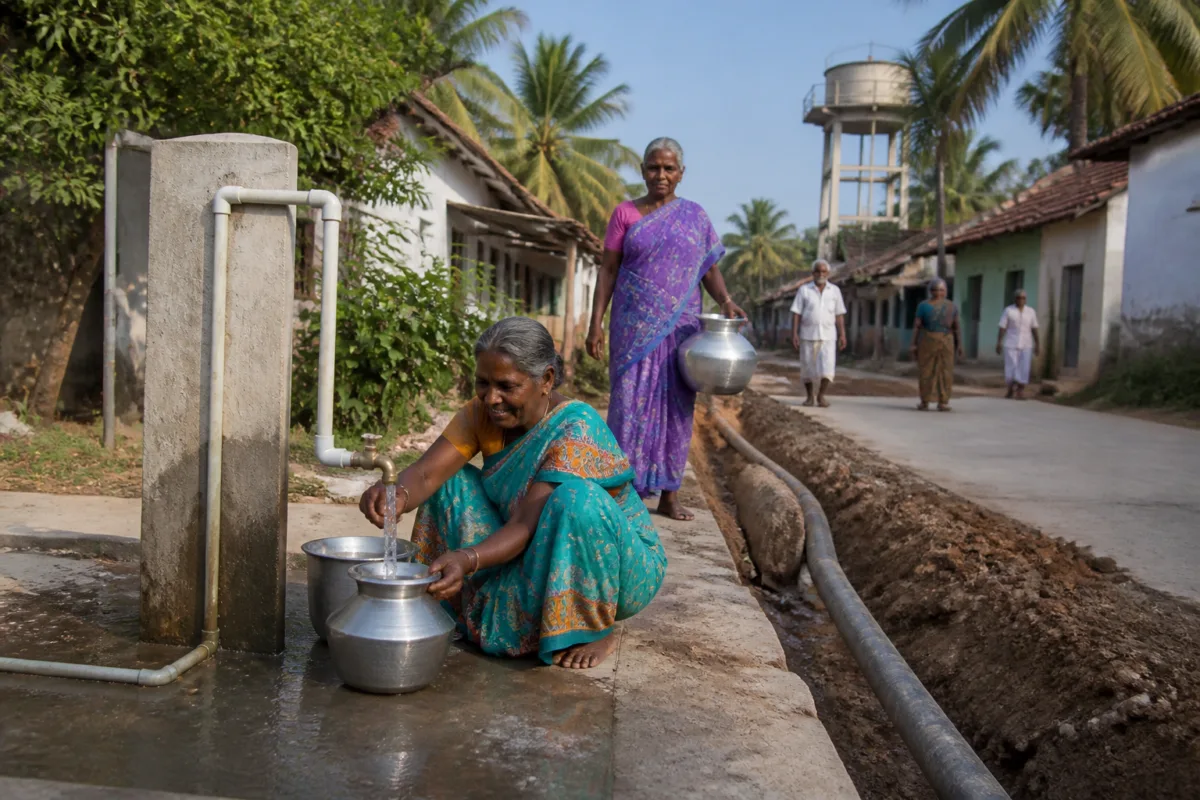
The Union government has set the end of 2028 as the target for providing household tap-water connections to every rural home across India under Jal Jeevan Mission 2.0, Union Jal Shakti Minister C. R. Patil said at a regional conference in Tiruchirappalli, Tamil Nadu, on Thursday.
The two-day conference is being organised jointly by the Union Ministry of Jal Shakti and the Tamil Nadu government. Representatives from Tamil Nadu, Karnataka, Andhra Pradesh, Telangana, Kerala, Puducherry and Lakshadweep are participating in the meeting, which is focused on the implementation of the next phase of the rural drinking-water programme.
Opening the conference, Patil said work under Jal Jeevan Mission 2.0 was being accelerated to meet the 2028 deadline. He said the objective was to ensure that all households across the country receive household drinking-water connections by the end of that year. The minister also said funds sought by the Tamil Nadu government for implementing the programme would be released in stages.
Patil said the responsibility would not end with the completion of construction. Village panchayats would need to be given awareness and support for maintaining the water-supply systems after the scheme is completed, according to the report. The statement places the maintenance of rural water infrastructure alongside the expansion of connections as a key implementation requirement.
Tamil Nadu Water Resources Minister Anand said the state was carrying out several projects to supply drinking water to 1.25 crore rural households. These include 45 new combined drinking-water supply schemes, the restructuring of 56 existing combined schemes and 21,258 individual village water-supply projects.
The projects have a combined allocation of Rs 18,123 crore, with Rs 9,025 crore provided as the Centre’s share and Rs 9,097 crore as the Tamil Nadu government’s share, Anand said. The figures indicate that the state’s implementation model includes both large, interconnected water-supply schemes and smaller projects serving individual villages.
Of Tamil Nadu’s 1.25 crore rural households, 1.15 crore have received household tap-water connections so far, according to the minister. The state has also reported that 9,398 village panchayats have achieved 100 per cent household tap-water coverage. Panchayats inhabited by tribal communities have been given priority in the implementation, he said.
The national deadline now shifts attention from the expansion of physical connections to the delivery and upkeep of functioning water services. The announcement did not provide a nationwide figure for the number of households still awaiting connections, nor did it specify a state-wise completion schedule. For Tamil Nadu, the next stages will involve completing the remaining household connections, advancing the listed projects and sustaining the systems through village-level administration.
The Tiruchirappalli conference is expected to continue with participation from the southern states and Union Territories represented at the meeting. The Union minister’s assurance was that funds requested by Tamil Nadu would be released progressively to support implementation through the 2028 target.

