


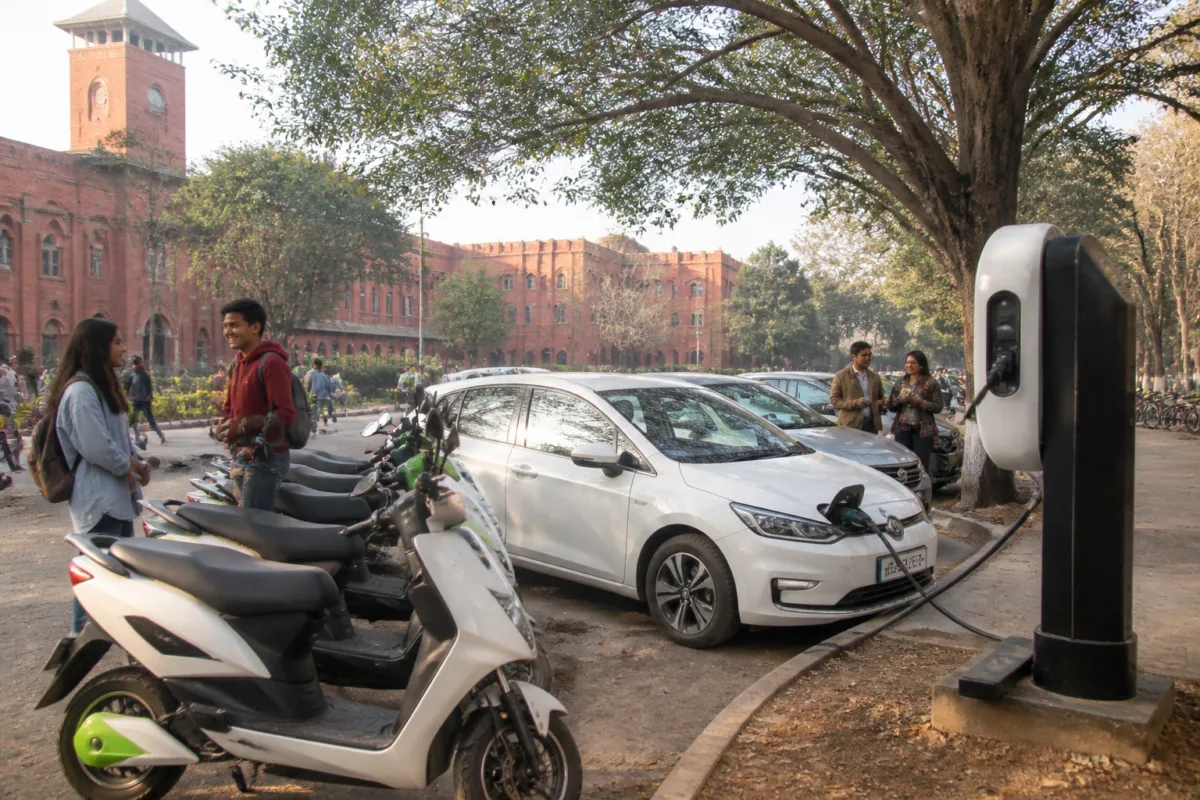
Delhi University may get electric vehicle charging stations across its North and South campuses, central administrative complex and all affiliated colleges after Executive Council member Sunil Sharma wrote to Vice-Chancellor Prof. Yogesh Singh seeking a university-wide charging network.
In his letter dated November 11, Sharma called for organised and accessible charging infrastructure in response to air pollution and the growing use of electric two-wheelers and cars by teachers, employees, researchers and students. The proposal covers more than 70 colleges affiliated with the university, according to the report by Jagran – New Delhi.
The letter said Delhi University has around 1,200 teachers, more than 1,100 non-teaching employees and over six lakh students. It also claimed that more than 20,000 students use electric vehicles. However, the report did not provide a separate official university assessment of the total number of EVs used by students and staff or details of existing charging points on individual campuses.
The proposed infrastructure is intended to address a practical problem for EV users: the lack of convenient charging locations during long periods of parking. Sharma suggested that charging stations should be installed at places where vehicles remain parked for extended periods. Teachers, employees and students commonly leave their vehicles on campus for six to eight hours, allowing charging to take place during the working or teaching day rather than requiring separate trips to public charging facilities.
The demand also highlights the operational challenge of shifting a large institutional community towards electric mobility. Access to a vehicle is not sufficient if users cannot reliably charge it at their destination. The shortage of charging points, along with concerns about vehicles running out of battery during journeys, can discourage people from adopting EVs even when they have regular access to campus parking.
Sharma linked the proposal to the National Electric Mobility Mission, the Delhi Electric Vehicle Policy and the sustainability objectives of the National Education Policy 2020. He said a coordinated charging system could reduce carbon emissions from vehicles used by the university community and support wider efforts to address air pollution in the National Capital Region.
The proposal does not yet specify the number of charging stations, the type and capacity of chargers, the locations to be prioritised, the electricity arrangement, user fees, operating agency or funding model. It also does not establish a timeline for installation. Sharma has asked the vice-chancellor to consider the proposal positively and initiate administrative action at the earliest. Any implementation will depend on a decision by the university administration and subsequent planning for campuses and affiliated colleges.

