


Ola Electric’s September-quarter results point to a deeper transition in India’s electric two-wheeler market than a narrower quarterly loss might suggest. The company is replacing much of its direct-to-consumer retail network with dealers, cutting borrowings and trying to increase production, while acknowledging that supply—not demand—is now the main constraint on its automotive business.
The company reported a consolidated net loss of Rs 362 crore for the September quarter, narrower than the Rs 418 crore loss recorded in the corresponding quarter last year. That improvement, however, came alongside a steep fall in revenue from operations, which declined 39% year-on-year to Rs 421 crore from Rs 690 crore. Sequentially, the loss widened from Rs 336 crore in the June quarter and revenue fell 7.5% from Rs 455 crore.
These figures show why Ola’s immediate challenge is not simply profitability. The company is attempting to redesign the way it reaches customers, finances inventory and scales vehicle production at the same time. That makes the result relevant to the wider urban mobility system, where electric two-wheelers depend not only on vehicle technology but also on retail access, after-sales support, charging availability and reliable delivery networks.
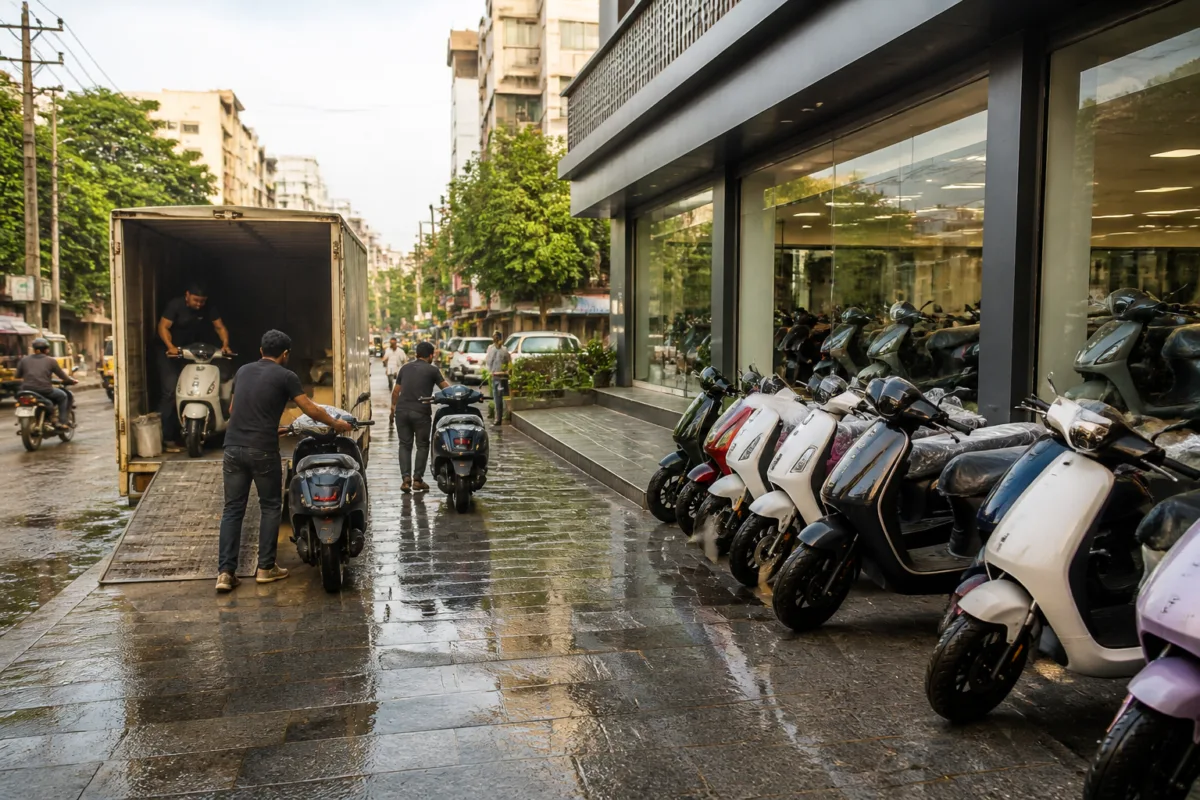
The most consequential change is the move away from Ola’s direct-to-consumer model. In its shareholder letter, the company said it had appointed 255 dealer partners operating 319 stores as of November 8, 2026. It plans to expand that network to 450 stores by December and 700 stores by March 2027. Ola stopped accepting orders through its direct-to-consumer stores on November 1 and expects to close most of those outlets by December.
The transition changes the financial responsibilities within the sales chain. Under the new dealer model, dealers pay for vehicles when placing orders and hold inventory at their stores. Ola said this would reduce its working-capital requirements and lower operating expenses by another Rs 50 crore as company-operated stores are shut. In effect, the company is seeking to move some of the cost and inventory burden away from its own balance sheet while expanding physical market coverage through partners.
That model may improve the company’s cash position, but it also makes execution dependent on the quality and reach of the dealer network. A company-operated outlet gives the manufacturer direct control over sales, inventory and customer interaction. A dealer-led network requires coordination across independent businesses, including order placement, vehicle availability, service and local market coverage. The supplied results do not establish how individual dealers will perform, but they make clear that distribution has become a central operating variable for Ola.
The company’s financial position has improved in one important respect. Total borrowings declined to Rs 1,819 crore in September 2026 from Rs 3,132 crore in December 2024, while borrowings in the automotive business fell to Rs 337 crore from Rs 2,422 crore over the same period. Ola attributed the reduction to its qualified institutional placement and rights issue. It expects the automotive business to generate positive free cash flow in the near term, supported by lower debt, reduced operating expenses and an improving working-capital cycle.
The figures also show that lower debt has not yet solved the operating problem. Free cash flow remained negative at Rs 371 crore in the September quarter, compared with negative Rs 351 crore in June. Adjusted operating EBITDA loss stood at Rs 246 crore, narrower than the Rs 258 crore loss a year earlier but wider than the Rs 195 crore loss in the preceding quarter. The adjusted operating EBITDA margin deteriorated to negative 58.5% from negative 42.8% in the preceding quarter.
Gross margin was 29.93% in the September quarter, compared with 30.9% a year earlier and 30.5% in June. Ola said gross margins could decline slightly during the second half of FY27 because of the transition. That warning is important because the dealer shift is being presented as a route to lower operating costs, but it does not automatically guarantee stronger margins. The company’s cost structure will depend on production volumes, vehicle pricing, dealer economics, inventory movement and the pace at which company-operated stores are closed.
The automotive segment reflects the same tension between scale and financial performance. Revenue declined to Rs 420 crore from Rs 688 crore a year earlier, while the segment’s net loss narrowed to Rs 214 crore from Rs 233 crore. The narrower segment loss alongside lower revenue indicates that cost reduction is already part of the company’s response, but the negative operating cash flow and widening sequential EBITDA loss show that the adjustment remains incomplete.
Ola’s production numbers provide the clearest evidence of the supply-side constraint it described. The company produced 9,235 vehicles in August, 12,284 in September and 14,092 in October. It is targeting production of 20,000 vehicles in November and expects to manufacture 25,000 vehicles in December. Ola said production had started increasing after remaining broadly flat for several months.
The company also disclosed that deliveries of 5,000 vehicles with paid orders were delayed from September to October because of charger unavailability. That detail connects the quarterly results to a practical issue in the EV market: a vehicle sale is not complete from the customer’s perspective if the associated charging equipment is unavailable. The delay also illustrates how a supply chain can constrain deliveries even when demand and manufacturing capacity are not the only limiting factors.
Ola’s statement that “demand is no longer our constraint; supply is” places the company’s current strategy in a different context. The immediate question is not merely whether electric two-wheelers can attract buyers. It is whether manufacturers can synchronise vehicle production, component availability, chargers, retail inventory and service support closely enough to convert paid orders into timely deliveries.
That coordination is particularly important in Indian cities, where two-wheelers form a practical part of daily mobility and where electric vehicles are often adopted for their running-cost advantages. The supplied material does not provide city-level sales, fleet-use or charging data, so it cannot establish how Ola’s transition is affecting specific urban markets. It does show, however, that the consumer-facing EV system extends well beyond the vehicle factory. A dealer store, a charger, a production line and a working-capital decision can all affect whether an urban customer receives and uses an electric scooter.
Ola is also continuing to develop its battery cell manufacturing business. The company said it had achieved the scheduled commercial operation date for 6 gigawatt-hours of manufacturing capacity and that the government had extended the Advanced Chemistry Cell Production Linked Incentive scheme timeline to calendar year 2031. The cell operation gives the company a second industrial focus beyond vehicle assembly, although the results supplied do not establish the capacity’s current output, utilisation or contribution to vehicle costs.
This manufacturing ambition adds another layer to the business transition. Ola is simultaneously reducing retail ownership, lowering automotive borrowings, expanding dealer coverage, increasing vehicle production and developing battery cell capacity. Each step addresses a different constraint: cash tied up in stores and inventory, financing costs, product availability and the long-term supply of a critical EV component. The strategy is therefore not a single turnaround measure but a reorganisation of the company’s operating model.
The policy environment matters because battery manufacturing is linked to the government’s ACC PLI scheme, while the company’s retail and production changes are being driven by commercial pressures. The supplied results identify the scheme extension but do not provide the value of incentives received, eligibility conditions or implementation milestones beyond the revised timeline. Those details would be necessary to assess how much public support contributes to the cell business.
The same limitation applies to the company’s expected improvement in free cash flow. Ola has identified lower debt, reduced operating expenses and a better working-capital cycle as the drivers of near-term improvement. It has also set specific dealer and production targets. But the September-quarter figures show that free cash flow remained negative and that sequential operating losses widened. The evidence therefore supports a conclusion that the transition is under way, not that it has already delivered a completed turnaround.
The larger urban question is whether India’s electric mobility expansion can be supported by operating networks as dependable as the vehicles themselves. Manufacturing scale attracts attention because it is easy to measure in units and gigawatt-hours. Customer experience depends on less visible systems: order fulfilment, charger availability, dealer density, inventory financing and service access. Ola’s results bring those systems into the centre of the EV conversation.
For now, the company’s evidence presents a mixed picture. Borrowings have fallen sharply, the automotive loss has narrowed year-on-year and production is rising from its August level. At the same time, revenue has declined, free cash flow remains negative, the sequential EBITDA loss has widened and paid-order deliveries were delayed by charger shortages. The next meaningful indicators will be whether Ola reaches its planned 450- and 700-store milestones, whether production approaches its November and December targets, and whether the dealer-led model improves cash generation without weakening customer fulfilment.

