


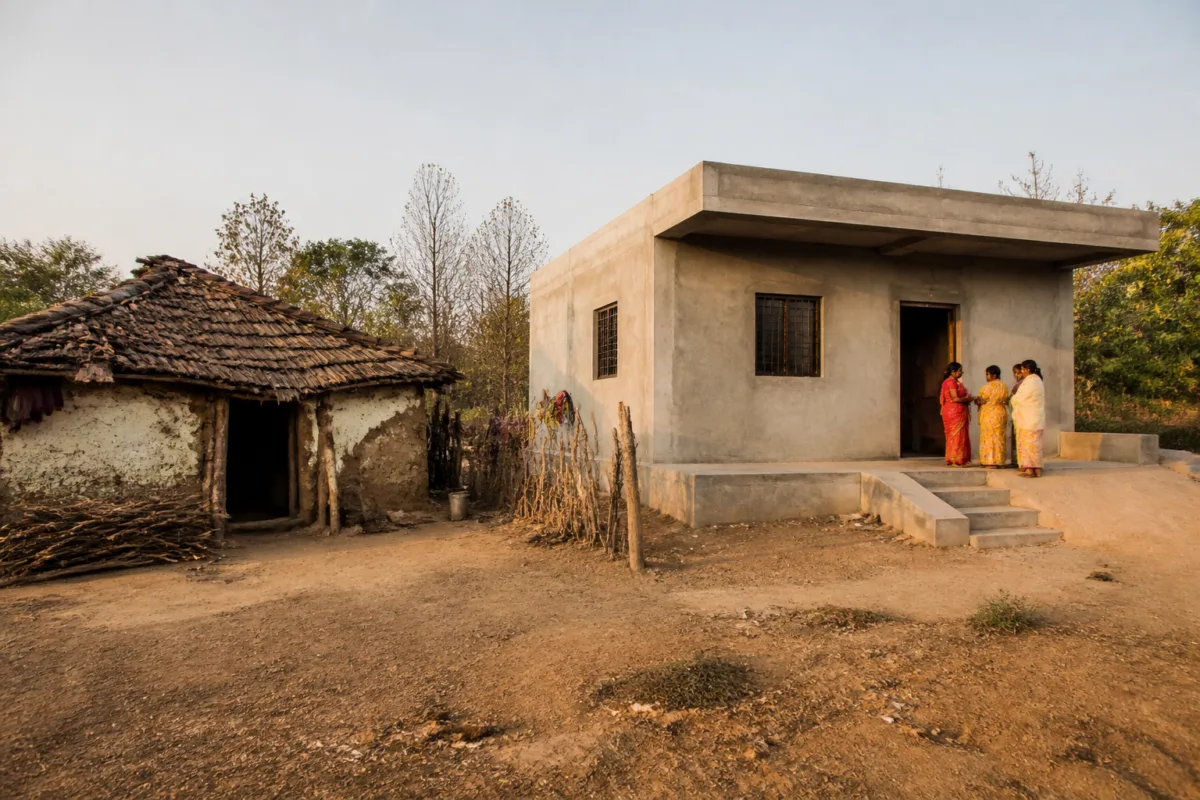
Mathurabai’s new concrete home in a remote Chandrapur hamlet is more than a housing benefit delivered decades late. It is the latest chapter in a 54-year journey that began with a custodial rape case, helped reshape India’s rape laws and yet left the survivor facing stigma, hardship and inadequate dignity for much of her life. Her rehabilitation shows how legal change can be historic on paper while remaining incomplete in the everyday lives of the people whose cases triggered it.
The 71-year-old Gond tribal survivor entered the house in Sindewahi taluka during a visit by Neelam Gorhe, a former deputy chairperson of the Maharashtra Legislative Council. The Maharashtra government allotted the home under the Pradhan Mantri Awas Yojana. Gorhe had visited Mathura a year earlier and returned on Bhai Dooj, describing the meeting as a personal “Bahin Dooj” celebration with a woman she had promised to support.
The contrast between the old and new houses carries the central fact of Mathura’s story. The ramshackle mud hut remains standing a few feet from the concrete home, a physical reminder that the person at the centre of a landmark legal struggle continued to live in difficult conditions decades after the case changed the national conversation on custodial sexual violence.
The housing intervention therefore matters not only because it provides a safer structure. It also demonstrates how rehabilitation depends on the ability of institutions and individuals to reconnect a historic case with present-day welfare systems. The new home came through a government housing scheme, but the account also records personal follow-up by Gorhe, support for Mathura’s sons and efforts to secure essential supplies. The result is a combination of formal entitlement and sustained intervention rather than a single administrative transaction.
Mathura’s case began on March 26, 1972, when her brother went to Desaiganj police station in Gadchiroli to report that she had been kidnapped. Mathura, then a young orphaned tribal girl working as a domestic help, was asked to remain at the police station. According to the account, two policemen, head constable Tukaram and constable Ganpat, sexually assaulted her there.
The legal process that followed moved through three different stages. A sessions court acquitted the policemen in 1974. The Bombay High Court convicted them in 1976. In 1978, the Supreme Court overturned that conviction. The verdict triggered nationwide protests and became a rallying point for women’s rights groups and legal scholars.
An open letter written by four law professors and a wider women’s movement helped lead to the Criminal Law Amendment Act of 1983. The changes strengthened protections relating to custodial rape and shifted the burden of proof in such cases. In institutional terms, Mathura’s case helped expose the particular power imbalance created when the alleged offence occurs in police custody, where the state controls the premises, the process and much of the evidence.
That legal legacy is the strongest reason the house cannot be viewed simply as a local welfare announcement. It connects criminal law, policing, social identity and housing. The case altered the legal framework for future survivors, but Mathura’s own life did not receive an equivalent transformation. The persistence of hardship points to a recurring limitation in rights-based reform: changing the law does not automatically create a system that identifies, tracks and rehabilitates the individuals whose suffering prompted that change.
The supplied account does not establish a complete rehabilitation package or provide figures on the number of custodial rape survivors who have received housing or other state support. It does, however, document several forms of assistance now being assembled around Mathura. Her elder son has found employment, while efforts are being made to secure a placement for her younger son. Gorhe also said that there were plans to document Mathura’s life, struggle and legal journey in a book.
These details broaden the meaning of rehabilitation. A house addresses shelter, but not necessarily livelihood, family security, public recognition or the ability to control one’s own narrative. The support described in Chandrapur includes all of these elements in partial form: a concrete home, employment assistance for the family, ration and Diwali kits, a shared meal with tribal women farmers, and a proposed written record of her experience.
The account also places the housing decision within a chain of institutional attention. Maharashtra took steps towards Mathura’s rehabilitation after a remark by former Chief Justice of India Bhushan R Gavai brought the forgotten case back into focus. Media coverage then helped bring her story to wider public attention. This sequence suggests that access to welfare and recognition was not automatic. It required the case to be remembered, publicly discussed and carried into the administrative system.
That is a significant governance issue. Welfare schemes such as the Pradhan Mantri Awas Yojana are designed to deliver housing support through administrative identification and eligibility processes. But a scheme can only reach a person whose circumstances are visible to the system and whose claim is connected to the relevant institutional channels. For a survivor living in a remote, drought-hit tribal hamlet, distance, poverty, social stigma and the passage of time can all make that connection difficult.
Mathura’s experience also shows why urban and rural housing policy cannot be separated entirely from questions of justice and state capacity. Although her home is in a rural Chandrapur settlement rather than a major city, the same built-environment questions remain central: whether a household has a safe structure, whether essential services and livelihoods are accessible, and whether public programmes reach vulnerable residents without requiring extraordinary advocacy.
The available evidence is specific but limited. It confirms the allotment of a PMAY home, the condition of the former mud hut, the survivor’s age and tribal identity, the history of the case, and the support being pursued for her sons. It does not provide the house’s cost, construction timeline, size, service connections or details of the administrative process through which the allotment was approved. Those missing details matter because they would show how the promise of rehabilitation was translated into a functioning home.
The absence of those details does not diminish the importance of the intervention, but it defines what can be concluded. The new house is evidence of recognition and material support. It is not, by itself, proof that the wider rehabilitation system has been resolved. Nor does the account establish whether similar support has reached other survivors whose cases became symbols of legal change.
The most important structural question is therefore not whether one house was inaugurated. It is why a woman whose case helped alter rape law had to wait until her seventies for a dignified home, and why renewed attention from public figures and the media was necessary to connect her with state support. The answer cannot be established fully from the supplied material, but the timeline makes the institutional gap visible.
Mathurabai’s new home closes one immediate chapter in a long story of exclusion. Its significance lies in the tension between the national legal reforms associated with her case and the delayed material dignity available to her personally. The next measure of rehabilitation will be whether housing, family livelihood, continued support and an accurate public record of her life are sustained beyond the ceremony that brought them together.

