


Hyderabad’s top ranking among India’s six major metros in the Swachh Vayu Sarvekshan 2026 is more than a favourable position on a national table. It offers a view of how air quality is shaped by the everyday work of urban local bodies: managing road dust, regulating construction and demolition waste, controlling vehicle and industrial emissions, improving solid-waste systems and coordinating public awareness measures.
The city scored 174.2 out of 200 and ranked 19th nationally among major urban centres with populations above 10 lakh. It performed ahead of Delhi, Mumbai, Bengaluru, Chennai and Kolkata in the metro comparison. Hyderabad also improved its position by three places over the previous assessment, according to the report published by the Times of India, which cited the Central Pollution Control Board’s survey results.
That combination of a strong score and an improved ranking matters because the survey does not assess air quality as a purely natural outcome. It evaluates the mitigation efforts undertaken by urban local bodies across several sources of pollution. The result therefore reflects both the pollution pressures a city faces and the administrative systems it uses to respond to them.
The survey’s categories point to the breadth of the challenge. Road dust, construction and demolition waste, vehicular pollution, industrial pollution, solid-waste management and public awareness all enter the assessment. These are not separate environmental issues operating in isolation. They are closely connected to how streets are built and maintained, how construction sites are managed, how waste moves through the city and how transport demand is met.
For Hyderabad, the current result suggests that the city has built a relatively effective combination of measures, although the available material does not identify the individual weight assigned to each category or state which specific intervention produced the largest improvement. That distinction is important. A high aggregate score confirms a broad performance outcome, but it does not by itself establish that every part of the city is performing equally well or that one programme can be credited for the result.
An environmentalist and retired official of the Telangana Pollution Control Board, Prasanna Kumar, attributed Hyderabad’s advantage partly to comparatively low levels of particulate matter, suspended particulate matter, benzene and sulphur oxides. He also pointed to the city’s relatively recent urban expansion and geographical spread. Unlike older metros that developed around densely concentrated urban centres, Hyderabad has grown in a more decentralised manner, he said.
Urban form can influence the way pollution is produced and experienced, but it does not remove the need for active management. A decentralised city may avoid some of the concentration associated with older, denser urban cores, while creating other administrative difficulties. Emissions, construction activity and waste flows can spread across a larger area, requiring monitoring and enforcement beyond a single central district. The survey result, therefore, should not be read as proof that Hyderabad’s geography alone has delivered cleaner air.
The institutional response described in the report is significant for that reason. Pollution board officials said the state has brought the Regional Transport Authority, the Greater Hyderabad Municipal Corporation and the police into the air quality monitoring committee. The stated purpose is to prepare, oversee and coordinate action plans for controlling and mitigating air pollution.
This arrangement recognises that no single agency controls the full chain of urban emissions. The transport authority is relevant to vehicle regulation, the municipal corporation to roads, waste and construction-related functions, and the police to enforcement and traffic-related activity. Bringing them into a common monitoring structure can address the administrative fragmentation that often weakens urban environmental programmes. The report, however, does not provide details of the committee’s meeting frequency, enforcement powers, compliance record or measurable outcomes.
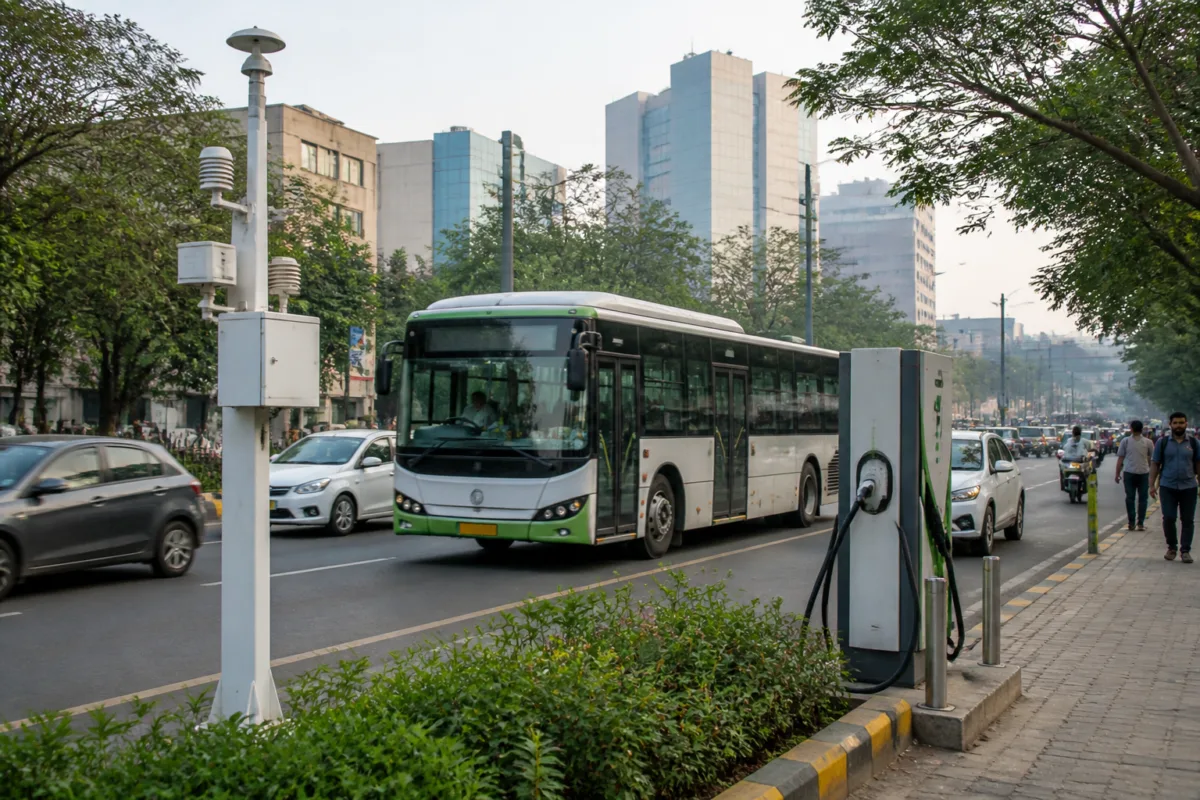
The next phase of Hyderabad’s clean-air effort is also being tied to public transport and electric mobility. Under the National Clean Air Programme, Rs 100 crore has been sanctioned to the Telangana State Road Transport Corporation for procuring electric buses. A further Rs 30 crore has been allocated to the Telangana Renewable Energy Development Corporation for setting up electric-vehicle charging stations and strengthening the city’s electric-vehicle infrastructure, according to a senior Telangana Pollution Control Board official quoted in the report.
These allocations show how air-quality policy is increasingly connected to transport infrastructure. Electric buses can reduce tailpipe emissions from public transport, while charging infrastructure is necessary for operating and expanding an electric fleet. But the source material does not state how many buses will be procured, which routes will receive them, when deployment will begin or how the allocations will affect measured pollution levels. The funding announcement is therefore an implementation commitment, not yet evidence of completed emissions reduction.
The distinction matters in a city where the survey covers multiple pollution sources. Electrifying buses addresses one part of the transport system, but it does not by itself resolve road dust, emissions from private vehicles, industrial pollution or construction-related particulate matter. The structure of the survey makes clear that sustained air-quality improvement requires simultaneous action across these categories.
The same applies to construction and demolition waste. The survey includes control of this waste among its assessment areas, but the report does not provide Hyderabad’s collection, processing or compliance figures. Construction activity is a major part of the built environment, and its pollution impact depends on site practices, material handling, movement of debris and the condition of roads around active projects. Without project-level or ward-level data, the citywide score cannot show whether better performance is evenly distributed across construction zones.
The report does provide a limited indication of how performance is distributed within the state. Sangareddy ranked eighth nationally among cities with populations below three lakh, scoring 186.8 points. Nalgonda ranked tenth in the same broad set of smaller urban centres, with 185.8 points. Hyderabad also had two wards recognised in state-level awards: Jubilee Hills Ward 215 in the category for wards with more than 30,000 residents, and Gunfoundry ward in the category for populations between 10,000 and 30,000.
These results widen the significance of the survey beyond Hyderabad’s metro ranking. They suggest that air-quality governance is being assessed at multiple urban scales, from large metropolitan systems to smaller cities and wards. That creates the possibility of comparing not only cities but also the administrative units within them. Yet the supplied report does not include ward-level scores, the criteria for the awards or a comparison between Hyderabad’s recognised wards and other parts of the city.
Experts cited in the report have called for greater green cover to strengthen Hyderabad’s environmental resilience. They also recommended promoting green buildings through rooftop gardens, terrace plantations and other forms of urban greening. These measures relate air quality to the physical design of the city, including buildings, roofs, open areas and streets.
The recommendation is notable because clean-air programmes are often understood primarily through monitoring stations, transport measures and regulatory action. Urban greening introduces another layer: the capacity of the built environment to support environmental resilience. However, the article does not quantify Hyderabad’s existing green cover, identify areas with the greatest deficit or establish how much pollution reduction the proposed measures could deliver. The evidence supports treating greening as an area for further action, not as a quantified explanation for the current ranking.
The policy landscape described here is consequently a multi-agency one. The Central Pollution Control Board conducts the survey; the National Clean Air Programme provides the framework under which funds have been sanctioned; the state pollution control board coordinates or monitors action; the transport corporation is responsible for the proposed electric-bus procurement; the renewable-energy agency is linked to charging infrastructure; and civic, transport and police authorities participate in the monitoring committee.
That institutional chain is both the strength and the test of the programme. Air pollution is generated through activities controlled by different departments, but the citizen experiences it as one condition of the city’s air. A survey score can recognise coordinated performance, while implementation still depends on whether each agency carries out its specific responsibilities and whether those actions are measured consistently over time.
Hyderabad’s result therefore confirms three things from the available evidence: the city is the best-performing among the six major metros assessed; it has improved its national position by three places; and its air-quality response is being linked to transport electrification, charging infrastructure and inter-agency monitoring. It does not establish that Hyderabad has solved its pollution problems, nor does it provide enough data to identify which interventions were decisive.
The issues that deserve continued monitoring are practical ones: the procurement and deployment of the electric buses, the rollout of charging stations, the functioning of the air-quality monitoring committee, compliance in construction and waste management, and the expansion of urban greening. The value of Hyderabad’s ranking will ultimately depend not only on where the city stands in one survey, but on whether the systems behind the score produce sustained and measurable improvement across its streets, wards and transport network.

