


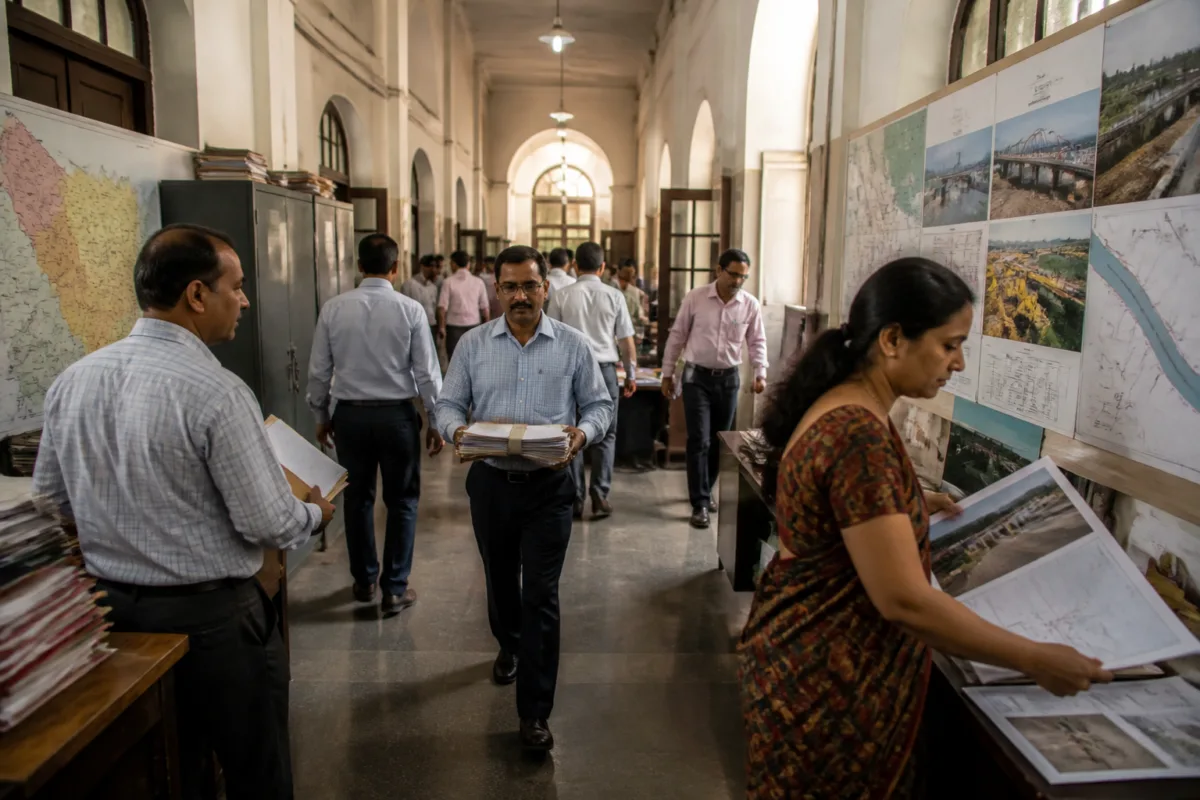
Bihar’s transfer of 143 IAS officers in 209 days under Chief Minister Samrat Choudhary has turned routine personnel changes into a larger test of administrative continuity. The reshuffles have reached departments responsible for education, finance, home affairs, urban development, housing, rural works and district administration, with several officers receiving fresh assignments or additional responsibilities more than once.
The scale of movement matters because government departments do not operate through isolated appointments. A secretary, principal secretary, additional chief secretary or district magistrate typically inherits ongoing files, budgets, projects, regulatory decisions and implementation responsibilities. When senior leadership changes repeatedly, the effect is not limited to who occupies a post. It can also alter which priorities receive attention, how decisions are processed and how quickly departments follow through on programmes already under way.
According to the Times of India report, Choudhary, who took oath as Bihar’s first BJP chief minister on April 15, 2026, began the overhaul almost immediately. By May 5, within 41 days, the government had transferred 49 IAS officers, 24 IPS officers and 61 deputy superintendents of police. The exercise continued through the following seven months, with further transfers and additional charges across the state administration.
The numbers show that the first phase was not a small adjustment to the bureaucracy. It involved senior civil servants as well as police officers and district-level supervisory officials. The later reshuffles added another layer: some officers were not simply moved once, but appeared in repeated changes or were given more than one responsibility. IAS officers Pankaj Kumar and Deepak Kumar Singh were among those identified in the report as being affected by repeated reshuffles.
The department experiencing the most visible churn was education, which has an annual budget of around Rs 68,000 crore. Seven senior IAS officers moved in and out of important positions during the period covered by the report. B Rajendra, who had taken over as additional chief secretary in September 2025 after S Siddharth, was relieved on May 15, 2026. Vinod Singh Gunjiyal replaced him but remained in the position for around 60 days before Rajiv Roshan took charge.
The changes extended beyond the department’s senior secretariat post. Anand Kishor, who had served as chairperson of the Bihar School Examination Board for nearly a decade, was removed in June and shifted to the environment, forest and climate change department. Sajjan Rajsekhar was removed as director of secondary education in August, while Vikram Virkar moved from primary education to become the district magistrate of Khagaria. C K Anil and Manoj Kumar were subsequently assigned top responsibilities in the department.
Education is an especially significant site for examining administrative continuity because the department combines a large budget with multiple delivery systems. It oversees school administration, examinations and different levels of education through a bureaucracy that must coordinate across the state and districts. The available report does not establish whether the changes improved or weakened outcomes. It does, however, show that the senior leadership responsible for the department changed frequently during a period of seven months.
The district administration also saw substantial movement. In June, 21 IAS officers were transferred and 11 districts received new district magistrates. Thiyagarajan S M, then Patna’s district magistrate, was appointed chairperson of the Bihar School Examination Board, while Kundan Kumar, who had been Nalanda’s district magistrate, was brought in as Patna DM.
A district magistrate is a key link between the state secretariat and local administration. District-level decisions connect state policy with land administration, public order, development schemes and the operation of government departments. The report does not detail the performance consequences of the district changes, but the replacement of district heads across 11 districts indicates that the reshuffle was also designed to reposition administrative leadership outside the secretariat.
The largest phase came in August, when 40 IAS officers were transferred or given new responsibilities in three separate rounds. H R Srinivas moved to the rural development department as additional chief secretary. Pankaj Kumar became principal secretary of the home department. Vinay Kumar was given charge of finance along with additional responsibility for the urban development and housing department.
That combination is important from an urban governance perspective. Finance controls the allocation and release of public money, while urban development and housing involve city planning, municipal systems, infrastructure and the regulation of built-up areas. Giving one officer responsibility across both portfolios may improve coordination in some circumstances, but it also creates a larger span of responsibility. The supplied report does not say how the additional charge affected decision-making or departmental timelines, so the institutional consequence cannot be assumed.
Other changes connected the reshuffle to construction and infrastructure administration. Abhay Kumar Singh became secretary of the rural works department while retaining additional charge of information technology. Dharmendra Kumar became chairperson-cum-managing director of the Bihar State Bridge Construction Corporation. These appointments placed senior officers in departments linked to roads, bridges, rural connectivity and digital administration.
The sequence continued after August. In September, eight officers were transferred or given additional charges, including Vivek Ranjan Maitrey, who was appointed director of sports. October saw six officers shifted or assigned additional responsibilities. C K Anil became additional chief secretary of education, while Pankaj Kumar also received the additional charge of inquiry commissioner. The November reshuffle involved three IAS officers: Deepak Kumar Singh moved from the Governor’s Secretariat to the Revenue Board, Kanwal Tanuj became finance secretary while retaining additional charge of planning and development, and Rachna Patil moved from finance to the Governor’s Secretariat as secretary to the governor.
The monthly pattern suggests two distinct phases. The first was a rapid reorganisation soon after the new government took office. The second involved continuing adjustments across departments, including the assignment of additional responsibilities. This distinction matters because a one-time change of government team is different from an administration in which senior posts continue to be modified over several months.
The stated political-administrative logic, as reported, was the chief minister’s effort to build his own administrative team by placing officers in important positions. That is a common feature of a change in government leadership: a new executive seeks officers it trusts in departments considered central to its programme. But the administrative system must also preserve institutional memory while political leadership changes. Files, tenders, budgets, court matters, departmental reviews and project commitments do not reset with every appointment.
The available evidence cannot establish whether the transfers were driven by performance reviews, political alignment, administrative requirements or a combination of factors. It also does not provide data on project delays, expenditure, examination administration, municipal performance or citizen outcomes after the changes. Those are important limits on what can be concluded from the transfer record alone.
What the record does establish is the breadth of the reorganisation. The changes covered the state’s core governing machinery, including home, finance, education, revenue, planning and development, urban development and housing. They also reached district administration, rural works, bridge construction, sports, information technology and the Governor’s Secretariat. This makes the reshuffle relevant not only as a personnel story but as a window into how a new government is arranging the machinery through which policy is implemented.
For cities and towns, the most consequential question is whether administrative responsibility remains clear while officers are moved or given additional charges. Urban development and housing already require coordination between the state department, urban local bodies, development authorities and finance officials. When portfolios are combined or transferred, the practical issue is not simply the identity of the new officer. It is whether approvals, funding decisions and accountability remain traceable.
The same applies to infrastructure. Roads and bridges depend on continuity from planning and procurement through construction, inspection and maintenance. A change in the leadership of a department or corporation may be necessary, but repeated movement can make it harder to identify which office is responsible for an unresolved decision. The source material does not provide project-level evidence to measure this effect in Bihar, so the point remains an institutional question rather than a finding about specific works.
The reshuffle also highlights the difference between formal administrative authority and delivery capacity. An officer can hold a department’s charge on paper while the department continues to depend on subordinate officials, district administrations, boards, corporations and local bodies for execution. Additional charges may help the government fill vacancies or coordinate related portfolios, but they can also widen the set of responsibilities attached to a single post. The report records those additional charges without assessing their operational results.
The clearest conclusion is therefore limited but significant. Bihar has undergone an unusually broad and continuing reorganisation of its senior administration during the first 209 days of the Choudhary government, with education seeing the most frequent changes and major portfolios such as finance, home and urban development also affected. Whether the exercise produces a more coherent administrative team will depend on what happens after the appointments: how long officers remain in place, whether departmental decisions become more consistent and whether citizens see improvements in public services. Those outcomes are not established in the transfer data and will require monitoring through budgets, project execution, district administration and service delivery records.

