


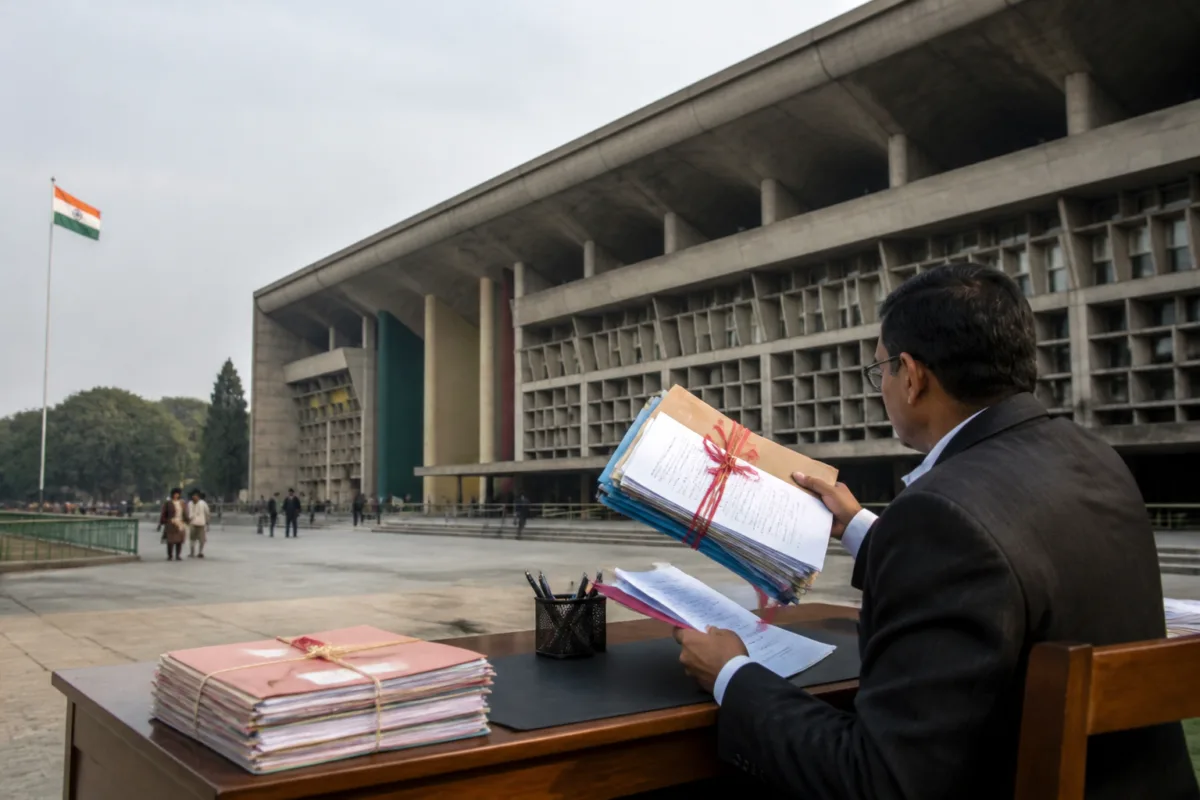
The Punjab and Haryana High Court has made Haryana’s instructions on transferring corruption-accused public servants binding, ruling that officials caught red-handed in trap or raid cases and released on bail cannot be posted at the same post or station connected with the case.
The court also directed that district-cadre officials must be shifted to another distant station within the district. Any deviation from the state’s instructions without prior permission from the competent court could invite penal consequences for Haryana’s chief secretary and the concerned officers.
The directions were issued by Justice Sumeet Goel while disposing of the regular bail petition of Jora Singh, a Haryana official facing proceedings under the Prevention of Corruption Act, 1988, and provisions of the Bharatiya Nyaya Sanhita, 2023. The court’s order followed an additional affidavit filed by Haryana Chief Secretary Anurag Rastogi on October 28, 2026.
The affidavit referred to instructions issued by Haryana’s Vigilance Department on October 27 regarding the posting of officers and officials accused in trap and raid cases. According to the instructions, officials apprehended red-handed and later released on bail “shall not be posted against the same post and in the same station”. They should instead be transferred away from the concerned jurisdiction, preferably beyond adjoining boundary districts.
For officials belonging to district cadres, the instructions provide for transfer to another distant station within the district. The chief secretary told the court that all concerned authorities had been directed to ensure strict compliance with the framework.
The issue was raised after the High Court, in an order dated August 27, expressed concern about public servants facing corruption trials being reinstated and posted in the same department, office or geographical jurisdiction linked to the criminal prosecution. The court had questioned whether existing procedures addressed the risk of witness tampering or manipulation of official records after suspension was revoked.
The Bench had also sought details of the service rules, regulations, procedures and guidelines governing the reinstatement of such officials. It specifically asked whether authorities were required to consult the prosecuting agency or the trial court before taking decisions on reinstatement.
In its latest order, the court recorded that the state would remain bound by the chief secretary’s additional affidavit. It stated that any deviation or variation without prior permission of the competent court would “indubitably” invite penal consequences for the chief secretary or the concerned officers.
The case involving Jora Singh arose from FIR No. 17, registered on December 7, 2025, at the State Vigilance and Anti-Corruption Bureau police station in Panchkula. The FIR invoked Sections 7 and 7A of the Prevention of Corruption Act and Sections 61(2) and 308(2) of the Bharatiya Nyaya Sanhita.
Singh was arrested on April 2, 2026, and the prosecution submitted its challan on May 26. The prosecution cited 28 witnesses, none of whom had been examined when the court granted him interim regular bail on August 27. The court noted that there was no allegation that he had misused the interim bail concession and made the interim regular bail order absolute.

