


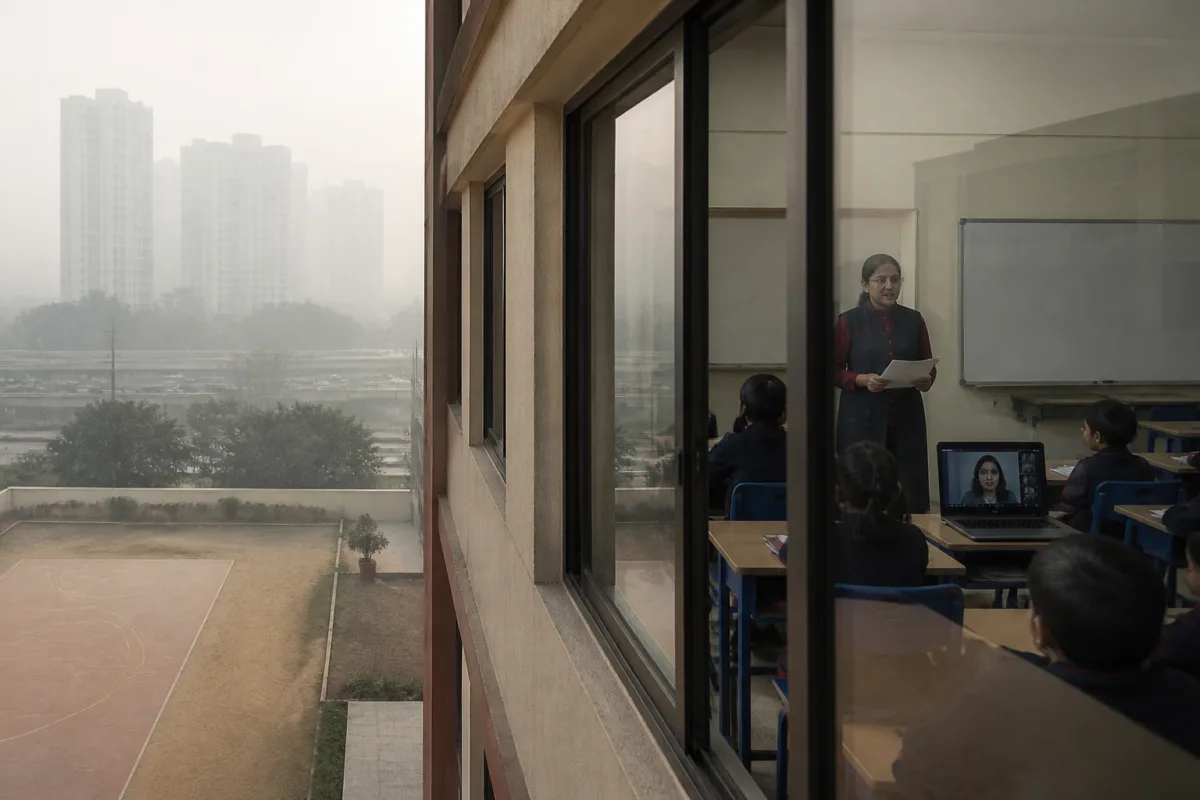
The decision to move classes for students up to Class 5 in Noida and Greater Noida to a hybrid format is more than a temporary school instruction. It shows how air pollution is increasingly altering the basic functioning of the city: when outdoor conditions deteriorate, the response reaches into classrooms, school schedules and the daily arrangements of families.
The Gautam Buddh Nagar Basic Education Department ordered all council-run, aided and recognised schools in the district to offer online and offline learning to students up to Class 5. The instruction followed directions issued by the Commission for Air Quality Management, or CAQM, after Grade 3 of the Graded Response Action Plan was imposed across Delhi-NCR. The district order was issued on 7 November and required immediate compliance.
The order was issued by District Basic Education Officer Rahul Panwar to the principals and managers of schools covered by the directive. It said that where online learning facilities were available, students must be given the choice of attending classes online or in person. Schools were also warned that failure to follow the instructions could result in action under the applicable rules.
That administrative chain is important. The pollution response did not originate with an individual school or a parent group. CAQM issued the regional direction on 6 November, after which the district education authority translated it into an instruction for schools in Gautam Buddh Nagar. The sequence illustrates how an air-quality emergency moves through institutions: a regional authority identifies a condition requiring action, and a district department applies it to local operations.
The order also reveals the limits of a uniform pollution response. The directive applies to students up to Class 5, rather than to every student in every grade. The material supplied with the order does not explain the basis for that age threshold, nor does it specify how long the hybrid arrangement will remain in force. It also does not set out a common digital platform, attendance system, timetable or technical standard for online classes. Those details are left to schools and the local administration.
That gap matters because “hybrid” is not a single experience. For a school with functioning online systems and households with reliable devices and connectivity, it can mean a relatively quick transition from a physical classroom to a digital one. For other families, the same instruction may create a choice in name but not in practice. The supplied order confirms that online and offline options must be offered where online facilities are available, but it does not establish how access will be measured or how schools should respond when those facilities are inadequate.
The order therefore operates at two levels. At the immediate level, it reduces the need for younger children to be physically present in school during a period of poor air quality. At the institutional level, it transfers part of the pollution response to schools, which must continue teaching while changing the mode of delivery. The source material does not provide attendance figures, school-wise implementation details or information on how many students chose each option. The scale of the operational burden cannot therefore be quantified from the available evidence.
The pollution readings provide the immediate context. Delhi’s 24-hour average Air Quality Index reached 313 on the Wednesday covered in the report, placing it in the “very poor” category. The report said that only one of Delhi’s 58 monitoring stations recorded air in the “severe” category that day. Air quality had shown some improvement a day earlier after wind speeds increased, but the overall reading subsequently returned to the very poor range.
These figures show why the school order was linked to a regional pollution framework rather than treated as an isolated local decision. The recorded AQI was not described as uniformly severe across all monitoring stations, yet the wider pollution episode was serious enough for GRAP-3 restrictions and a school-level response for younger children. The available report does not provide a separate AQI reading for Noida or Greater Noida, so the effect of local conditions in Gautam Buddh Nagar cannot be assessed independently from the information supplied.
The decision also exposes an administrative distinction between measuring pollution and managing its consequences. Monitoring stations generate air-quality readings, while CAQM issues directions and district departments enforce them through local institutions. Schools become the point at which a regional environmental condition is experienced by children, teachers and households. The school order is consequently both an education instruction and a public-health response, although the source does not state a separate health assessment or cite medical advice.
The choice of a hybrid model, rather than a complete closure, indicates an attempt to preserve educational continuity while reducing compulsory physical attendance for younger students. However, the order does not say whether schools must maintain full in-person capacity, whether parents can choose freely between modes, or whether any exemptions apply. It also does not state whether transport arrangements, school examinations, midday services or extracurricular activities are affected. Those unanswered operational questions are central to how the directive will work on the ground.
The institutional responsibility is similarly divided. CAQM provides the regional trigger and directions under the pollution-control framework. The Gautam Buddh Nagar Basic Education Department communicates the order to schools and warns of enforcement action. School principals and managers are responsible for implementing the hybrid arrangement. Families, meanwhile, must make the practical decision about attendance, but the reported order does not describe any formal mechanism for recording or supporting that choice.
This structure reflects a recurring feature of urban governance: broad environmental rules are implemented through institutions that were not created primarily to manage pollution. Schools are designed to deliver education, but during a pollution episode they also become sites of exposure management. Their capacity to respond depends on infrastructure, staffing and access to digital systems, none of which are documented in the supplied material.
The available numbers are limited but significant. The affected age group extends to Class 5. The district directive covers three categories of schools: council-run, aided and recognised institutions. It followed the CAQM instruction of 6 November and was issued locally on 7 November. The contemporaneous air-quality picture included a Delhi AQI of 313, 58 monitoring stations and one station in the severe category. Together, these details establish the timing and breadth of the response, but not its educational outcomes.
What the evidence does not show is equally important. There is no information in the supplied report on the number of schools in Gautam Buddh Nagar, the number of children affected, the duration of the hybrid system, participation in online classes, or compliance rates. There is also no evidence on whether the arrangement reduced children’s exposure or affected learning continuity. Claims about those outcomes would require attendance data, school records, health evidence or a follow-up assessment.
The immediate urban question is therefore not simply whether schools can switch between online and offline teaching. It is whether a city’s essential institutions can continue functioning equitably when environmental conditions repeatedly disrupt normal routines. In this instance, the government has created a formal option for younger students, but the reported order leaves implementation capacity largely unmeasured.
For now, the confirmed position is that schools across Gautam Buddh Nagar serving students up to Class 5 must operate in hybrid mode under the district order, following CAQM’s Delhi-NCR directions linked to GRAP-3. The next developments to monitor are the duration of the arrangement, school-level compliance, student participation in both modes and any revised instruction from the air-quality or education authorities.

