


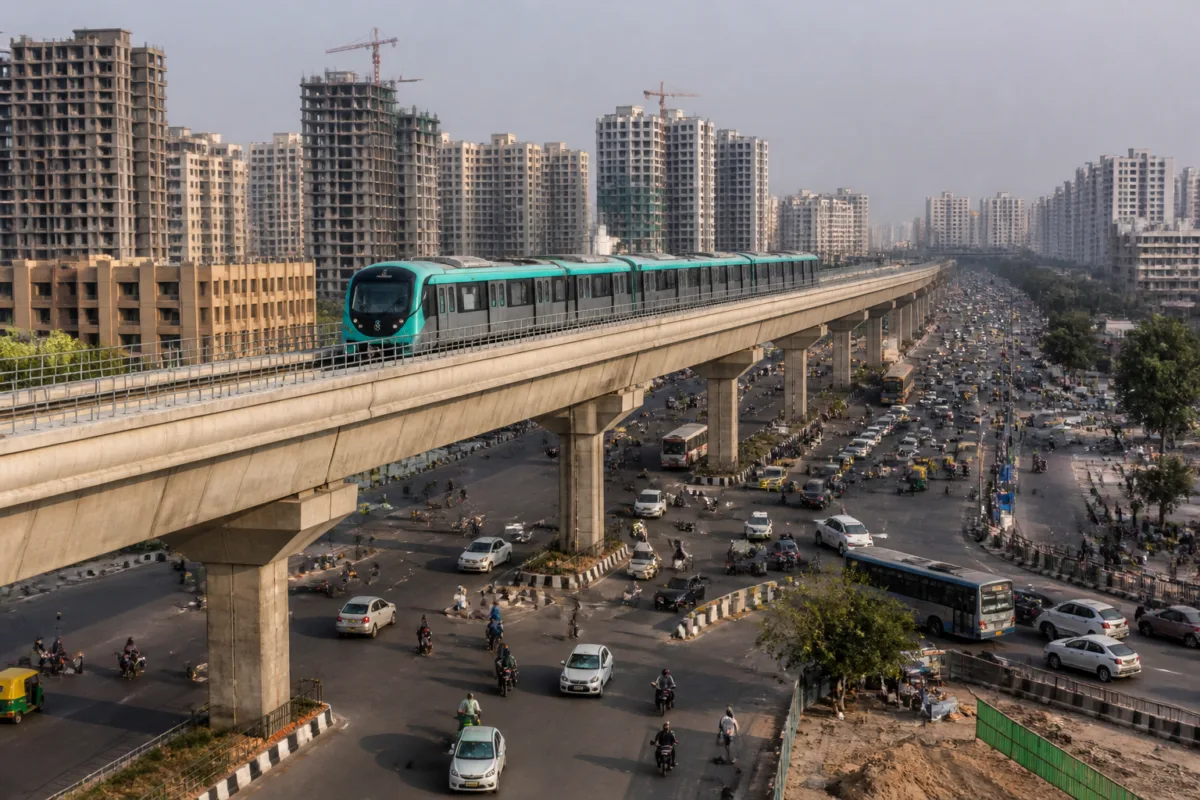
The Noida Greater Noida Metro network will expand by 8.449 kilometres after the Union government approved an elevated extension of the Aqua Line from Noida Sector 51 to Greater Noida Sector 4, with five new stations and an estimated cost of Rs 2,390 crore.
Railways Minister Ashwini Vaishnaw announced the approval on Wednesday, saying the project is intended to strengthen public transport between Noida and Greater Noida. The extension is targeted for completion within four years.
The new corridor will begin at Noida Sector 51 and run through stations at Sector 61, Sector 70, Sector 122 and Sector 123 before reaching Greater Noida Sector 4 near Kisan Chowk. The Sector 61 station will provide an interchange with the Delhi Metro Blue Line, creating a new connection between the Aqua Line and the wider Delhi-NCR metro system.
The corridor is expected to serve rapidly expanding residential areas in Noida and Greater Noida West. Residents of developments including Cleo County Residencies in Noida Sector 122 and Gaur City 1 and 2 in Greater Noida Sector 4 are among those expected to gain more direct access to mass transit.
Vaishnaw said the extension would improve connectivity, reduce travel time and ease congestion at Parthala Chowk, Gaur City and Ek Murti Circle. The project is also expected to reduce dependence on private vehicles by providing an alternative for daily commuting.
The minister said the corridor would support access to corporate and industrial employment areas, as well as residential districts, educational institutions and proposed data centres. Companies identified in the announcement include IKEA, Adobe, HCL and Havells. The extent of the benefit for individual workplaces will depend on last-mile connections and the eventual operating plan, neither of which was detailed in the supplied announcement.
The extension is also being positioned as part of a wider regional transport network. Through the Magenta Line, passengers would have easier access to Indira Gandhi International Airport, while the Blue Line would connect them towards New Delhi, Anand Vihar and Hazrat Nizamuddin railway stations. The announcement also linked the corridor to future connectivity with Noida International Airport at Jewar, Hindon Airport and the Regional Rapid Transit System through a proposed multimodal transportation hub.
The approval comes against the backdrop of rapid population growth in the Noida-Greater Noida area. According to figures cited by the minister, the population was about 739,000 in the 2011 Census and had increased to approximately 2.47 million under the 2021 master plan. The figures underline the pressure on the region’s transport network as housing, workplaces and institutional development spread beyond the established urban cores.
The immediate milestones are the detailed implementation of the approved corridor and construction over the four-year target period. The project will need to translate its planned interchange, station locations and regional connections into a functioning network for residents of Noida and Greater Noida West.

