


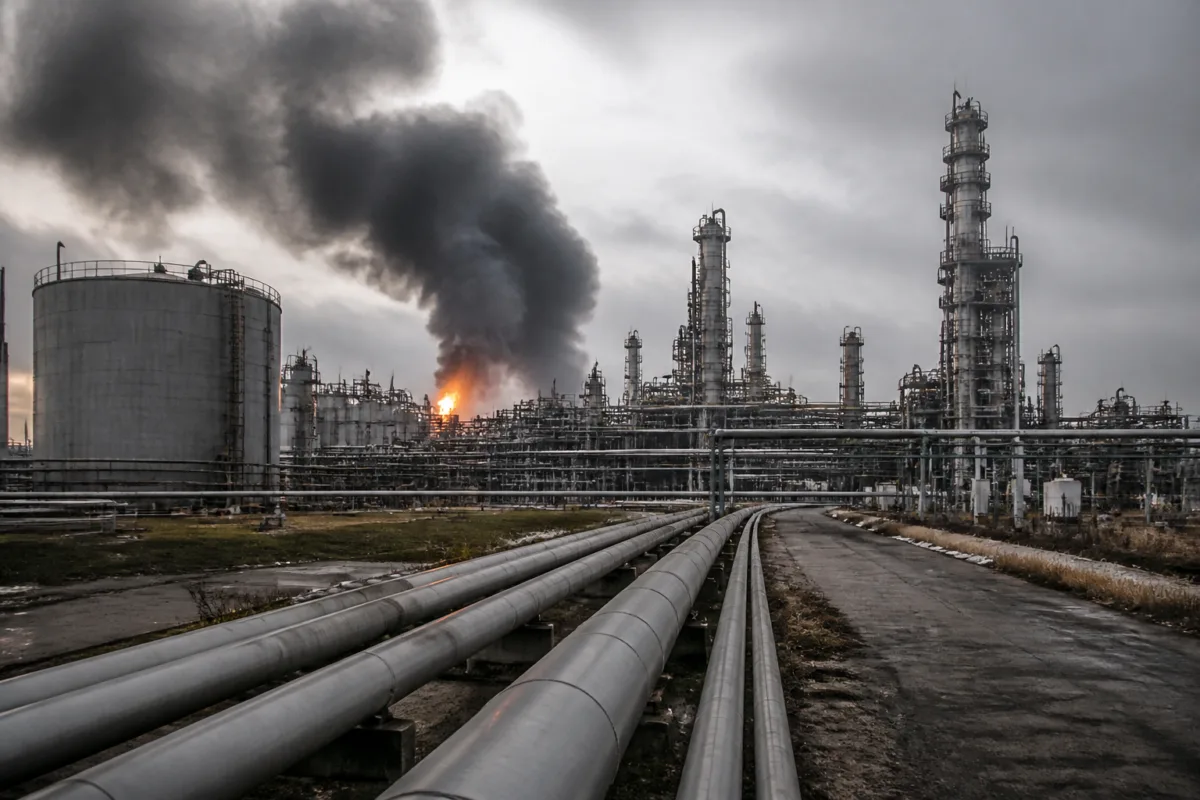
Russia’s oil refining system is under pressure after Ukrainian drone attacks affected nine of the country’s 35 major refineries and reduced refining capacity by around 30% since late October, according to two industry sources cited by the Times of India. The disruption is more than a battlefield development: it is testing the resilience of a national fuel network that must supply domestic demand while Russia continues sending diesel to international markets.
The affected facilities have a combined nameplate capacity of about 300,000 metric tonnes a day, equivalent to 2.2 million barrels, the report says. Three major refineries in central Russia, along with plants in Ryazan, Yaroslavl and the Volga region, have been affected. Russia’s total primary refining capacity is approximately 930,000 tonnes per day, although its refineries were processing closer to 700,000 tonnes, or five million barrels, of crude daily at the end of October.
Those figures show why the reported attacks have created pressure without necessarily implying that the entire Russian refining system has stopped functioning. The headline capacity affected is based on the facilities’ nameplate potential, while the estimated reduction in actual crude processing is lower. Industry sources put the real fall in daily processing at about 200,000 tonnes. The difference between nominal capacity and operating throughput is important because it determines the immediate effect on fuel supply, refinery utilisation and the ability to compensate through other plants.
Refineries are not interchangeable points on a map. Their location, technical configuration and connection to crude supply, storage facilities, pipelines, roads and railways influence how quickly production can be shifted elsewhere. The report does not provide a plant-by-plant account of the damage or the time required for repairs, but the geographical spread of the affected facilities indicates that the disruption is not confined to a single localised incident. Plants in central Russia and the Volga region form part of a wider network that supports industrial activity, transport and domestic fuel distribution.
The pressure is particularly significant because it arrives alongside reported domestic fuel shortages. Russia is also continuing to ship diesel to international markets under an export deal with US President Donald Trump, according to the report. This creates a direct tension between external commitments and internal supply: a country can retain substantial overall crude production while still experiencing fuel stress if refining capacity, distribution or product availability becomes constrained.
The distinction between crude oil and refined fuel is central to understanding the situation. Crude must be processed into products such as diesel and petrol before it can support most road transport, industrial equipment and other end uses. Damage to refining capacity therefore affects the conversion stage of the energy system. Even where crude remains available, reduced processing can limit the volume of usable fuels reaching consumers and businesses.
The reported attacks followed the failure of a proposed ceasefire on strikes against energy infrastructure. The proposed halt had been announced by US President Donald Trump between Kyiv and Moscow in late October, but the arrangement did not take effect, according to the Times of India report. Ukraine subsequently intensified strikes on Russian oil facilities, presenting them as retaliation for Russian attacks on Ukrainian energy infrastructure.
The exchange has created an energy-infrastructure conflict in which refineries, power plants, substations, heating systems, water networks and transport facilities are all connected to the ability of cities and economies to function. The report says Russian forces continued targeting Ukraine’s energy and transport infrastructure. Ukrainian Prime Minister Sergii Koretskyi said six large electricity substations across four central Ukrainian regions had been struck, while railway infrastructure in eastern and central Ukraine had also been attacked.
This matters because energy infrastructure is both a military target and a civilian service platform. Electricity substations distribute power to homes, industry, communications systems and public facilities. Rail infrastructure moves people, fuel, food and equipment. Refineries supply transport fuels that connect cities to surrounding production regions. Damage at any one point can produce effects well beyond the immediate site, particularly when alternative capacity is limited or supply routes are disrupted.
The reported Russian refining losses also demonstrate why capacity figures need to be read alongside operational data. Russia’s approximately 930,000 tonnes-per-day primary refining capacity represents the system’s broad technical ceiling, not necessarily its daily output. At the end of October, actual processing was reported at around 700,000 tonnes per day. Against that baseline, an estimated reduction of 200,000 tonnes represents a substantial decline in operating throughput, even though it is smaller than the 300,000-tonne nameplate capacity associated with the affected plants.
That gap also shows the limits of judging an energy system only by its installed capacity. A refinery may be counted as part of national capacity while operating below its potential, undergoing maintenance or facing constraints in crude supply, storage, transport or product distribution. Conversely, a temporary interruption at a large plant can quickly affect regional fuel balances if other refineries cannot increase output or if products cannot be moved efficiently to where they are needed.
The effects are likely to be uneven across Russia because the report identifies specific regions and facilities rather than a uniform national shutdown. Central Russia, Ryazan, Yaroslavl and the Volga region are directly named in the account. The precise impact on individual cities, fuel prices, rationing measures and transport operations is not established in the supplied material. What is clear is that the attacks have added to Moscow’s difficulty in managing domestic fuel shortages while maintaining diesel exports.
The institutional response is also divided between operational management and diplomatic escalation. Regional authorities have reported damage and casualties, while national officials have defended their positions on attacks against energy targets. The governor of the Leningrad region said a woman was killed after a drone strike triggered a fire at the Kirishi oil refinery, described in the report as Russia’s second-largest. Russian Foreign Minister Sergei Lavrov accused Ukraine of ignoring calls to stop attacks on Russian energy targets in an article published by Kommersant.
Ukrainian President Volodymyr Zelenskyy, meanwhile, said Kyiv would continue striking targets linked to Russia’s oil sector in response to attacks on Ukrainian energy infrastructure. He said Ukrainian power plants, energy networks, heating systems and water supply systems were under constant attack and that Moscow had refused de-escalation steps discussed by its partners. These statements establish the competing official positions, but they do not independently quantify the damage or determine the operational condition of every facility mentioned.
The broader urban question is how energy-dependent settlements absorb repeated shocks to interconnected infrastructure. Fuel shortages can affect buses, freight, emergency services, construction equipment and household mobility. Electricity disruptions can affect water pumping, heating, communications and public buildings. Rail damage can interrupt the movement of fuel and essential goods even when production remains available elsewhere. The report does not provide a measured account of these civilian effects, but the infrastructure links are visible in the facilities and systems identified.
The reported disruption also underlines the strategic importance of decentralisation and redundancy. A system with multiple refineries, transport routes and storage sites may be better placed to compensate for the loss of one facility. But when several major plants across different regions are affected within a short period, the ability to reroute supply becomes more important than the headline size of national capacity. The supplied report does not establish how much spare capacity is available or whether alternative refineries have increased production.
For policymakers and infrastructure managers, the episode reinforces the need to distinguish between physical capacity, operating capacity and dependable service. A refinery’s nameplate capacity does not guarantee fuel availability. A functioning power plant does not ensure electricity reaches consumers if substations or transmission networks are damaged. A rail line may remain technically open while interruptions elsewhere make the route ineffective. Resilience is therefore determined by the performance of the complete network, not by the survival of individual assets.
The evidence currently confirms a substantial reported reduction in Russian refining capacity, pressure on domestic fuel availability and a continuing cycle of attacks on energy and transport infrastructure in Russia and Ukraine. It does not establish the full duration of the outages, the exact repair status of the nine affected refineries, or the effect on city-level fuel supply. Those are the developments that will determine whether the disruption remains a short-term operational setback or becomes a longer strain on Russia’s energy and urban systems.

