


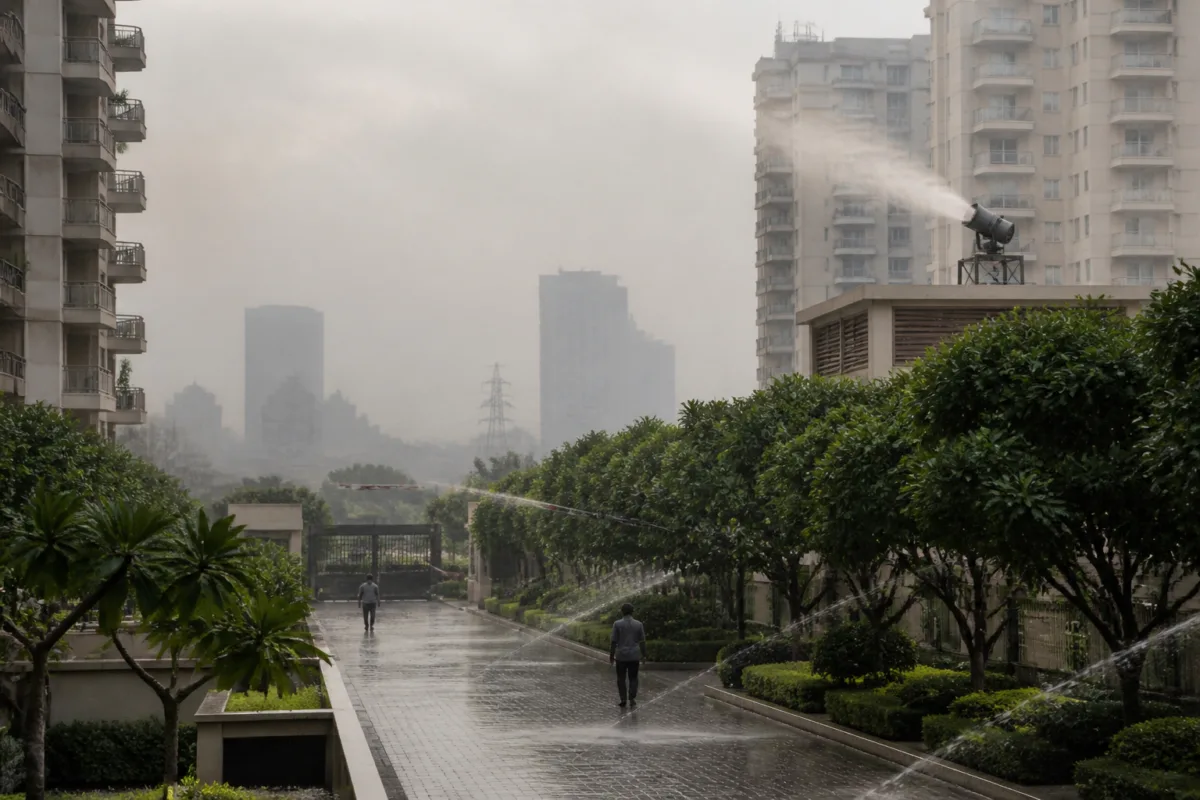
Gurugram air pollution has pushed even some of the city’s most expensive residential communities to create their own systems for cleaner internal spaces. Anti-smog guns, sprinklers, misting vehicles, treated wastewater and mechanised sweeping are being used inside gated complexes, but the measures also reveal a larger urban problem: private campuses can manage dust within their boundaries, while much of the pollution is generated beyond them.
The measures were reported in luxury housing societies across Gurugram as the city’s air quality remained in the poor to very poor range. According to Central Pollution Control Board and Haryana State Pollution Control Board data cited in the report, Gurugram’s 24-hour average Air Quality Index was 345 on November 7, 288 on November 8, 345 on November 9 and 324 on November 10.
These readings show sustained deterioration rather than a single short-lived spike. The response inside housing complexes has therefore moved beyond routine maintenance. Residents and management bodies are attempting to reduce dust on internal roads, protect landscaped areas and make outdoor spaces more usable at a time when people are avoiding walks and exercise outside.
At Central Park Resorts in Sector 48, where four-bedroom flats were reported to cost more than Rs 20 crore, fine water mist is being released from autos and electric rickshaws within the complex. Anti-smog guns have been installed on building rooftops and are being operated for 15 minutes every hour from 4 am after pollution levels rose.
The approach is different across other communities. Rising Homes in Sector 92 connected its sewage treatment plant to a sprinkler network four years ago at a cost of Rs 2.5 lakh. The treated water is used for spraying across the premises, and the duration of spraying was increased by two hours after Diwali.
At Vipul Greens on Sohna Road, where four-bedroom flats were reported to cost around Rs 4.5 crore and larger apartments up to Rs 8 crore, the society has installed anti-smog guns, rooftop sprinklers and dust-compression units around trees. Sprinklers have been operating throughout the day since Diwali, according to the report.
DLF City’s Phases 1 to 4 have adopted a broader winter pollution-management arrangement. The management has set aside a specific budget, deployed mechanised sweepers to remove dust and silt from roads, and continued water spraying. It is also monitoring dust control at construction sites and keeping watch over open waste burning.
Taken together, these examples show that housing societies are not using one standard technology. Their responses depend on the physical layout of the community, the resources available to the resident welfare association or management, and whether the complex has systems such as an STP that can supply water for dust suppression. The common feature is that each intervention is largely confined to the property it serves.
That boundary is central to understanding what these measures can and cannot achieve. Water spraying, misting and dust suppression may reduce resuspended dust on internal roads and around trees. Mechanised sweeping can remove accumulated material from paved surfaces. But the report notes that pollution from main roads, construction sites and open areas remains outside the direct control of individual societies.
This creates a fragmented model of pollution management. A well-funded society can organise equipment, allocate a winter budget and alter operating schedules quickly. A public road adjoining the same society, however, depends on municipal maintenance, construction-site compliance, traffic conditions and enforcement against activities such as open waste burning. The result is an uneven urban response in which the quality of internal space can depend on the resources of the community that manages it.
The reported property values make that inequality visible, but the underlying question is not limited to luxury housing. The examples show how responsibility for an urban environmental problem is being partly absorbed by private residential institutions. Resident welfare associations and facility managers are taking operational decisions, paying for equipment and determining when systems should run. Their ability to respond is linked to the financial capacity of residents and the governance structure of each complex.
The use of sewage treatment plant water at Rising Homes also illustrates the importance of existing utility infrastructure. The society’s sprinkler network was made possible by connecting it to an STP, allowing treated water to be used for spraying. The report does not establish the quality, quantity or regulatory conditions of that water, so the example should be understood as an operational arrangement reported by the society rather than as evidence that every residential complex can replicate it.
Nor do the reported interventions establish that anti-smog guns or sprinklers can lower Gurugram’s citywide AQI. The data cited in the report describe city-level air quality, while the measures operate within selected compounds. This distinction matters: reducing local dust exposure inside a housing complex is not the same as reducing the concentration of pollutants across the urban region.
The reported readings also place the private response in context. Gurugram recorded an AQI of 345 twice during the four-day period cited, followed by 324 on November 10. Although the reading fell to 288 on November 8, the overall sequence remained within the poor to very poor range. The available evidence therefore supports a description of persistent stress on the city’s air, not a conclusion that internal mitigation systems have solved the problem.
The institutional division is equally important. Housing societies can manage their premises, deploy equipment and monitor internal roads. Pollution-control boards provide the air-quality measurements cited in the report. Other responsibilities, including public-road maintenance, construction dust control and action against open waste burning, extend beyond the authority of a single residential complex. The report does not provide details of a coordinated citywide programme linking these separate responsibilities.
That gap is the larger urban issue exposed by the societies’ response. Private infrastructure can create pockets of dust control, but it cannot substitute for public management of roads, construction activity and open land. When citywide pollution is high, even residents of expensive apartments are avoiding outdoor exercise. Internal interventions may improve conditions within a gate, but daily travel, work, school and access to public space still connect residents to the wider city.
Gurugram’s experience also shows why environmental management cannot be assessed only through equipment installed at a site. The relevant questions include where the pollution originates, which institution controls that source, how compliance is monitored and whether action continues beyond the winter period. The supplied report documents several local responses, but it does not provide comparative measurements showing how much pollution each intervention removed or how long the benefits lasted.
What the evidence confirms is narrower but significant: prolonged poor air quality has prompted affluent residential communities to spend money and reorganise operations to manage local dust and exposure. What it does not confirm is that these measures can materially change the city’s AQI. The next developments to monitor are whether public roads, construction sites and open areas receive comparable dust-control attention, and whether the private measures continue as a sustained management practice rather than a seasonal response.

