


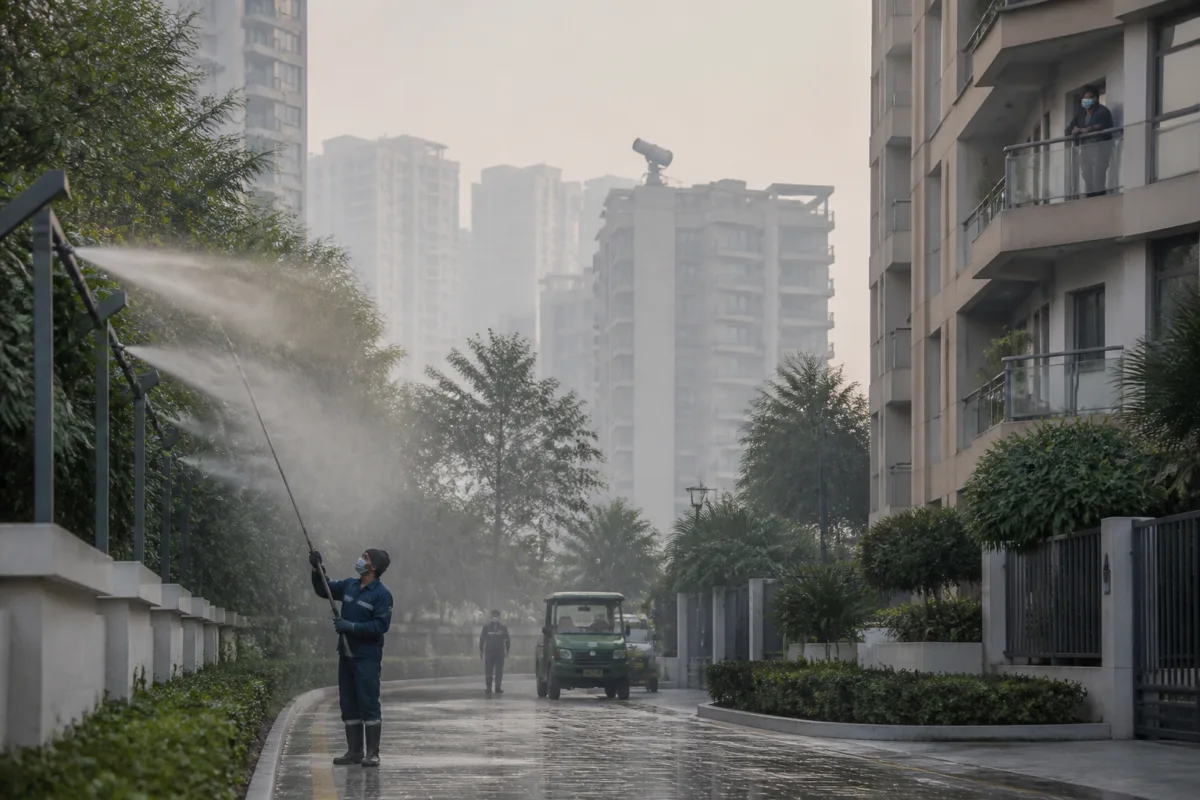
Gurugram’s luxury housing societies are deploying anti-smog guns, sprinklers, misting systems and mechanised sweepers as residents retreat indoors during another period of unhealthy air. The measures show how affluent gated communities are trying to manage pollution within their boundaries, but they also reveal a harder urban reality: private estates can suppress some dust inside a compound, while the larger sources of pollution remain outside it.
The contrast is especially visible in a city where expensive housing is often marketed through controlled environments, landscaped open spaces and managed infrastructure. In Sector 48, Central Park Resorts has reportedly introduced fine water misting through autos and e-rickshaws inside the society. Anti-smog guns have been installed on rooftops and, after pollution levels rose, were being operated for 15 minutes every hour from 4am. The report, based on an Indian Express account, says four-bedroom flats in the development cost more than Rs 20 crore.
That spending power has allowed individual societies to respond faster than city-wide systems can. But it has not created clean air beyond the gates. Residents of these developments are still exposed while travelling, walking along public roads or using open spaces outside their complexes. The account also notes that many have reduced outdoor exercise and walking despite living in high-value properties designed around amenities and open areas.
The interventions differ from one society to another, reflecting the role of resident welfare associations and private management agencies in filling operational gaps. At Rising Homes in Sector 92, where flats are priced at about Rs 2-4 crore, the RWA spent Rs 2.5 lakh four years ago to connect the sewage treatment plant to a sprinkler network. Treated water is used for spraying within the premises, and the spraying period was extended by two hours after Diwali.
At Vipul Greens on Sohna Road, four-bedroom flats are reported to cost around Rs 4.5 crore, with larger apartments reaching Rs 8 crore. The society has installed anti-smog guns, rooftop sprinklers and dust-compression units around trees. Since Diwali, sprinklers have reportedly been operating throughout the day. DLF City, covering Phases 1 to 4, has set aside a winter pollution-control budget that includes mechanised sweepers for removing dust and silt from roads, water sprinkling and monitoring of dust-control measures at construction sites. The management is also watching for open waste burning.
These actions point to a distinction that is often lost in public discussions about air pollution: not every measure addresses the same pollutant or source. Sprinkling and misting can help settle dust on roads, landscaped areas and exposed surfaces. Mechanised sweeping can remove accumulated dust before vehicle movement resuspends it. Monitoring construction sites and preventing open waste burning address specific local activities. But such measures do not amount to a complete air-quality strategy, particularly when pollution moves across property boundaries.
The supplied AQI figures underline that wider exposure remains severe. According to data from the Central Pollution Control Board and the Haryana State Pollution Control Board cited in the report, Gurugram’s 24-hour average AQI was 345 on November 7, 288 on November 8, 345 again on November 9 and 324 on November 10. These readings kept the city in the poor to very poor range across the period. The variation from one day to the next did not change the broader pattern of sustained unhealthy air.
This is where the private-estate response reaches its institutional limit. A housing society controls its internal roads, gardens, building entrances and, in some cases, construction-related activity within its premises. It cannot control dust from a major public road, emissions from traffic beyond its gate, pollution from another construction site, or conditions in open areas elsewhere in the city. It can reduce exposure in a managed micro-environment, but it cannot govern the airshed in which that micro-environment exists.
The arrangement also creates a fragmented geography of protection. Residents of societies with stronger maintenance budgets may encounter more frequent sprinkling, cleaner internal roads and better monitoring of local dust. Other neighbourhoods may lack the funds, equipment or management capacity to replicate those measures. Even within affluent developments, the cost of such interventions is ultimately connected to maintenance budgets and residents’ ability to pay. Clean-air protection therefore becomes partly a function of the quality of private estate management rather than a consistent public service.
That does not make the measures irrelevant. Dust control inside large developments can matter to residents, workers and visitors, particularly where internal roads, landscaping and construction activity generate local dust. Reusing treated sewage for sprinkling can also connect pollution control to existing utility infrastructure, as the Rising Homes example indicates. The more important question is how these local measures are assessed, regulated and linked to city-wide pollution plans.
The DLF City example is significant because it combines several operational actions rather than relying only on anti-smog equipment. Mechanised sweeping, water spraying, construction-site monitoring and checks on open waste burning address different local sources. Yet the report does not establish how much each intervention reduces pollution, whether the equipment is independently audited, or how frequently the measures are carried out across all affected areas. Those gaps matter because visible equipment is not the same as demonstrated air-quality improvement.
The same caution applies to anti-smog guns. Their presence may indicate an attempt to respond quickly to deteriorating conditions, but the supplied material does not provide evidence of their impact on the city’s average AQI. Nor does it establish whether operating them from early morning changes exposure for residents beyond the immediate premises. The available evidence supports reporting their use, not claiming that they have solved the pollution problem.
The institutional structure behind Gurugram’s air also complicates accountability. Private societies manage their internal spaces, while public agencies remain responsible for roads, construction regulation, waste management and broader pollution-control enforcement. The report identifies the CPCB and Haryana State Pollution Control Board as sources for AQI data, but it does not detail which agency is responsible for each pollution source or how enforcement is coordinated. That missing link between measurement and responsibility is central to understanding why private interventions coexist with persistently high city-wide readings.
Gurugram’s housing market adds another layer. The reported prices, ranging from roughly Rs 2 crore to more than Rs 20 crore, suggest that residents are paying for an environment with substantial private management and amenities. Yet the AQI data shows that premium housing cannot fully separate residents from regional air pollution. Buildings may provide filtered interiors or controlled grounds, but the daily urban system still includes public roads, workplaces, schools, transport corridors and construction zones.
The episode therefore exposes the limits of treating pollution as a compound-level maintenance problem. A society can wash down its roads, operate sprinklers and monitor its premises, but the city needs coordinated control over dust, traffic, construction and waste across administrative and property boundaries. Without that coordination, the most visible response may be concentrated where residents have the resources to pay for it, while the underlying sources remain distributed across the urban region.
The evidence currently confirms three things: Gurugram’s luxury societies are investing in local pollution-control measures; the city’s AQI remained between 288 and 345 from November 7 to 10; and private interventions cannot control pollution originating on public roads, construction sites and open areas outside the societies. What remains unestablished is the measured effectiveness of each intervention and whether these private actions are integrated into a wider public enforcement system. Those are the facts that should shape the next assessment of Gurugram’s winter air response.

