


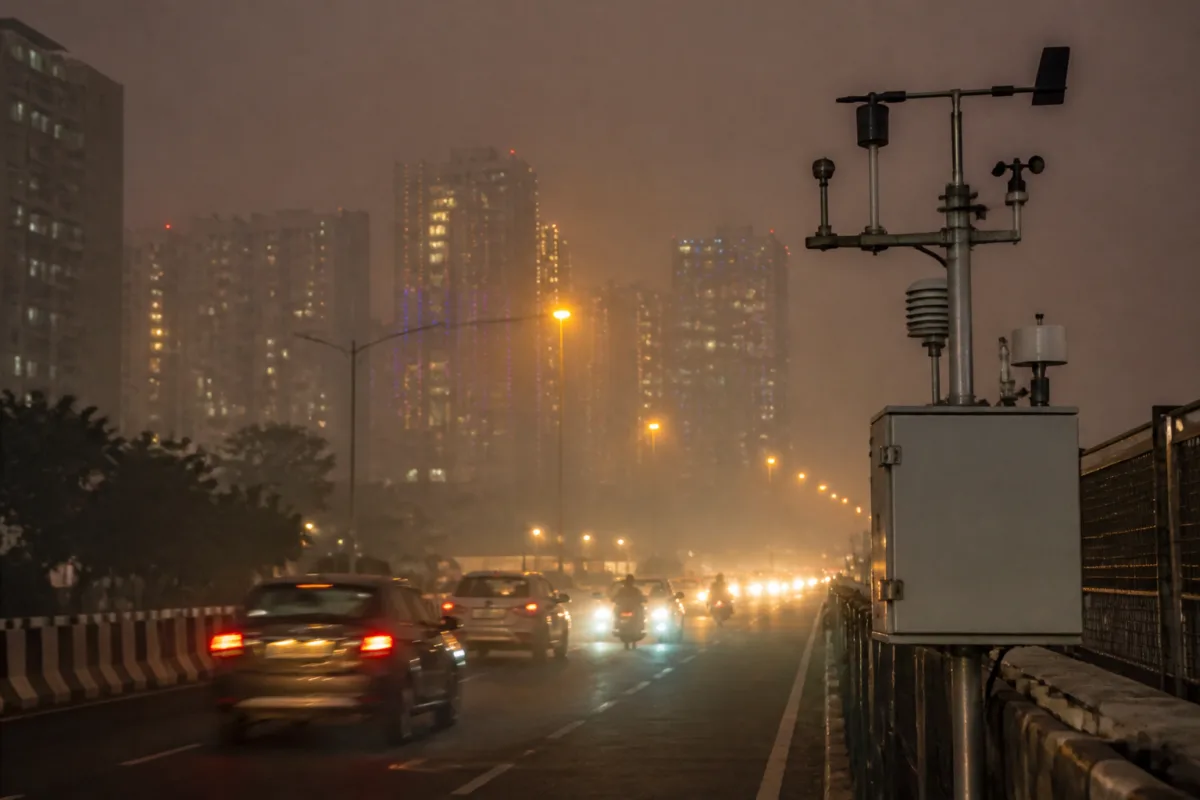
Delhi’s air pollution emergency became harder to measure precisely when the city needed reliable information most. Data from 36 pollution monitoring stations was unavailable after midnight during the Diwali night episode, while the data that was released by the Delhi Pollution Control Committee indicated particulate matter concentrations rising to around 3,000 micrograms per cubic metre—many times above the permissible limits cited in the report.
The episode exposes two connected urban problems: the intensity of pollution during a high-emission night and the fragility of the monitoring network used to describe that pollution. For residents, especially children, older people and those with asthma, the immediate concern was exposure to hazardous air. For administrators, the missing readings created a second problem: whether the city could provide a complete and trustworthy account of conditions across its neighbourhoods.
According to the report, only one monitoring station was not providing data at 7 pm on Sunday. After midnight, the number of stations without data had risen to 36. The report does not establish why the stations stopped transmitting or whether the outage was caused by equipment failure, connectivity problems, maintenance, power disruption or another operational issue. That distinction matters because each cause would point to a different weakness in Delhi’s pollution-control system.
The available DPCC figures nevertheless indicated an extreme deterioration in air quality. The report cites a permissible limit of 60 micrograms per cubic metre for PM2.5 and 100 micrograms per cubic metre for PM10. Against those reference points, a reported concentration of around 3,000 represents a level so far above the stated limits that the loss of monitoring coverage becomes more than a technical inconvenience. It affects the public record of the event and the ability of authorities to assess how widely the pollution spread.
The report does not specify consistently whether the figure of 3,000 referred to PM2.5, PM10 or a particular station-level reading. That limitation is important. PM2.5 and PM10 are different size categories of particulate matter, and a citywide interpretation cannot be drawn from an unspecified measurement alone. The available account establishes that released readings showed severe particulate pollution, but it does not provide a complete station-by-station dataset, an average for the city, the duration of the peak or the precise pollutant category associated with the highest number.
This is where the monitoring question becomes central to the urban story. Pollution data is not only a scientific record; it is part of the infrastructure through which a city communicates risk. Residents use readings to decide whether to travel, exercise outdoors, send children outside or seek medical attention for breathing problems. Authorities use the same information to evaluate emergency measures and explain whether conditions are improving or worsening. When a large share of stations is offline during a major pollution episode, both public behaviour and official response are operating with an incomplete picture.
The report quotes Manoj Kumar, an analyst at the Centre for Research on Energy and Clean Air, as saying that Central Pollution Control Board data for that night was still unavailable. This creates a second layer of uncertainty around the episode. DPCC data and CPCB data serve as important reference points in public discussions about air quality, but the supplied report does not explain whether the two systems use identical instruments, reporting intervals or validation procedures. Nor does it state whether the unavailable CPCB data was later restored or published.
The institutional arrangement is significant. The DPCC is responsible for pollution-control functions within Delhi, while the CPCB operates at the national level. A citywide pollution emergency therefore depends not only on the functioning of individual monitoring stations but also on coordination between agencies, data transmission systems and public dashboards. The report’s account does not identify the agency responsible for the outage or record an official explanation. That missing response leaves the operational cause unresolved.
There is also a difference between measuring pollution and managing it. Monitoring stations can show where and when particulate concentrations rise, but they do not by themselves reduce emissions. The readings become useful for governance only when they inform enforcement, public-health communication and decisions about activities that contribute to poor air quality. If data disappears during the most polluted period, the ability to assess those measures is weakened as well.
The timing of the episode adds to its significance. Diwali night is identified in the report as the period during which pollution became dangerous and station coverage deteriorated. The supplied account does not quantify the contribution of fireworks, weather, traffic, construction dust, regional emissions or other sources, so no single cause can be assigned from the available evidence. It does, however, show how a predictable high-risk period tested both the city’s air and its ability to document air conditions.
The health implications cited in the report are also significant, although the supplied material does not provide a new Delhi-specific medical study or hospital data for this episode. Experts quoted in the report refer to studies linking high PM2.5 exposure with increased risks of heart attack and stroke, and identify children, older people and asthma patients as particularly vulnerable. Those groups are not affected equally by a citywide pollution event: exposure depends on location, time spent outdoors, building ventilation and existing health conditions. The report does not provide neighbourhood-level readings or health-outcome data, limiting what can be concluded about the distribution of harm.
The available numbers reveal the scale of the data gap more clearly than the scale of the citywide exposure. At 7 pm, one station was reportedly unavailable; after midnight, 36 stations were unavailable. The number of offline stations therefore increased sharply during the night. But without the total number of stations in the network, the proportion affected cannot be calculated from the report. Nor can it be determined whether the unavailable stations were concentrated in particular areas or spread across Delhi.
That missing denominator is not a minor statistical detail. A monitoring network is only as useful as its coverage, uptime and transparency. If stations are concentrated in some parts of a city, a high reading from those locations may not represent conditions elsewhere. If stations go offline selectively, the remaining readings may create an incomplete or distorted picture. A robust public system must therefore communicate not only the readings it has received but also the readings it has not received, the duration of outages and the reasons for them.
The report raises questions about reliability without proving that the missing data altered the published assessment. It says the disappearance of data had already prompted concern about the credibility of monitoring centres. That concern is reasonable as a governance question, but the material supplied does not establish deliberate suppression, manipulation or negligence. A responsible account must distinguish between an outage and evidence of wrongdoing. The immediate institutional requirement is transparency about what happened to the data and when it will be recovered or validated.
The episode also demonstrates why pollution monitoring should be treated as urban infrastructure rather than as a purely technical service. Roads, water systems and public transport are judged partly by their availability during periods of peak demand. Air-quality monitoring should be judged similarly: its reliability matters most during severe pollution events, not only on ordinary days. That requires clear responsibility for equipment, communications, data checks, public release and contingency arrangements when stations fail.
The evidence currently supports three conclusions. Delhi experienced an episode of severe particulate pollution during Diwali night, the released readings cited in the report were far above the permissible limits mentioned, and data from 36 monitoring stations was unavailable after midnight. It does not yet establish the precise pollutant represented by the reported peak, the technical reason for the outages, the geographic distribution of missing stations or the final status of CPCB data.
Those unresolved facts are the next important part of the story. The DPCC and CPCB would need to clarify the missing-data period, identify affected stations, explain the outage, publish any restored readings and state how the reported concentrations were calculated. Until that information is available, Delhi’s pollution episode can be understood as both a public-health emergency and a test of whether the city’s environmental information system can remain dependable when residents most need it.

