


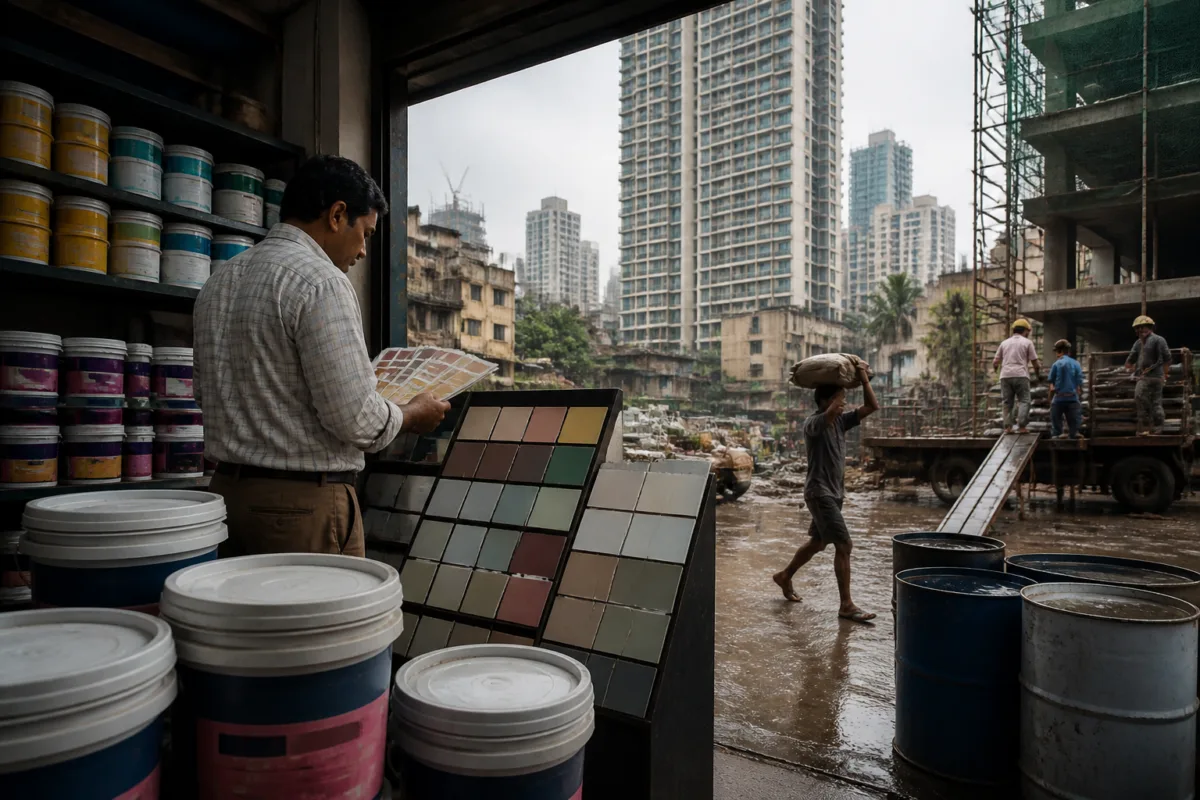
JSW Dulux is using resilient urban and semi-urban demand to push ahead with expansion even as crude-linked raw material costs, geopolitical volatility and competitive pricing pressure squeeze the paint industry. The company’s strategy reveals a broader feature of India’s construction-material market: demand may remain strong, but manufacturers must recover costs without weakening the volumes that support housing, renovation and industrial development.
Rajiv Rajgopal, Managing Director and CEO of JSW Dulux, told The Hindu BusinessLine that the company recorded double-digit volume growth despite sharp fluctuations in crude oil prices and wider macroeconomic pressures. He said the manufacturer plans to pursue market expansion while protecting profitability through calibrated price increases, manufacturing efficiencies, product differentiation and a wider dealer network.
The immediate pressure comes from the structure of paint manufacturing. Several important raw materials are linked to crude oil prices, making the industry sensitive to international energy markets and geopolitical disruptions. According to the report, crude prices had moved close to historic highs, while a recent 2 per cent anti-dumping duty on some chemicals added to the cost environment. Paint companies have responded with price increases, but have also absorbed part of the additional cost to protect demand.
That balancing act matters because paint is both a construction input and a discretionary home-improvement product. A new home, a redevelopment project or a commercial building creates a relatively predictable requirement for coatings. Repainting, premium finishes and upgrades to existing homes are more dependent on household confidence and spending capacity. The company’s account suggests that both parts of the market have remained supportive, although the strength is uneven across geographies and product categories.
JSW Dulux’s pricing response has therefore not been presented as a single broad increase. Rajgopal said the company implemented cumulative and calibrated hikes across categories, with decorative products absorbing revisions more smoothly than industrial products. Industrial categories required more targeted cost-recovery measures because their customer relationships, specifications and input requirements differ from those of household decorative paints.
This distinction is important for understanding the economics of the built environment. Decorative paint reaches consumers through dealers and retail channels, where brand, finish, colour and perceived quality influence purchasing decisions. Industrial coatings are more closely tied to manufacturing and infrastructure supply chains. They serve automotive original equipment manufacturers, power projects, oil and gas infrastructure, marine applications and coil-coating operations. A producer that can increase industrial volumes is therefore exposed not only to housing demand but also to the pace of investment across several industrial sectors.
JSW Dulux said its industrial coatings division continued to post double-digit growth, supported by demand from these sectors. The supplied report does not provide absolute revenue, volume or capacity figures for the division, so the scale of that growth cannot be independently assessed from the available information. However, the mix of end users indicates that the company’s market is connected to multiple layers of the urban economy, from vehicles and buildings to utilities and industrial facilities.
The geographical pattern described by the company is equally significant. Rajgopal said urban and semi-urban markets, including metros and Tier-I and Tier-II cities, had shown robust acceleration. Rural markets faced localised difficulties in some states because of rainfall scarcity. This contrast places city demand at the centre of the company’s near-term expansion strategy.
Urban demand for paints is not generated only by new residential construction. It also comes from ongoing maintenance, home improvement, commercial fit-outs and the upgrading of existing properties. Real-estate expansion can increase demand for coatings during construction, while higher discretionary spending can support premium products after possession. The company linked consumer demand to both real-estate expansion and discretionary home-improvement projects, although the report does not quantify the contribution of either segment.
That combination helps explain why urban markets can remain comparatively resilient even when rural demand is uneven. Cities concentrate formal employment, real-estate development, organised retail and construction activity. They also provide manufacturers with denser dealer networks and access to customers seeking differentiated or premium products. For a paint company, this can make urban expansion more efficient than attempting to rely on broad-based volume growth in markets where purchasing power and distribution remain more variable.
JSW Dulux plans to strengthen its dealer network in Tamil Nadu, Maharashtra and West Bengal, identifying these states as core high-potential markets. Dealer expansion is not simply a sales decision. In the paint industry, the retail network influences product availability, colour selection, contractor relationships and the ability to support customers across a fragmented construction market. A wider network can improve reach, but it also raises the importance of inventory management, channel economics and the company’s ability to maintain service standards.
The company is also pursuing premium and specialised segments. The report cites Dulux Velvet Touch Eternity in the luxury decorative category and specialised automotive refinish products under the JSW Dulux banner. These products allow the company to compete on features and brand positioning rather than relying solely on price. That approach is especially relevant in a market where new entrants are putting pressure on baseline pricing.
JSW Dulux said it would avoid unsustainable trade spending and aggressive discounting, preferring premium differentiation and long-term brand equity. This is a strategic choice with consequences for the wider supply chain. Discounting can protect short-term volumes but may weaken margins for manufacturers and alter incentives for dealers. Refusing to compete primarily through discounts may protect profitability, but it also requires the company to persuade consumers, contractors and institutional buyers that differentiated products justify their prices.
The company is targeting consolidated EBITDA margins of 12-13 per cent as manufacturing efficiencies and structural integrations scale up over the coming quarters. The target is an internal business objective rather than an independently verified outcome. Its importance lies in showing how the manufacturer is attempting to absorb part of the cost shock without allowing margin pressure to permanently weaken operations.
Manufacturing efficiency is particularly important when input prices are volatile. Price increases usually operate with a time lag: costs can rise quickly, while customer contracts, dealer expectations and market resistance can slow the recovery of those costs. The report indicates that JSW Dulux has sought to manage this gap through a combination of price revisions and operational improvements. It does not provide details on the specific manufacturing changes, integration measures or savings expected from them.
The paint market’s exposure to crude prices also illustrates how urban construction costs are shaped by forces outside the city. A housing project may be planned locally, but the price of coatings used in homes, offices, factories and public infrastructure can be affected by international energy markets, chemical supply and trade measures. The recent anti-dumping duty cited in the report adds another layer to that chain, showing how domestic trade policy can affect the cost base of a material used across the built environment.
At the demand end, higher prices create a delicate question. If manufacturers pass on all cost increases, customers may defer repainting, switch to lower-priced products or reduce the scope of a project. If manufacturers absorb too much of the increase, margins may suffer and future investment in distribution, product development and capacity may become more difficult. The company’s emphasis on calibrated increases suggests an attempt to manage this trade-off rather than resolve it through one large price adjustment.
The competitive environment makes that task harder. The report says new entrants continue to pressure baseline pricing across India. For established manufacturers, the response involves more than protecting market share. They must decide where to expand, which products to premiumise and how much channel support is sustainable. Dealer additions in Tamil Nadu, Maharashtra and West Bengal indicate that JSW Dulux is prioritising distribution density in markets where it sees room for further penetration.
The evidence supplied points to a market divided along several lines: urban versus rural demand, decorative versus industrial products, premium versus mass-market offerings and volume growth versus margin protection. JSW Dulux’s reported performance is positive on volumes, but the company continues to face cost and pricing constraints. The available material does not establish whether the broader industry has experienced the same level of growth or whether the company’s performance is ahead of competitors.
For cities, the larger issue is the cost and availability of materials that support both new construction and the maintenance of existing buildings. Paint is often treated as a finishing product, but its demand is tied to housing delivery, commercial development, industrial investment and household improvement. Its price and distribution can therefore provide a small but useful indicator of how different parts of the urban economy are performing.
JSW Dulux’s stated plan is to combine price discipline, manufacturing efficiencies, premium products and dealer expansion while maintaining double-digit volume growth. What remains uncertain from the supplied evidence is whether crude-linked costs will stabilise, how much of the increase customers will ultimately bear and whether the company’s 12-13 per cent EBITDA margin target will be achieved. The next markers to watch are the pace of dealer rollout, performance across urban and semi-urban markets, industrial-coating demand and the company’s ability to convert volume growth into sustained margin improvement.

