


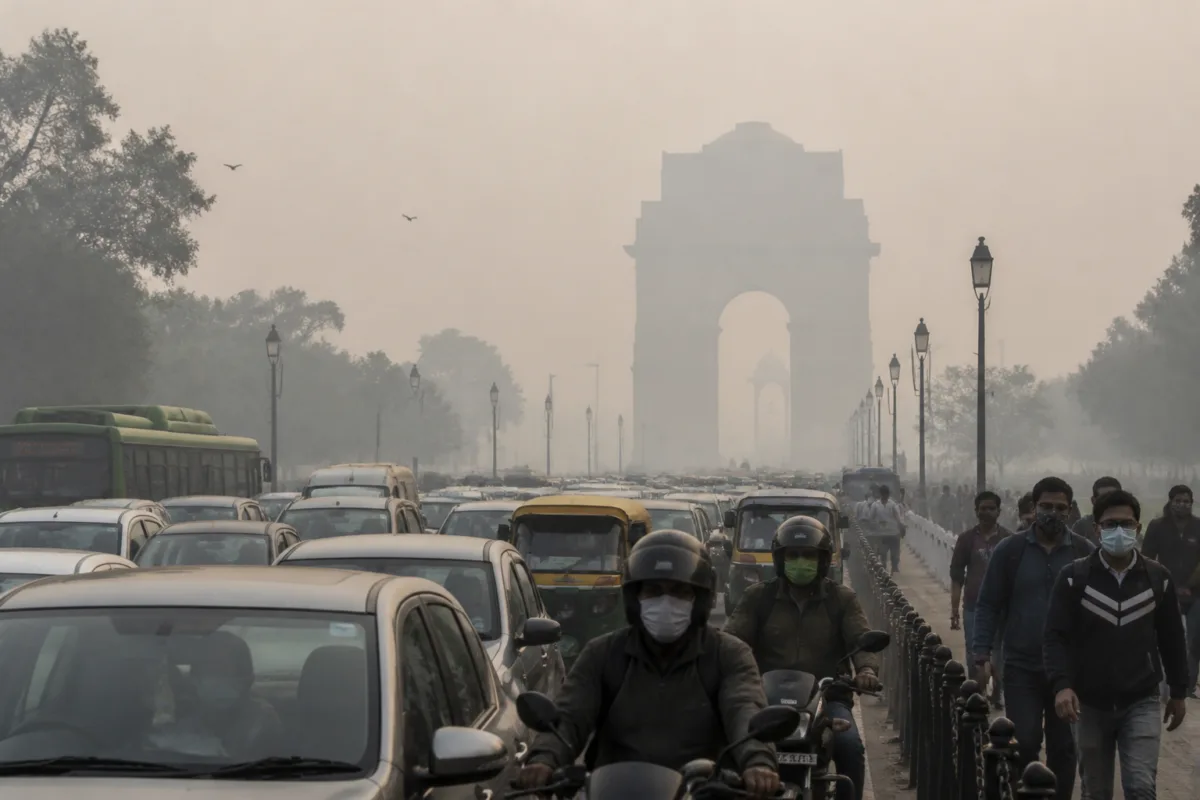
Delhi’s air quality crossed the AQI 400 mark on Wednesday, November 11, with several parts of the National Capital Region recording readings in the very poor to severe range, according to a report by Jagran citing local monitoring data and a Central Pollution Control Board update.
The deterioration came days after Diwali, when firecracker use contributed to a sharp decline in air quality across the capital. Jagran reported that there had been no visible improvement after the festival, leaving residents exposed to persistently polluted air.
The report listed an AQI of 405 in Burari, while readings were around 376 in North Campus, 351 in Noida Sector 62, 291 in Vivek Vihar, 278 in Jahangirpuri, 261 in Punjabi Bagh and 250 in Loni, Ghaziabad. The figures show uneven pollution levels across the wider metropolitan region, with some locations remaining close to or above the 300 mark.
A separate CPCB-linked update cited in the report placed the AQI around India Gate at 242 at 6.15 am. That reading was categorised as ‘Poor’, indicating significant variation between monitoring locations even as Delhi’s overall air-quality situation remained concerning.
The Central Pollution Control Board’s AQI scale classifies readings from 301 to 400 as ‘Very Poor’ and readings above 400 as ‘Severe’. At these levels, prolonged exposure can pose heightened risks, particularly for children, older people and those with respiratory or cardiovascular conditions. The report did not provide a detailed pollutant-wise breakdown or identify the contribution of individual sources beyond linking the post-Diwali deterioration to firecrackers.
The latest readings also underline the difficulty of treating Delhi’s air pollution as a single-city problem. Monitoring points in Delhi, Noida and Ghaziabad recorded different levels, reflecting the regional nature of the air basin and the need for coordinated action across the National Capital Region. However, the supplied report did not specify any new emergency restrictions, construction curbs, traffic measures or other interventions announced in response to Wednesday’s readings.
Jagran reported that government agencies had continued to make claims and promises about reducing pollution and improving air quality, but did not cite a fresh official statement detailing the next steps. The immediate operational focus remains the monitoring of AQI levels across the capital and neighbouring urban areas as authorities assess whether conditions improve.

