


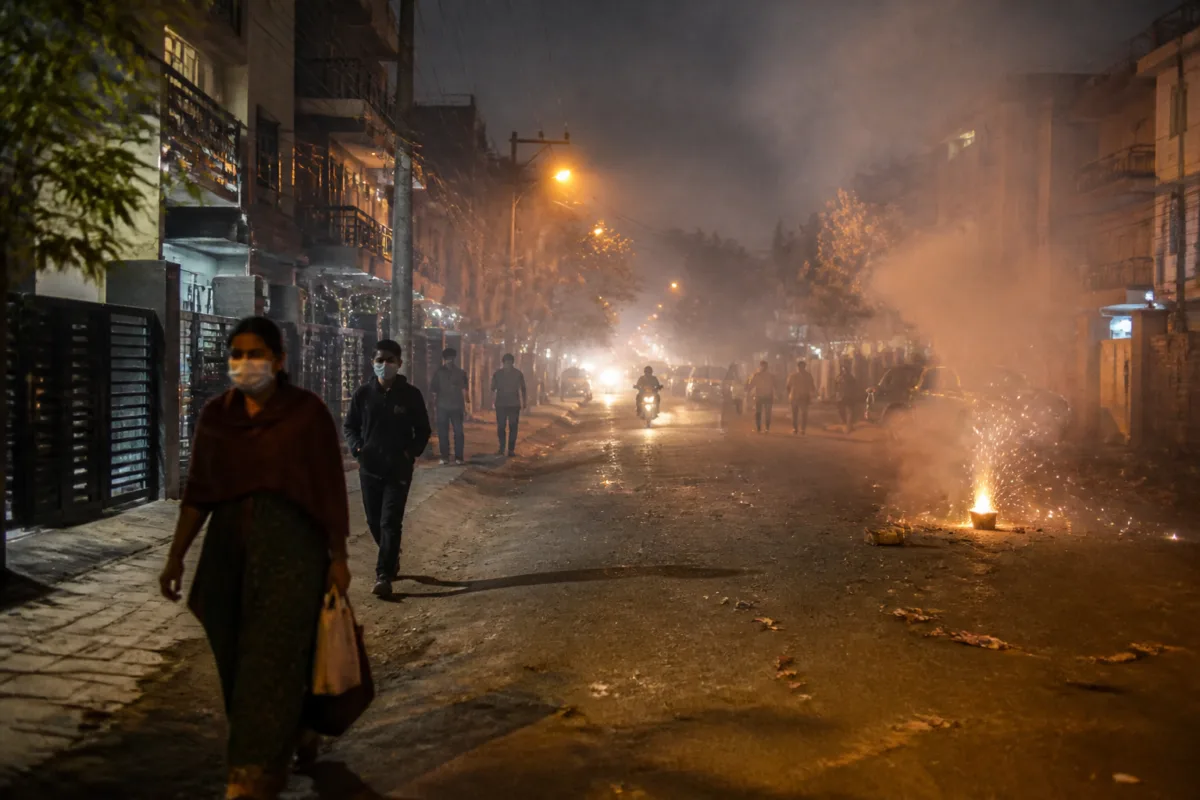
Siliguri’s air-quality debate after Diwali and Kali Puja has exposed a familiar urban governance problem: pollution can appear to improve in one official comparison while remaining dangerously high during specific festival windows. Bengal tourism minister Shankar Ghosh said coordinated administrative action had reduced air and noise pollution in the city and its surroundings. But a separate reading cited in the report showed Siliguri’s air quality index at 236 on Monday, less than 24 hours before the minister’s remarks.
The significance of the dispute lies less in which number is politically more convenient than in what the numbers represent. The minister compared an average AQI of 130 recorded on November 4, 2021, with an AQI of 83 recorded on November 8 this year, citing data from the West Bengal Pollution Control Board. The report also cited aqi.in, which recorded Siliguri’s AQI at 236 on Monday. These figures may relate to different dates, times, monitoring points or methods, but the supplied account does not establish those details. Without that information, a citywide conclusion about improved air quality remains difficult to draw.
That distinction matters because festival pollution is not necessarily captured by a single daily average. Firecracker emissions can produce sharp, short-duration increases in particulate pollution, particularly during concentrated evening periods. A city may record a lower average over one date and still experience severe exposure during a few hours when residents are outdoors, streets are crowded and windows are open. The Siliguri episode therefore raises a basic question about how urban authorities communicate air-quality conditions: are they reporting an annual or daily trend, or the actual exposure experienced by residents during the worst hours?
The report records two competing interpretations of the same festive period. Environmentalists and non-governmental organisations attributed the deterioration observed on Monday to widespread firecracker use, allegedly in violation of government-prescribed restrictions. Ghosh, citing pollution-control-board data, said the figures showed a significant improvement and that noise pollution had also declined. He said the sound level generated by firecrackers was approximately 110 decibels on November 8, compared with around 124 decibels on October 24, 2022. Both sets of figures were recorded between 7pm and 11pm, according to the report.
The disagreement is not merely a contest between government data and public perception. It points to the need to understand the measurement framework behind pollution claims. The minister’s figures compare selected dates across different years, while the aqi.in figure refers to a reading on Monday. The report does not say whether the figures were recorded at the same location, under comparable weather conditions or using the same averaging period. It also does not identify the specific pollution-control-board station or stations used for the minister’s comparison. Those gaps limit what can be concluded from the numbers.
## What the Siliguri air-quality data reveals
The available evidence does, however, establish that air quality varied sharply during the festive period. Siliguri had a reported AQI of 236 on Monday, a level environmentalists considered a serious deterioration. The minister cited an AQI of 83 for November 8 and argued that administrative coordination had produced better results than in earlier years. The report does not resolve whether the lower figure reflects a sustained improvement, a different monitoring period or conditions before the reported Monday spike.
That uncertainty is important for residents. A daily average can conceal the timing of exposure, while a single peak reading may not describe conditions across the entire city. For local administration, both measurements are relevant. The average helps assess broader performance, while peak and hourly readings indicate when enforcement, public warnings and emergency responses may be most necessary. A credible public communication system has to make clear which of these questions each number answers.
The same issue appears in the noise-pollution figures. The reported decline from approximately 124 decibels in 2022 to around 110 decibels this year suggests an improvement in the four-hour evening measurement cited by the minister. But the report does not provide the monitoring location, the number of readings or the maximum level recorded during the period. Nor does it establish whether the decline was consistent across Siliguri and its surrounding areas. The figures are therefore useful as an administrative comparison, but insufficient on their own to describe the full sound environment of the city.
The controversy also underlines the difficulty of regulating pollution produced through dispersed household activity. Firecracker use does not occur at a single industrial site or along one identifiable traffic corridor. It is distributed across neighbourhoods and concentrated into a limited number of hours. Enforcement consequently depends on restrictions being understood, stocking and distribution being monitored, violations being detected and residents being persuaded to change behaviour. Ghosh said the administration would intensify efforts to limit noise pollution, particularly by restricting the stocking and distribution of high-decibel firecrackers.
That proposed emphasis is significant because it shifts attention upstream. Controlling use after fireworks have already been purchased is harder than controlling the availability of products that breach restrictions. But the supplied report does not provide details of the enforcement mechanism, the agencies involved, the number of inspections, seizures or cases filed. It therefore records an administrative intention rather than evidence of implementation.
## The institutional challenge behind festival pollution
The minister attributed the reported improvement to coordinated efforts by government departments. This points to a multi-agency responsibility. Air-quality monitoring rests with pollution-control authorities, while local administration and enforcement agencies must address restrictions on firecrackers and public-order concerns. Municipal systems also influence the urban environment through waste collection and street management, although the report does not attribute specific responsibilities in those areas.
Coordination is particularly important during festivals because pollution control is time-sensitive. Monitoring must be active before, during and after the celebration. Restrictions need to be communicated before purchases are made. Enforcement needs to operate during the evening window when firecracker use is concentrated. Public information must then explain whether reported readings are averages, peaks or station-specific measurements. Without that sequence, official data can arrive after the exposure has already occurred and appear disconnected from residents’ experience.
Ghosh himself stressed the need to maintain consistent air quality throughout the year. That is a more demanding administrative objective than reducing a festival-time spike. It requires pollution to be assessed beyond the narrow period of Diwali and Kali Puja and would require the authorities to identify the city’s regular sources of deterioration. The report does not provide data on non-festival sources in Siliguri, so it cannot establish how much of the city’s wider air-quality burden comes from firecrackers or other activities.
The minister also highlighted the cleanliness of major rivers flowing through the city, particularly the Mahananda, and said he would consult experts about keeping the rivers clean during the coming Chhath festival. This broadens the festival-management question from air and noise to water and waste. The report does not specify the pollution risks, planned interventions or agencies responsible for the river-related work. It does show, however, that festival administration involves several environmental systems at once and cannot be measured only through one AQI reading.
## Balurghat shows the scale of the problem
The sharpest figure in the report comes from Balurghat, the headquarters of South Dinajpur. The town recorded an AQI of 485 at 9pm on Sunday, described as the highest in north Bengal during the period. Administrative sources attributed the reading to the unusually large number of firecrackers burst during Kali Puja celebrations. The town had recorded an AQI of around 160 on Diwali night the previous year, according to the report.
The comparison suggests a major year-on-year deterioration at a specific time and location, but it also requires careful interpretation. The report does not provide the monitoring station, averaging period or weather conditions for either figure. It does not say whether the two readings were generated through identical methods. Still, the difference is large enough to explain why environmental concerns extended beyond Siliguri and why festival pollution cannot be treated as a single-city issue.
Environmental activist Tuhin Shubhra Mandal said the Balurghat reading was not conducive to human health and called for greater public awareness about the harmful effects of firecrackers. His statement adds a public-health perspective to the administrative debate. It also makes clear that restrictions cannot depend only on government action. Residents’ choices determine the scale of emissions during a compressed period, while enforcement determines whether the rules have practical force.
The evidence in the report supports a cautious conclusion. Administrative coordination may have produced better outcomes on some dates or according to some measurements, as the minister claimed. At the same time, Siliguri and Balurghat experienced reported pollution spikes during the festive period, and the available account does not reconcile those readings with the official comparisons. The central urban issue is therefore not simply whether pollution improved, but whether the monitoring and public reporting system can show when, where and for how long residents faced the greatest exposure.
For Siliguri, the next test will be whether the administration’s stated plans move beyond festival-period claims. The report says officials intend to restrict high-decibel firecracker stocking and distribution, maintain air quality throughout the year and consult experts on protecting the Mahananda during Chhath. The implementation of those steps, together with clearer disclosure of monitoring locations and time periods, will determine whether the city’s pollution debate becomes more evidence-led or remains divided between isolated readings and lived experience.

