


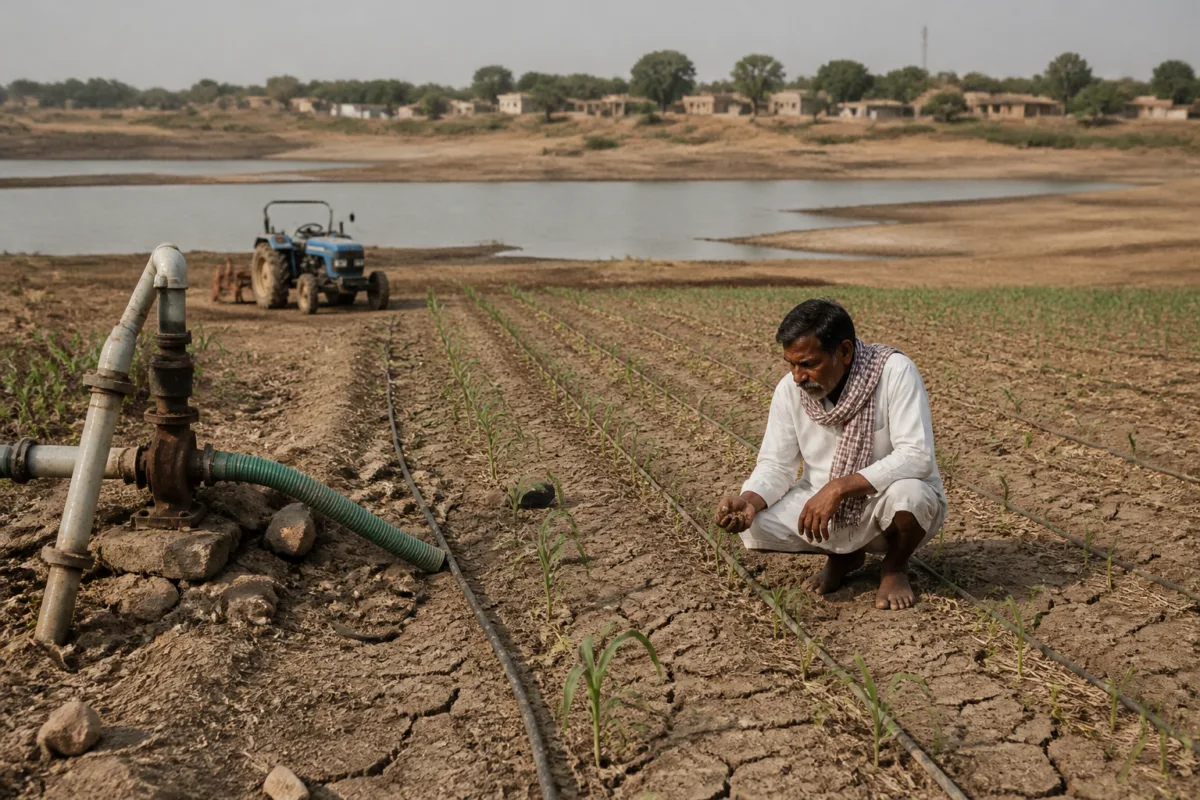
The Telangana government has asked banks to restructure or reschedule crop loans in 365 drought-affected mandals and ensure fresh credit for farmers ahead of the Rabi season, as poor rainfall, depleted reservoirs and weak groundwater recharge intensify pressure on farm incomes.
The direction was issued at a special meeting of the State Level Bankers’ Committee on ‘Drought Relief Measures for Kharif 2026’ held at Praja Bhavan on Tuesday. Deputy Chief Minister Mallu Bhatti Vikramarka, Agriculture Minister Tummala Nageshwar Rao and senior officials attended the meeting.
The government said crop loans should be restructured or rescheduled under Reserve Bank of India guidelines according to the severity of the drought. In applicable cases, repayment periods may be extended by three or five years. The measures are intended to reduce the immediate interest and repayment burden on farmers affected by the drought.
Drought has been declared in 365 mandals across 31 districts, including 111 mandals classified as severely affected. According to the government, poor rainfall and the absence of expected floods in the Krishna and Godavari rivers have sharply reduced reservoir storage, with several reservoirs reaching dead storage levels.
The government also said poor groundwater recharge had contributed to shortages in an estimated 10 lakh to 15 lakh borewells. The reduced availability of surface and groundwater has increased the financial pressure on farmers as the state prepares for the next agricultural season.
With Rabi cultivation approaching, banks were asked to immediately disburse the targeted ₹38,268 crore in crop loans. The meeting noted that only 53 per cent of the overall agricultural credit target of ₹96,943 crore had been achieved up to September. Against the ₹1,329 crore target for monsoon farming, disbursement had reached only 17 per cent.
Commercial banks were asked to give greater priority to agricultural lending and to increase credit for micro-irrigation equipment, including drip and sprinkler systems. Banks were also urged to promote crops requiring less water, such as pulses, oilseeds and horticultural crops.
The government further sought more lending for oil palm, dairy, poultry, livestock and beekeeping to support alternative sources of rural income during the drought. The State Level Bankers’ Committee was asked to strengthen lending to farmer producer organisations and women’s self-help groups.
The government said increasing lending by up to ₹2 lakh per self-help group, wherever eligible, could improve liquidity in rural areas. The committee was also directed to monitor education loans and address delays in their sanction.
The instructions place responsibility on banks to translate the drought declaration into loan restructuring, new credit and support for lower-water farming and allied activities. The immediate milestones are the processing of eligible loan accounts under RBI guidelines and the release of the targeted Rabi crop credit.

