


A political dispute over Karnataka’s alleged advertising expenditure has raised questions about how public money is being prioritised while Bengaluru roads, contractor payments, employment and welfare delivery remain contested issues. Karnataka BJP president BY Vijayendra has alleged that the Congress government spent Rs 473 crore on advertisements over the past three years, but the figure is not independently established in the material available for this report.
Vijayendra made the allegation in a post on X on Tuesday, saying the government had spent more than Rs 43 lakh a day on publicity. He attributed the figure to media reports and argued that the spending had not been matched by visible improvements in development or public welfare.
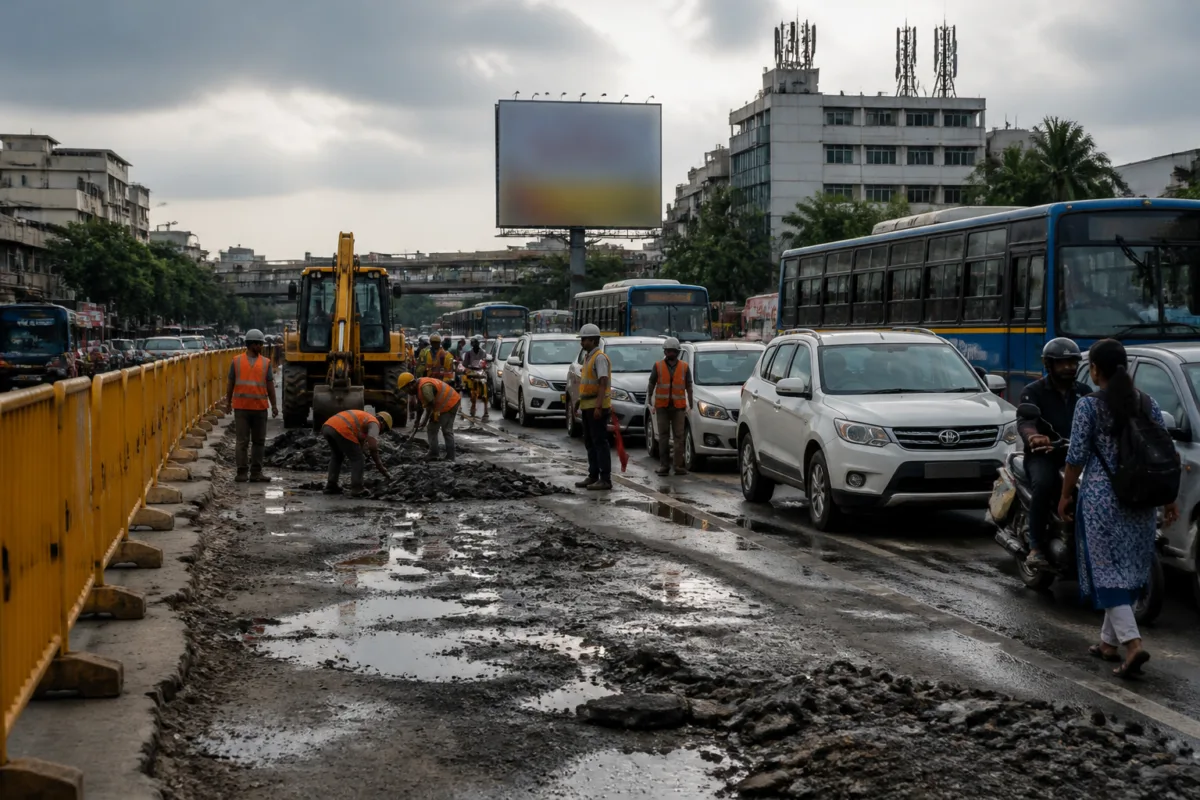
The BJP leader framed the issue as a question of governance priorities. He said the alleged expenditure was being incurred while Bengaluru’s roads were deteriorating, contractors were waiting for pending payments, young people were struggling to find employment and farmers were facing uncertainty, drought and financial distress.
“Development zero, publicity hero,” Vijayendra said, accusing the Congress government of spending on projecting its image rather than building roads, creating jobs or supporting farmers. He also said citizens were not asking to see the Chief Minister’s photograph in newspapers, but wanted better roads, affordable living, employment for their children, timely payments to contractors and support for farmers.
The central figure in the controversy is the alleged Rs 473-crore advertising expenditure. The supplied material does not include a government expenditure statement, budget document, tender record, department-wise release, audit finding or other primary source that establishes the amount, the period covered or the departments involved. The figure therefore remains an allegation made by the BJP leader and requires documentary verification before it can be treated as an established account of government spending.
The distinction matters because advertising expenditure by a state government can cover several forms of public communication, including campaign publicity, public information and departmental announcements. The material supplied for this report does not specify the nature of the alleged spending, the agencies or departments that incurred it, the media platforms used, or whether the amount refers to allocations, commitments, bills paid or actual expenditure.
Vijayendra also questioned the implementation of the Congress government’s five guarantee schemes. He alleged that the schemes were facing financial and implementation challenges and said the government appeared more interested in advertising its promises than delivering them. No scheme-wise expenditure, beneficiary data, implementation report or government response was included in the supplied report.
His wider criticism links the advertising dispute to several pressures affecting urban and rural administration. In Bengaluru, the allegation is connected to the condition of roads and the government’s handling of pending payments to contractors. For contractors, delayed payments can affect cash flow and the ability to continue civic works, but the supplied material does not provide the value of outstanding bills, the number of affected contractors, the departments involved or the reasons for any delay.
The roads issue is similarly described through the BJP leader’s criticism rather than through an engineering assessment, civic works report or municipal data. The supplied report does not identify specific roads, projects or maintenance contracts. It also does not establish whether road deterioration is linked to funding shortages, delayed payments, poor construction, repeated utility works, monsoon damage or administrative delays.
Vijayendra further cited rising milk prices, bus fares, electricity charges and the cost of essential services as evidence of pressure on households. These issues broaden the political argument beyond advertising and into the cost of living and public service delivery. However, the supplied material does not provide the dates, tariff orders, price comparisons or official notifications needed to assess the scale of these increases.
The controversy consequently contains two separate questions. The first is factual: how much did the Karnataka government spend on advertising during the period cited by the BJP leader, and what did that expenditure cover? The second is administrative: how should the government balance public communication with road maintenance, contractor payments, employment support, farmer assistance and welfare delivery?
The available material establishes that the BJP has raised these questions, but it does not resolve either one. There is no response from the Karnataka government in the supplied report addressing the Rs 473-crore figure, the daily spending calculation, the condition of Bengaluru roads, pending contractor payments or the implementation of the guarantee schemes.
A verified assessment would require the underlying expenditure records and a clear definition of what has been counted as advertising. It would also need to distinguish between government information campaigns and political publicity, identify the relevant financial years, and establish whether the reported amount represents expenditure across the entire state government or selected departments. Without those details, the daily figure cited by Vijayendra cannot be independently checked from the supplied material.
The dispute also highlights the accountability challenge surrounding public communication spending. A government’s advertising budget is not, by itself, proof that development work has been neglected. Conversely, claims about public welfare cannot be assessed only through publicity campaigns. Both questions require records showing expenditure, outputs and implementation performance.
For Bengaluru residents, the immediate civic concerns identified in the allegation are practical: the condition of roads, the pace of public works and whether contractors are paid on time. For the wider state, the dispute includes farmers’ distress, unemployment, essential-service costs and the delivery of the five guarantee schemes. The supplied report records these concerns as part of the BJP’s criticism, but provides no independent measurement of their scale or change over time.
The next step is therefore documentary rather than rhetorical. The advertising figure, the basis for the Rs 43-lakh-a-day calculation, the status of contractor payments and the implementation record of the guarantee schemes need to be established through official records and responses from the departments concerned. Until then, the Rs 473-crore claim remains an attributed political allegation, not a verified finding.

