


A political dispute over Delhi pollution intensified on Tuesday after Aam Aadmi Party leader Saurabh Bharadwaj rejected the Bharatiya Janata Party’s claim that Punjab farm fires were responsible for the rise in post-Diwali pollution, citing contribution figures attributed to the Centre’s SAFAR platform.
Bharadwaj said the SAFAR website showed that stubble burning contributed 5% to Delhi’s pollution one day before Diwali and 0% on Diwali. He argued that the direction of winds on Diwali carried air towards Pakistan, rather than Delhi. His remarks were made in response to BJP leader Kapil Mishra’s claims about the role of Punjab’s farm fires.
Bharadwaj also said smoke from crop-residue burning would not reach Delhi immediately and would take at least two to three days to travel with the wind. He alleged that blaming farmers for Diwali pollution was an attempt to protect the use of firecrackers. These claims were reported by Live Hindustan – NCR and have not been independently assessed in the supplied material.
The AAP leader additionally questioned the functioning of Delhi’s air-quality monitoring system. He alleged that some AQI monitoring stations had been shut even as the government claimed that air quality was improving. He also criticised water sprinkling as an inadequate response to the city’s pollution problem, saying it did not address the underlying causes.
The BJP disputed the AAP’s account of the pollution episode. BJP leader RP Singh said that the number of reported stubble-burning incidents had remained around 150 to 160 until the day before Diwali, but rose to approximately 1,100 to 1,200 on Diwali night. He described the increase as a conspiracy, according to the report.
Singh also accused former Delhi chief minister Arvind Kejriwal of sending polluted air towards Delhi after losing an election. The supplied report does not provide an official response from Kejriwal or independent evidence supporting that allegation.
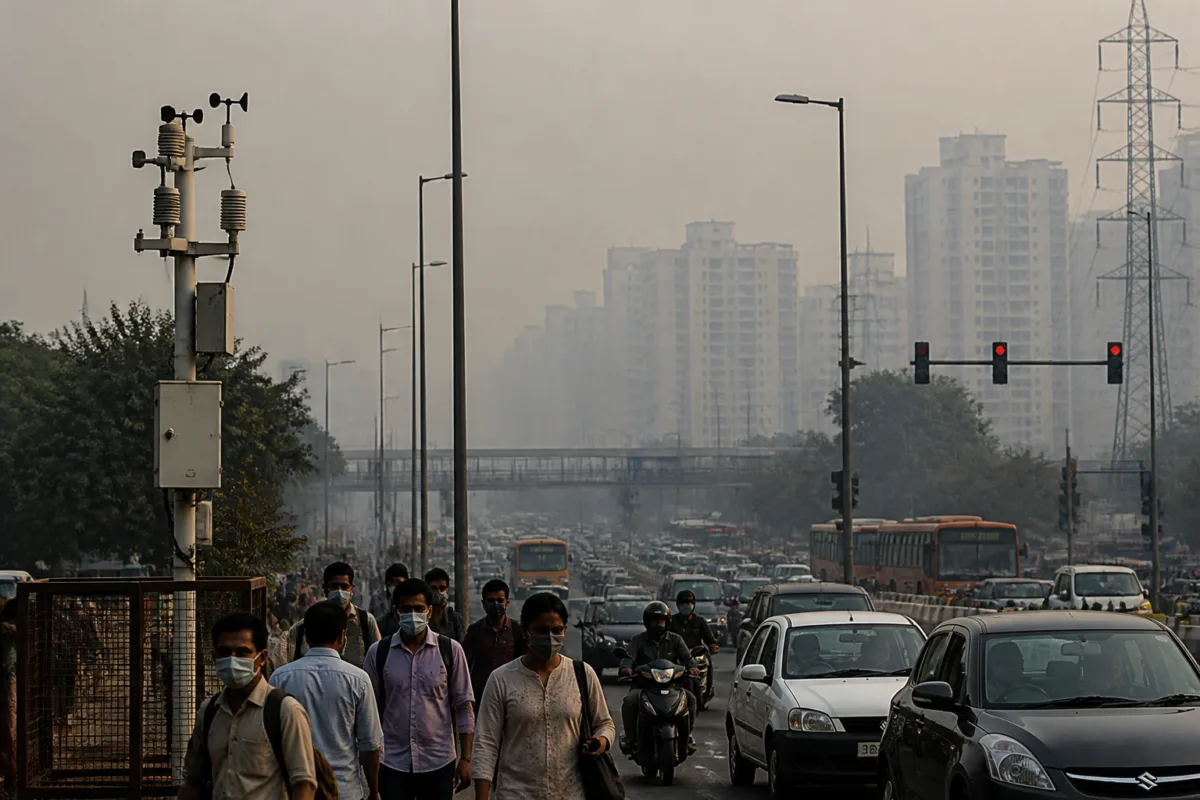
The dispute places renewed attention on the difficulty of separating the sources of Delhi’s pollution during the festival and post-festival period. The claims in the political exchange refer to wind direction, the timing of crop-residue smoke, firecrackers, AQI monitoring and water sprinkling, but the report does not provide a complete emissions breakdown or technical assessment covering all these factors.
The immediate questions for Delhi residents are whether the cited SAFAR figures remain available for public scrutiny, whether AQI monitoring stations are operational, and how authorities are attributing pollution between local emissions and pollution transported from outside the city. The political parties’ competing claims remain the subject of dispute in the absence of further evidence in the supplied report.

