


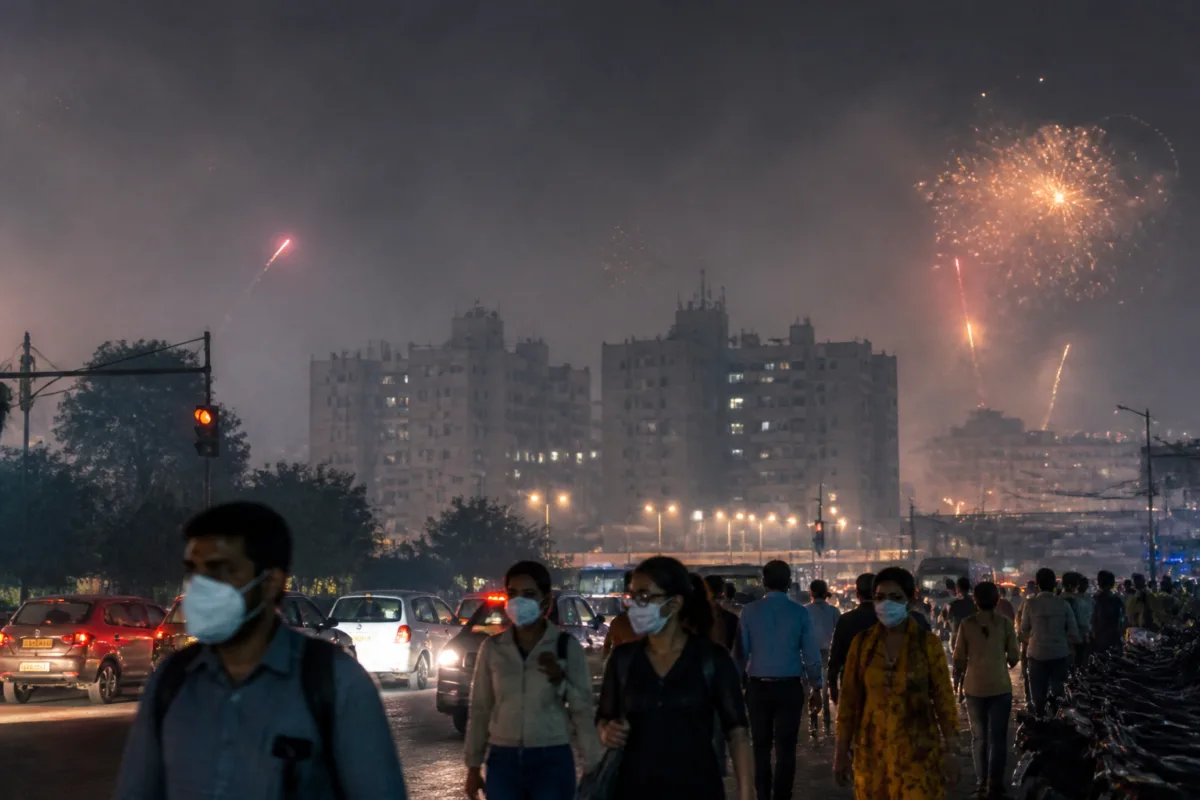
Delhi’s hourly PM2.5 concentration surged to 4,985 micrograms per cubic metre at Jahangirpuri during Diwali, exposing residents to pollution levels far beyond India’s daily national standard and the World Health Organisation’s guideline, according to an analysis of Delhi Pollution Control Committee real-time air-quality data published by the Times of India.
The northwest Delhi station recorded the peak reading at 6pm and 8pm on Diwali before pollution rose again at 8am the following day, making Jahangirpuri the most polluted location in the city across Sunday and Monday, the report said. The reading was about 83 times the national ambient air quality standard of 60 micrograms per cubic metre and more than 332 times the WHO daily guideline of 15 micrograms per cubic metre.
The DPCC later changed the Jahangirpuri readings on Monday night, showing that the station’s peak hourly PM2.5 concentration was 776 micrograms per cubic metre at midnight on Diwali. The change adds uncertainty to the station’s earlier peak figure, but the wider pattern of severe pollution was visible across multiple monitoring locations, with most stations recording sharp increases around midnight when firecrackers were set off in large numbers.
At Mundka, hourly PM2.5 rose from 245 micrograms per cubic metre at 7pm on Diwali to 3,744 at 2am the following day. Jawaharlal Nehru University recorded a peak of 3,023 at 4am, compared with 118 at 7pm on Diwali. The peak reading at NSUT’s west campus was 3,008, while Mandir Marg recorded 2,908.
Other stations also recorded hazardous hourly concentrations. Nehru Nagar in Lajpat Nagar reached 2,808 micrograms per cubic metre, Wazirpur recorded 2,721, Talkatora Garden 2,599, the Commonwealth Games Sports Complex in Akshardham 2,471, Patparganj 2,597 and Ashok Vihar 2,589.
The pollution spike was not limited to fine particulate matter. Hourly PM10 concentration reached 4,697 micrograms per cubic metre at Punjabi Bagh, nearly 47 times the national daily standard of 100 micrograms per cubic metre and more than 104 times the WHO daily guideline of 45. Anand Vihar recorded 3,490, Patparganj 3,929, RK Puram 2,881, Nehru Nagar 2,879 and Wazirpur 2,671.
Sunil Dahiya, founder of the environmental think tank Envirocatalyst, said people across Delhi inhaled PM2.5 concentrations averaging between 450 and 550 micrograms per cubic metre through Diwali night. He described those levels as eight to nine times the national 24-hour standard and 30 to 37 times the WHO guideline.
Dahiya said even a few hours at such concentrations could trigger asthma attacks, worsen existing lung diseases and increase the risk of heart attacks and strokes. He identified children, older people, pregnant women, outdoor workers and people with heart or lung conditions as the groups most exposed to harm.
According to Dahiya, fine particles can reach deep into the lungs and bloodstream, while coarser PM10 can inflame the airways and eyes. He also said Delhi’s air had already been more than twice the safe limit before Diwali, indicating that the festival-night spike added to an existing seasonal pollution burden.
The DPCC readings show how pollution can vary sharply by location and time within the capital. They also underline the operational importance of real-time monitoring, particularly when data revisions affect the reported peak at one of the city’s most polluted stations. The published analysis did not state whether the revised Jahangirpuri readings reflected a technical correction, a data-validation process or another cause.

