


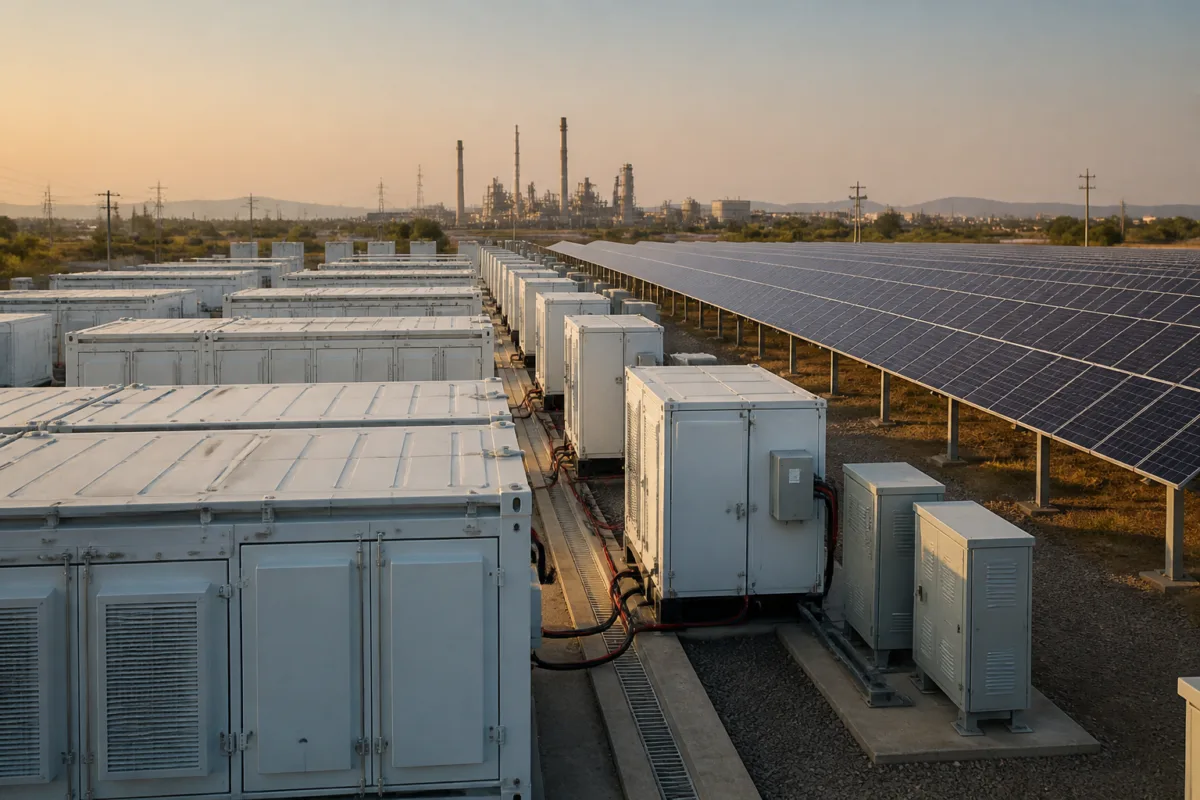
Sodium-ion batteries are moving from a laboratory alternative to a commercial contender, but their importance for India will depend on more than a lower lifetime cost. A Wood Mackenzie report says the technology is entering commercial production with more than 70 gigawatt-hours of supply agreements, while its total cost of ownership is already 21 per cent below that of lithium iron phosphate batteries. The shift could strengthen India’s renewable-energy ambitions, but the country remains at an early stage of commercial validation and still lacks a mature sodium-ion supply chain.
That distinction matters because battery storage is becoming an increasingly important link between renewable generation and electricity demand. Solar and wind output varies by time of day and weather conditions, while power systems need electricity to be available when consumers and industry require it. Storage projects therefore compete not only on the price of cells but also on reliability, operating costs, replacement requirements, financing confidence and the availability of components.
Wood Mackenzie’s assessment places sodium-ion batteries, or SIBs, within that wider transition. The consultancy describes the chemistry as an emerging alternative to lithium-ion batteries, supported by supply-chain security, cycle life and a wide thermal operating threshold. These characteristics are particularly relevant to markets where battery systems must function across different temperatures and where dependence on a narrow group of mineral and manufacturing suppliers creates commercial and strategic risks.
The immediate economic picture is more complicated than the headline cost comparison. The global average upfront cost of an SIB cell is estimated at $229 per kilowatt-hour, compared with $200 per kilowatt-hour for lithium iron phosphate, or LFP, cells. Sodium-ion therefore begins with a cost disadvantage. Wood Mackenzie nevertheless estimates that SIB can deliver 21 per cent lower total cost of ownership over a 20-year project life.
The reported advantage comes from the potential elimination of augmentation events and lower operating expenditure. In battery-storage projects, the initial purchase price is only one part of the financial calculation. Capacity degradation, system augmentation, maintenance and operating costs can affect the economics over the life of an asset. If sodium-ion systems maintain performance without the same level of augmentation, a higher initial price could be offset by lower lifetime expenditure.
The consultancy expects cell-level cost parity with LFP among market leaders by the end of 2026. Module- and system-level parity, however, is not expected until after 2030. That gap shows why a promising cell chemistry does not immediately translate into cheaper, financeable storage projects. Modules, power-conversion equipment, thermal-management systems, project integration and local supply chains all influence the final cost of a working installation.
Wood Mackenzie says system economics remain stable across storage durations of two to four hours. These durations are important for many grid-connected applications because they allow stored electricity to be shifted across periods of high and low demand. However, the report does not suggest that SIB will displace LFP across all projects in the near term. For assets being deployed today, LFP remains the bankable choice for two- to four-hour systems because it has a longer commercial track record and a larger established manufacturing base.
This is the central tension in India’s battery-storage opportunity. The country needs lower-cost and more resilient storage as renewable capacity expands, but project developers, lenders and utilities also require evidence that a technology can perform consistently at scale. Sodium-ion batteries may offer advantages in materials and operating conditions, yet manufacturers still need to scale production, refine cell materials and establish a dependable performance record.
The supply-chain question is particularly significant. Wood Mackenzie cites China’s export controls, India’s underdeveloped supply chain, slow expansion of US gigafactories and German trade policies as near-term constraints on deployment. These factors indicate that the battery market is shaped not only by engineering performance but also by industrial policy, trade rules and the geography of manufacturing.
China currently occupies the strongest position in the sodium-ion ecosystem. The International Energy Agency, in a February 2026 commentary cited by the report, said nearly all existing global sodium-ion manufacturing capacity is located in China. China is also expected to account for more than 95 per cent of global capacity in 2030 when installed and announced plants are considered. Its dominance extends beyond cell assembly to cathode and anode active materials and their precursors.
The concentration creates both an opportunity and a vulnerability. India can potentially access a technology whose mineral base is more geographically diversified than that of lithium-ion batteries. Wood Mackenzie says the minerals used in sodium-ion components offer an upstream supply-chain resilience advantage. Yet a diversified mineral base does not automatically create manufacturing independence. If cells, active materials and production expertise remain concentrated in China, India could simply exchange one form of external dependence for another.
The scale of China’s industrial push is visible in the planned capacity of major manufacturers. BYD has 30 GWh of planned sodium-ion manufacturing capacity in China, while CATL is targeting at least 1 GWh of sodium-ion shipments by the end of 2026. The report identifies China as the most mature market in the sector, with an estimated learning rate of 18-20 per cent during 2026-35. China, the United States and Europe have significant offtake agreements, whereas India remains in the early commercial-validation stage.
Policy is also changing the competitive equation. China’s reimposition of a consumption tax on lithium-ion batteries in July 2026 exempts sodium-ion batteries until the end of 2028. LFP batteries face a 2 per cent levy from September 2026, rising to 4 per cent from September 2027. In the United States, Section 301 tariffs of approximately 58 per cent on Chinese energy-storage cells are creating an incentive for domestic sodium-ion production, alongside manufacturing credits under the Inflation Reduction Act’s 45X provision.
In Europe, carbon-footprint disclosure requirements under the EU Battery Regulation are described as a structural support for sodium-ion technology. These measures show how policy can alter market outcomes before a technology reaches full cost parity. A chemistry that is not yet the cheapest at the cell level may become more attractive when tariffs, taxation, carbon accounting and domestic-manufacturing incentives are included in project decisions.
India is also attempting to build local capacity. Wood Mackenzie points to a $1.25 billion incentive scheme and duty exemptions on manufacturing equipment. Those measures are intended to support domestic production, but the report’s description of India as being at the early commercial-validation stage suggests that incentives have not yet translated into the depth of industrial capability visible in China.
The policy challenge is therefore broader than choosing between lithium-ion and sodium-ion batteries. India must determine how storage manufacturing fits within its renewable-energy expansion, industrial policy and electricity-market design. Incentives may help attract factories, but a viable ecosystem also requires component suppliers, testing and certification capacity, skilled labour, long-term offtake, project finance and operating data from deployed systems.
The report’s timeline reinforces the need to separate immediate deployment from medium-term industrial planning. LFP is still the established option for projects being commissioned now. Sodium-ion’s economics are expected to improve during the 2030-35 period, which Wood Mackenzie describes as the window in which the technology’s economics could shift decisively. This does not mean that all future storage will use one chemistry. The consultancy expects a market served by different technologies, each suited to particular applications and duration profiles.
For India, that technology pluralism could be more valuable than a premature bet on a single chemistry. Sodium-ion batteries may be useful where thermal performance, supply-chain resilience and long project life outweigh a higher initial cost. LFP may remain preferable where proven bankability and immediate availability matter most. The eventual market structure will depend on how quickly Indian manufacturers can move from incentives and pilot activity to repeatable commercial production.
The evidence currently supports a measured conclusion. Sodium-ion batteries have crossed an important threshold: they have supply agreements, large manufacturers are announcing capacity and their lifetime economics are becoming competitive. But the technology has not yet overcome the manufacturing concentration, commercial track record and system-level cost barriers that determine whether a storage technology can scale.
India’s larger urban and infrastructure challenge is to ensure that renewable-energy growth is supported by storage that is affordable, reliable and less exposed to concentrated supply chains. The next indicators to watch are the development of domestic sodium-ion capacity, the performance of early Indian projects, progress towards module- and system-level cost parity after 2030, and whether policy support produces an integrated manufacturing ecosystem rather than isolated cell-assembly capacity.

