


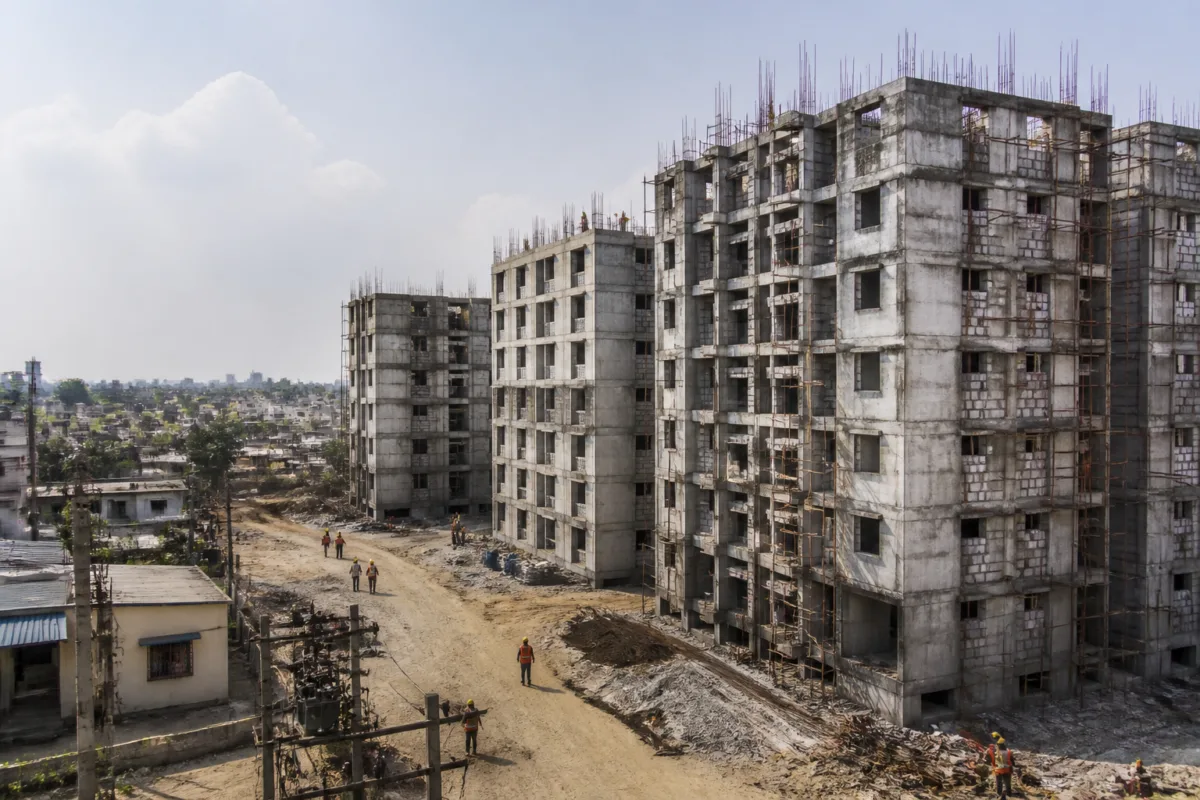
Nagpur’s proposed planning cell and a ₹91.45-crore housing project for sanitation workers point to the same underlying problem in urban governance: civic outcomes depend not only on the availability of land or funds, but also on whether a municipal corporation has the institutional capacity to plan, coordinate and deliver them on time.
The Nagpur Municipal Corporation’s standing committee has directed the civic administration to begin the process of establishing a dedicated planning cell. Standing committee chairperson Shivani Dani-Wakhare said the absence of a specialised planning department was affecting the timely execution of several civic projects and that a separate cell was needed for systematic planning and better implementation.
The proposal emerged during discussions on a set of civic works, including the distribution of house T-shirts to municipal school students. Dani-Wakhare questioned the timing of that process, noting that only five months of the academic session remained. Her criticism, as reported by the Times of India, reflects a familiar administrative weakness: a project can be approved or conceived, yet still lose much of its public value when planning, procurement and execution do not move in sequence.
A dedicated planning cell would not automatically resolve those delays. Its significance would depend on its mandate, staffing, authority and relationship with the municipal departments that currently prepare and execute projects. The report does not specify the proposed cell’s structure or whether it would control budgets, coordinate departments or monitor timelines. Those details will determine whether it becomes an operational planning institution or another layer in the municipal hierarchy.
The timing issue matters because municipal projects are often judged by completion rather than approval. A school-related supply distributed late in an academic year, for example, may technically fulfil a decision while delivering less practical value to students. The committee’s intervention places the focus on the full project cycle: identifying a need, preparing a workable plan, arranging procurement, executing the work and completing it within the period when residents or beneficiaries need it.
The second decision before the standing committee demonstrates why that institutional capacity is important. The committee approved a ₹91.45-crore project to construct 392 flats for sanitation workers at Mouza Nari through a public-private partnership model. The project is designed without direct cash payment from NMC to the developer. Instead, the developer will be compensated through Transferable Development Rights, or TDR.
Under the approved arrangement, M/s Sandeep Developers Pvt Ltd will construct the housing complex on an 11,109.629-square-metre plot. The complex will comprise 14 buildings. Civic officials described the project as potentially the first in Maharashtra in which an urban local body implements an entire housing scheme using TDR as the payment mechanism.
TDR changes the financing structure of the project. Rather than paying the developer entirely through a conventional cash contract, the municipal corporation provides development rights that can be used or transferred under the applicable planning framework. In this case, the developer had requested 10% advance TDR to arrange construction finance and procure materials, including nearly 485 metric tonnes of steel. The civic administration approved 7% advance TDR, equivalent to 6,014 square metres, with the remaining entitlement to be released in phases linked to construction milestones.
That milestone-linked release is one of the most important administrative features of the arrangement. It connects the developer’s access to project value with measurable progress on construction. The reported decision does not establish how the milestones will be certified, who will verify them or what remedies will apply if work falls behind schedule. Those mechanisms will be central to whether the TDR model protects public value while giving the developer enough certainty to finance the project.
The project also shows that housing delivery is not limited to putting buildings on a vacant plot. The sanitation workers’ housing scheme forms part of the broader Basic Services for Urban Poor initiative. While 544 houses have already been built under the scheme, the remaining land has been earmarked for the new project. The new flats therefore represent an extension of an existing housing effort rather than an isolated real estate transaction.
The use of TDR may help a cash-constrained urban local body mobilise construction without an equivalent immediate budgetary payment. At the same time, it creates a different set of public responsibilities. The value of development rights must be assessed and administered transparently. Construction progress must be independently tracked. The completed homes must be allocated to eligible sanitation workers through a clear process. The project must also remain connected to transport, water, sewage and other services that make housing usable.
NMC’s additional approval of ₹1.28 crore for sewage treatment capacity underlines that last requirement. The housing complex will receive an additional 200 kilolitres per day of sewage treatment capacity because the area does not have a trunk sewerage network. This is a significant design and governance detail: the housing project cannot rely on a citywide sewer connection that does not exist, so a local treatment solution must be built into the development.
The sewage decision also illustrates the risk of evaluating housing only through the number of units created. The headline figure is 392 flats, but the urban service obligation includes treatment capacity, operation and maintenance, access and integration with the surrounding settlement. If those systems are not planned alongside the buildings, the project can deliver physical structures without delivering complete housing infrastructure.
The planning cell proposal and the TDR-funded housing project are therefore linked by more than their appearance in the same committee meeting. Both require NMC to coordinate multiple functions: land, design, construction, finance, development rights, beneficiary eligibility and sewage infrastructure. A specialised planning function could help bring these elements together, but only if it has access to project information and the authority to identify delays before they become costly.
The available report does not establish whether the proposed cell will oversee the Mouza Nari housing project. It also does not provide a completion date, the terms of the PPP agreement, the expected handover process or the future operating arrangements for sewage treatment. These gaps do not diminish the significance of the approvals, but they mark the next stage at which the public interest will need to be assessed.
For Nagpur, the larger urban question is whether new financing methods and new administrative units can improve delivery without weakening accountability. TDR can reduce the immediate cash burden on a municipal corporation, but it does not remove the need for valuation, monitoring and enforcement. A planning cell can create institutional focus, but it cannot substitute for clearly assigned responsibility and time-bound execution.
What the committee has approved so far is a planning intervention and a housing-finance mechanism. What remains to be demonstrated is whether the proposed planning cell will acquire a defined mandate and whether the sanitation workers’ housing project will convert its land, TDR allocation and sewage investment into completed, serviced homes. The next useful milestones will be the formalisation of the cell, disclosure of the project’s implementation framework and progress against the construction-linked TDR releases.

